Understanding Road Line Markings and Their Role in Surface Safety
When planning surfacing improvements, many property owners focus primarily on the structural layers and finished material. However, road line markings UK projects rely on are just as important in ensuring a surface functions safely and efficiently.
Clear, well-designed markings control traffic flow, reduce confusion and help prevent accidents. On commercial premises, they guide deliveries, organise parking areas and separate pedestrian routes from vehicle zones. On private estates, they reinforce speed control measures and improve visibility in shared spaces.
Without properly applied markings, even a newly surfaced road can become disorganised and potentially hazardous. Integrating markings into the planning stage ensures the finished surface performs as intended from the outset.
The Types of Road Line Markings Used on Private and Commercial Sites
Road line markings are not limited to public highways. Industrial yards, schools, business parks and residential developments all benefit from clearly defined layouts.
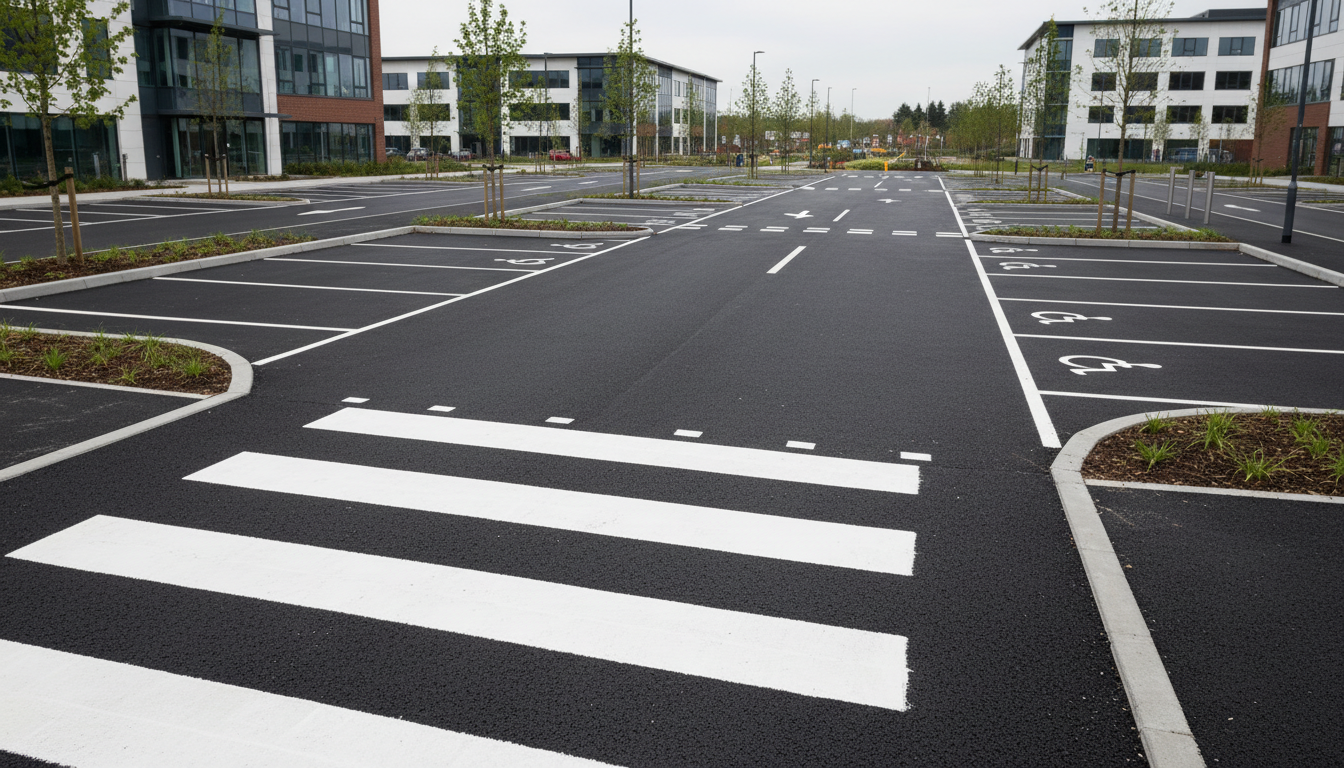
Common applications include parking bay delineation, directional arrows, hatch markings, disabled access bays and pedestrian crossings. On larger sites, loading zones and restricted areas may also require clearly defined boundaries to support safe vehicle manoeuvring.
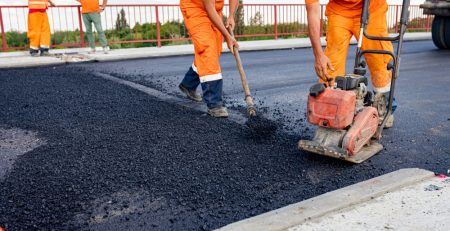
For sites that have recently undergone tarmac installation, allowing the surface to fully cure before applying thermoplastic or paint markings is essential. This ensures adhesion and long-term durability.
Markings should always reflect the way a site is used rather than simply copying highway layouts. Careful planning prevents unnecessary repainting and future layout alterations.
Compliance and Health & Safety Considerations
Road line markings UK property managers install must often comply with health and safety requirements. While private roads are not governed by the same regulations as public highways, workplace safety laws still apply to commercial and industrial premises.
Clear demarcation between pedestrian walkways and vehicle routes reduces the risk of collisions. Well-marked fire access lanes ensure emergency vehicles can navigate sites efficiently. Accessible parking bays must be correctly sized and positioned to meet equality standards.
Professional commercial surfacing contractors understand how markings integrate with broader safety planning. This includes ensuring correct spacing, visibility and reflectivity where required.
Failure to implement appropriate markings can expose site owners to liability if accidents occur due to unclear traffic guidance.
Materials Used in Road Line Markings
The durability of road line markings depends on material choice and traffic intensity. Paint-based systems may be suitable for light-use areas, while thermoplastic markings provide greater longevity in heavy-traffic environments.
Thermoplastic materials are heated and bonded directly to the surface, creating a thicker, more resilient marking. They are commonly used in car parks, logistics yards and access roads where constant vehicle movement occurs.
Reflective beads can be incorporated to improve visibility in low-light conditions. This is particularly important on sites operating during early mornings or evenings.
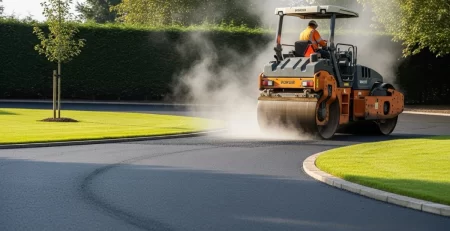
When planning marking works alongside resurfacing, coordinating with experienced teams ensures compatibility between surface type and marking material. Sites that have undergone machine lay tarmac often provide an ideal uniform base for precise line application.
Timing Markings After Surfacing Works
Applying line markings too soon after resurfacing can compromise both the surface and the marking itself. Fresh tarmac requires time to cool and stabilise before additional treatments are introduced.
As part of structured project planning, contractors will schedule marking works after the surface has sufficiently cured. This prevents tracking, smudging or adhesion problems.
For larger resurfacing schemes, phasing may be necessary to maintain access while markings are applied. Careful coordination minimises disruption to business operations.
Sites that require resurfacing and layout redesign can review previous projects through detailed case studies to understand how integrated planning improves final outcomes.
Designing Effective Site Layouts
Effective road line markings begin with a well-considered layout plan. Simply repainting faded lines without reviewing site usage can perpetuate inefficient traffic flow.
During planning, consider entry and exit points, turning circles, parking demand and pedestrian desire lines. On busy commercial sites, separating heavy goods vehicle routes from staff parking reduces congestion and improves safety.
Educational settings benefit from clearly defined drop-off zones and pedestrian walkways, often delivered alongside specialist education surfacing works designed to withstand frequent use.
Private estates may require subtle yet clear markings to preserve aesthetics while maintaining order. Balancing visibility with appearance is an important design consideration in residential environments.
Maintenance of Road Line Markings
Like the road surface itself, markings require periodic inspection and maintenance. Heavy traffic, weather exposure and UV degradation gradually reduce visibility.
Routine checks should assess fading, peeling or surface wear. Reapplying markings at appropriate intervals maintains safety standards and preserves site organisation.
Integrating marking inspections into broader surface maintenance planning prevents reactive repairs and ensures long-term performance. For businesses operating across multiple regions, working with contractors who cover areas we cover ensures consistency in maintenance standards.
Ignoring worn markings can create confusion and increase the likelihood of minor collisions or pedestrian incidents, particularly in busy car parks.
The Relationship Between Surface Quality and Marking Performance
The longevity of road line markings is closely linked to the condition of the underlying surface. Cracked or uneven surfaces reduce adhesion and cause premature peeling.
Before applying new markings, surfaces should be clean, dry and free from loose debris. If structural defects exist, these should be addressed first. In some cases, resurfacing may be necessary before re-marking.
Coordinating surfacing and marking works under a single project plan avoids duplication and ensures both elements complement each other. Engaging a contractor with expertise across both services simplifies communication and ensures consistent quality control.
Planning Markings as Part of a Broader Surfacing Strategy
Road line markings should not be treated as an afterthought. Instead, they form part of a comprehensive surfacing strategy that includes structural design, drainage, access planning and long-term maintenance.
When incorporated from the outset, markings support traffic efficiency, regulatory compliance and site safety. This integrated approach reduces the need for future alterations and supports smoother day-to-day operations.
Whether managing a commercial estate, school premises or private development, aligning surfacing works with professional marking design ensures the finished surface performs effectively from both a structural and organisational perspective.