Are Potholes Dangerous to Vehicles? The Complete Threat Assessment
Potholes represent a genuine and costly hazard to vehicle owners across the UK and beyond. Total Surfacing Solutions, experts in road and driveway surfacing, help prevent these dangers with professional repairs and resurfacing services.
When your car strikes a pothole, the impact force is equivalent to a 35 mph collision, sending shockwaves through multiple critical systems simultaneously.
The answer is straightforward: yes, potholes are extremely dangerous to vehicles, costing drivers significant amounts in emergency repairs and long-term damage.
This guide breaks down exactly what happens when vehicles hit potholes, why the damage cascades, and what immediate steps protect your investment.
Common Damages From Potholes Vehicles Experience
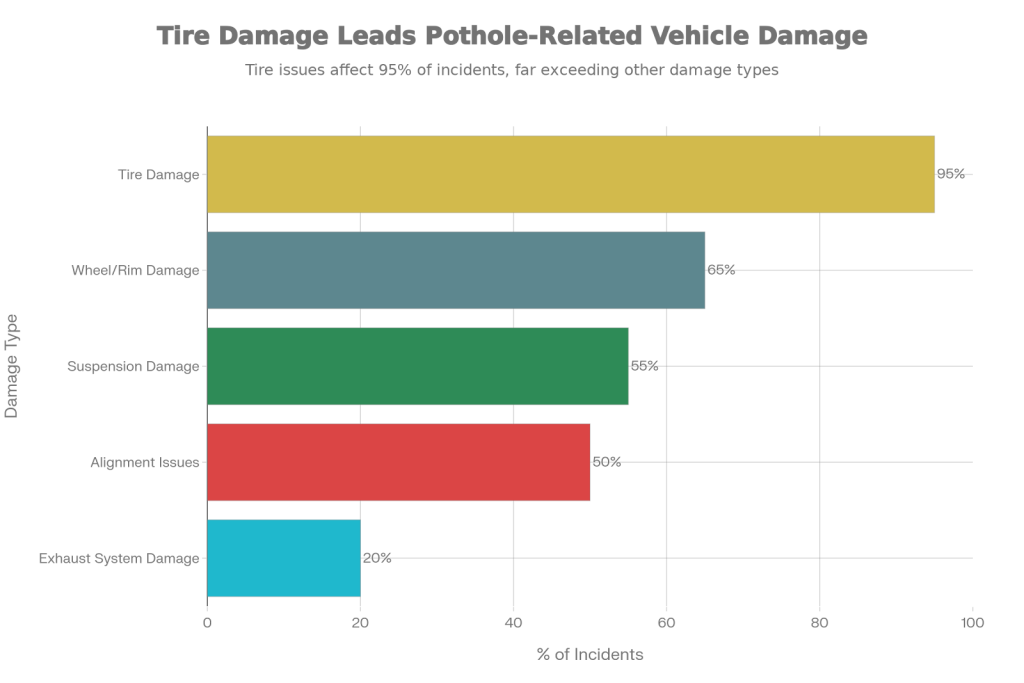
Potholes cause immediate structural damage across multiple vehicle systems. Tires suffer punctures and blowouts while wheels bend and crack. Suspension components fail under sudden impact stress.
Tire Damage Remains the Most Prevalent Issue
Tires absorb the first impact and suffer the most immediate consequences. Potholes cause punctures, sidewall bulges, tread separation, and complete blowouts. The sharp edges of road cavities slice through rubber, while the sudden compression creates internal structural damage.
Sidewall bulges appear as bubble-like protrusions, indicating weakened tire integrity. These weakened areas become blowout zones, especially at highway speeds.
Wheel and Rim Damage Compromises Structural Integrity
When tire walls strike pothole edges, bent rims and cracked wheels result from the concentrated force. Steel wheels typically bend, while aluminum rims can crack completely.
A bent rim breaks the seal between tire and wheel, causing air to escape gradually or suddenly. This air loss prevents proper vehicle handling and creates immediate safety hazards.
Suspension Components Take Hidden Punishment
Your suspension system absorbs shock through struts, shocks, springs, and control arms. These precision components compress to absorb bumps, but potholes deliver force beyond their design tolerance.
Damaged shocks cause excessive bouncing, nose-diving during braking, and difficulty steering. Internal leaking shocks reduce dampening effectiveness, creating a rougher ride quality.
Wheel Alignment Shifts Out of Specification
The jarring impact bends tie rods, shifts control arms, and damages ball joints. These steering components work together to maintain proper wheel angles.
When misaligned, your vehicle pulls strongly to one side, and uneven tire wear accelerates rapidly. Misalignment also reduces fuel efficiency by up to 10%, forcing your engine to work harder against rolling resistance.
Exhaust System Sustains Scraping Damage
Deep potholes cause low-hanging exhaust pipes to scrape and puncture. Holes in exhaust systems allow noxious fumes into the cabin, reduce engine power, and create strange rattling noises. This damage requires immediate attention for safety and environmental compliance.
🔧 Book Professional Pothole Repair
Why Are They So Damaging to Vehicles? Understanding the Mechanics
Moisture freezes beneath pavement, expanding and cracking asphalt. Potholes form progressively deeper cavities with each vehicle impact. Higher speeds deliver exponentially greater destructive force.
The Physics of Pothole Formation Creates Hazardous Voids
Potholes form through a predictable cycle that makes them progressively worse. Moisture seeps beneath pavement surfaces where the subgrade layer lacks proper support. When temperatures drop, this water freezes and expands, cracking the asphalt above.
Repeated vehicle impacts then widen and deepen the hole exponentially. Each car that drives through removes more broken pavement chunks, creating larger cavities that catch subsequent vehicles.
Speed Amplifies Impact Force Exponentially
The relationship between speed and damage is non-linear; doubling your speed quadruples the impact force. Hitting a pothole at 30 mph delivers far more destructive energy than hitting the same pothole at 15 mph.
This explosive force propagates through your entire suspension system, affecting components throughout the undercarriage. Higher speeds provide less time to react and maneuver safely.
Components Designed for Gradual Loading, Not Sudden Shocks
Vehicle suspension systems are engineered for progressive force distribution. Your shocks compress gradually over bumps, distributing energy safely. Potholes deliver an instantaneous, concentrated force that exceeds design parameters.
This sudden overload causes structural failure in ways that normal driving never would. The energy must go somewhere, and it cascades through connected systems.
Vulnerable Populations Face Heightened Risks
Motorcyclists, cyclists, and pedestrians experience disproportionately severe consequences. Motorcyclists lack vehicle protection and can be thrown from their bikes. Cyclists lose traction and crash into hard pavement.
Pedestrians face the danger of vehicles swerving uncontrollably to avoid potholes, potentially striking them. These vulnerable users have no protection layer between themselves and the road hazard.
Wet Conditions Conceal the Danger Completely
Standing water over potholes creates a visual deception that catches drivers unprepared. You cannot judge depth or surface integrity beneath water coverage. Winter ice masks potholes even more effectively.
This concealment prevents drivers from taking evasive action, ensuring maximum impact force transfers to vehicles.
What to Do? Immediate Steps After Pothole Impact
After hitting a pothole, assess safety first. Perform visual damage inspection of tires and wheels. Monitor handling and seek professional diagnosis within 24-48 hours.
Step 1: Assess Safety and Move to a Protected Location
Immediately after impact, move your vehicle to a safe location away from traffic if possible. Turn on hazard lights to alert other drivers. Do not attempt to inspect damage while standing near moving traffic.
If your vehicle is undrivable or making concerning noises, call for professional assistance rather than risking further damage.
Step 2: Perform a Visual Damage Assessment
Begin with an external inspection of all four tires and wheels. Look for:
- Bulges or bubbles on tire sidewalls
- Visible punctures or cuts
- Bent or cracked rims
- Air leaking around tire-wheel seals
Check underneath your vehicle for dangling parts, leaking fluids, or scraped components. Inspect your bumpers and side skirts for damage. The exhaust system should emit no unusual sounds or smells.
Step 3: Monitor Your Vehicle’s Handling and Performance
Drive slowly to a secure location while noting any changes:
- Steering wheel position: Does it return to center or pull to one side?
- Ride quality: Is bouncing excessive after bumps?
- Noises: Do you hear new clunking, knocking, or rattling sounds?
- Warning lights: Has a dashboard light illuminated?
- Vibration: Does the steering wheel or seat vibrate abnormally?
These observations provide valuable diagnostic information for mechanics.
Step 4: Get a Professional Inspection Without Delay
Book an appointment with a qualified mechanic within 24-48 hours. Provide them with details about the pothole encounter, depth estimate, speed of impact, and any symptoms you’ve noticed. Mechanics perform systematic inspections, including:
- Tire pressure and internal damage assessment
- Wheel alignment checks using precision equipment
- Suspension component inspection for cracks and bending
- Steering system evaluation
- Exhaust system integrity verification
Early detection prevents secondary damage. A bent suspension component left unrepaired causes accelerated wear throughout related systems, multiplying repair costs significantly.
Step 5: Follow Preventive Tire Pressure Maintenance
After repairs are completed, maintain exact tire pressure as specified on your driver’s door panel (not the tire sidewall). Proper inflation helps tires absorb future impacts more effectively.
Check pressure monthly and before long journeys. Well-inflated tires resist punctures and sidewall damage far better than under- or over-inflated alternatives.
Step 6: Document Everything for Insurance Claims
Photograph all visible damage from multiple angles. Collect repair invoices and mechanics’ written assessments. Document the pothole’s location with GPS coordinates if possible. Many insurance policies cover pothole damage, and thorough documentation strengthens claim approval chances.
Common Types of Vehicle Damage from Potholes
⚡ Get Pothole Fixed Today
Preventive Strategies That Actually Reduce Risk
Maintain extended following distances and reduce speed on damaged roads. Treat standing water with suspicion and inspect tires regularly. Report dangerous potholes to the authorities.
Maintain Aggressive Following Distances
Standard advice recommends 3-4 second gaps between vehicles. Increase this to 5-6 seconds when traveling on roads prone to potholes. Extra distance provides crucial time to spot potholes ahead and either slow down or change lanes. You’ll see hazards earlier than tailgating drivers, giving your brain milliseconds to react.
Reduce Speed in High-Risk Areas
Potholes concentrate in certain predictable locations: streets with heavy truck traffic, roads lacking recent maintenance, areas prone to freeze-thaw cycles, and regions with poor drainage.
Drive through these zones at reduced speeds, even if traffic permits higher speeds. This simple precaution reduces impact force dramatically.
Treat Standing Water with Extreme Suspicion
Never assume standing water is shallow. Assume every puddle conceals a dangerous pothole, especially during the winter months. Drive around standing water whenever safely possible.
If avoidance is impossible, reduce speed significantly before impact and maintain a firm grip on your steering wheel.
Inspect Your Tires Regularly
Monthly tire pressure checks prevent the underinflation that increases pothole vulnerability. Examine tire tread depth using the penny test. Insert a penny into the tread with Lincoln’s head upside down.
If you see the top of Lincoln’s head, your tread is too worn and replacement is urgent. Worn tires cannot absorb pothole impacts effectively.
Report Potholes to Local Authorities
Help future drivers and your community by reporting significant potholes to your local council or road authority. Most councils have online reporting systems or telephone hotlines.
Provide location details and depth estimates. Reported potholes receive prioritization, potentially preventing damage to countless vehicles.
Frequently Asked Questions
Can a Single Pothole Impact Cause Permanent Vehicle Damage?
A single pothole can absolutely cause permanent damage, especially if struck at high speed. One severe impact can bend suspension components, misalign wheels, and damage tires beyond repair.
What seems like a minor pothole may cause internal tire damage that becomes a blowout weeks later. The structural integrity of your vehicle can be compromised by a single incident.
What Warning Signs Appear After Hitting a Pothole?
Immediate warning signs include steering wheel vibration, pulling to one side, or unusual noises. Delayed warning signs appear days or weeks later as microstructural damage develops.
These include gradual steering changes, increasing tire wear on one side, excessive bouncing over bumps, or dashboard warning lights. Any new symptom after a pothole impact warrants professional inspection.
Does Insurance Cover Pothole Damage to My Vehicle?
Most insurance policies include comprehensive or collision coverage for pothole damage. However, coverage varies significantly by policy, and filing a claim may increase premiums. Contact your insurer to confirm coverage before filing.
Thorough documentation of damage and repair estimates strengthens approval chances. Some regions offer government compensation schemes for pothole damage on public roads.
How Much Does Pothole Damage Repair Typically Cost?
Average repair costs range from £590 to several thousand pounds, depending on damage severity. A single tire replacement costs £80-£200. Wheel alignment runs £75-£120.
Suspension repairs involving struts or control arms cost £400-£1,500 or more. Early detection and repair prevent secondary damage that compounds costs exponentially. A £150 tire repair caught early prevents a £1,200 suspension repair later.
How Can I Avoid Potholes While Driving?
Scan the road 10-15 seconds ahead of your vehicle’s current position. This forward vision allows early hazard detection. Stay centered in your lane rather than near the edges where potholes concentrate.
Reduce speed on damaged roads and never swerve suddenly to avoid potholes; swerving often causes accidents worse than pothole impacts. Accept that sometimes hitting a pothole is unavoidable, and that’s acceptable if you’re driving responsibly.
Protect Your Vehicle From Pothole Threats
Potholes demand serious attention from every UK driver navigating deteriorating road surfaces. The 35 mph collision-equivalent impact causes immediate and cascading damage across tires, wheels, suspension, and alignment systems.
Early detection through visual inspection and professional diagnosis prevents exponential repair cost escalation. Implementing preventive strategies such as maintaining tire pressure, increasing following distances, and reducing speed on damaged roads significantly minimizes risk exposure.
However, professional pothole repairs and proactive road resurfacing represent the only long-term solution to protect entire communities. Report hazardous potholes to local authorities today. Your vehicle’s safety and your wallet depend on addressing these infrastructure failures immediately.