Forklift Lane Markings for Safer Warehouses
Busy warehouses, yards, depots, and industrial facilities can become dangerous when forklifts, pedestrians, pallets, loading bays, and storage zones share the same space without clear visual control. The problem is not only movement speed, but confusion about who should go where.
The serious action is to install Forklift Lane Markings that create safe traffic paths, pedestrian walkways, and storage areas while reducing accident risks. Clear markings help drivers, workers, and visitors understand movement rules before a mistake happens.
The quick clue: safer sites use visible lines before they rely on verbal instructions.
For professional surfacing and marking support, Total Surfacing Solutions can help businesses plan safer, clearer working areas across industrial and commercial sites.
Forklift Lane Markings: Safety Routes
Forklift lane markings create visual routes that guide drivers through busy working areas. This section explains why marked lanes, pedestrian separation, storage control, and hazard warnings are essential for safer site movement.
Forklift Lane Markings are floor or surface markings used to define where forklifts should travel, stop, turn, load, and avoid pedestrian conflict. They help turn a busy warehouse floor into a controlled movement system.
These markings are especially important where forklifts operate near picking zones, racking aisles, dispatch areas, loading bays, and pedestrian doors. Without them, workers may guess routes, cross at unsafe points, or stand inside vehicle movement areas.
A good marking layout should define safe traffic paths, pedestrian walkways, and storage areas clearly. This makes movement easier to understand for forklift drivers, warehouse staff, visitors, contractors, and supervisors.
Clear markings also support reducing accident risks by making danger zones easier to see. They do not replace training or traffic management, but they make safe behaviour easier to follow every day.
A focused guide to industrial floor marking can help site managers understand how lane colours, symbols, and zones work together inside operational spaces.
| Marking Type | Main Purpose | Where It Helps |
| Forklift lanes | Vehicle route control | Main traffic routes |
| Pedestrian walkways | Worker separation | Picking and access areas |
| Stop lines | Driver control | Crossings and junctions |
| Storage bays | Pallet discipline | Stock and staging areas |
| Hazard zones | Risk warning | Doors, edges, machinery |
| Crossing points | Controlled movement | Shared traffic areas |
| Loading bay lines | Safer loading flow | Dispatch and goods-in |
The best forklift lane marking system is simple, visible, and consistent. Staff should understand it quickly without needing to ask where they are allowed to walk or drive.
Traffic Flow Planning: Clear Movement
Warehouse traffic should not be designed after problems happen. This section explains how forklift routes, one-way systems, crossing points, and turning areas create safer movement before markings are installed.
Traffic flow planning starts with watching how people and vehicles actually move. Forklifts may follow shortcuts, pedestrians may cross near racking, and pallets may block routes during busy periods.
A strong layout reduces conflict before paint touches the floor. The plan should show forklift routes, pedestrian paths, crossing points, parking zones, storage areas, speed control zones, and loading routes.
One-way systems can help reduce head-on forklift movement in narrow aisles. Stop lines, give-way markings, and directional arrows can also make driver decisions clearer at junctions.
A layout designed for line marking for efficient operations can support productivity as well as safety, because staff spend less time navigating unclear routes.
Traffic planning should identify:
- Main forklift routes
- Pedestrian-only areas
- Shared crossing points
- Blind corners
- Loading bay approaches
- Racking aisle entries
- Emergency access routes
- Pallet staging areas
- Speed control zones
- Vehicle turning points
Good traffic flow reduces hesitation. When drivers and pedestrians understand the route instantly, the site becomes easier to manage.
Pedestrian Walkways: Safer Separation
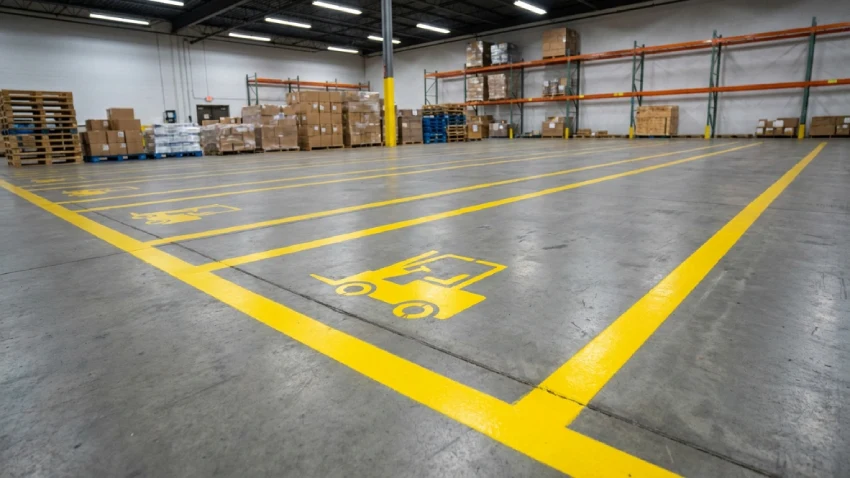
Pedestrian walkways are one of the most important parts of forklift lane marking. This section explains how clear walking routes help keep workers away from vehicle paths and collision zones.
Pedestrians should not need to guess where it is safe to walk. Clear pedestrian walkways give workers a visible route through warehouses, factories, yards, and loading areas.
Walkways should be wide enough, visible from a distance, and positioned away from forklift turning zones where possible. They should also connect key areas such as entrances, welfare rooms, offices, picking zones, and exits.
Crossing points should be controlled and obvious. Zebra-style markings, stop lines, warning text, and high-visibility colours can help both drivers and pedestrians understand priority.
Many accidents happen because people and vehicles share space without clear boundaries. Proper pedestrian walkways can help prevent warehouse accidents by making movement decisions more predictable.
Pedestrian route features:
| Feature | Why It Matters |
| Clear walkway edges | Defines safe walking space |
| High-contrast colour | Improves visibility |
| Crossing points | Controls shared movement |
| Stop lines | Guides forklift drivers |
| Direction arrows | Reduces confusion |
| Warning text | Reinforces risk zones |
| Barriers where needed | Adds physical protection |
Pedestrian markings work best with training, signage, mirrors, lighting, and physical barriers in higher-risk areas. Floor markings should be part of a full traffic-management system.
Storage Area Lines: Better Control
Storage area markings stop pallets, stock, and equipment from spreading into travel routes. This section explains how defined bays protect forklift lanes, walkways, exits, and loading areas.
Unmarked storage areas quickly become messy. Pallets creep into walkways, stock blocks crossings, and temporary staging areas, becoming permanent hazards.
Storage bay markings tell staff exactly where materials belong. They also help supervisors identify when stock is placed incorrectly or when forklift routes are being narrowed.
Good markings can separate full pallets, empty pallets, waste, finished goods, returns, and loading-stage materials. This reduces confusion and keeps traffic paths clearer.
Storage control is also part of health & safety line marking because blocked pedestrian routes and vehicle lanes increase the chance of avoidable incidents.
Useful storage markings include:
- Pallet bays
- Goods-in staging zones
- Dispatch holding areas
- Empty pallet zones
- Waste collection points
- Battery charging areas
- Equipment parking bays
- Racking clearance zones
- No-storage zones
- Emergency access keep-clear areas
A clear storage layout helps forklift drivers move with fewer obstructions. It also makes housekeeping easier because every area has a visible purpose.
Hazard Zone Markings: Risk Warning
Hazard markings highlight areas where staff need extra attention. This section explains how colour, contrast, text, and symbols help warn people before they enter higher-risk spaces.
Hazard zones may include forklift crossing points, loading edges, blind corners, machine areas, battery charging zones, restricted aisles, ramps, dock edges, and emergency equipment areas.
These zones need markings that stand out from normal traffic lanes. High-contrast colours, diagonal hatching, warning text, and symbols can help make risk areas clearer.
Hazard markings should not be decorative. They should communicate a specific warning that staff can understand quickly during a busy shift.
A strong marking plan should include hazard zone markings in industrial facilities where forklifts, people, machinery, and loading activity overlap.
Common hazard marking areas:
| Hazard Area | Marking Purpose |
| Blind corners | Warn drivers and pedestrians |
| Dock edges | Reduce fall or collision risk |
| Battery zones | Identify restricted areas |
| Machine zones | Control access |
| Crossing points | Improve shared-route awareness |
| Racking ends | Protect impact-prone areas |
| Emergency equipment | Keep access clear |
| Pedestrian doors | Warn of sudden foot traffic |
Hazard markings should be reviewed regularly. If the site layout changes, old markings can confuse staff and create new risks.
Loading Bay Routes: Heavy Movement
Loading bays are high-risk areas because forklifts, lorries, pallets, pedestrians, and tight deadlines meet in one place. This section explains how lane markings make loading activity safer and more controlled.
Loading areas should show where forklifts travel, where pedestrians stand, where pallets wait, and where vehicles reverse or park. Without visible control, busy bay areas can quickly become unsafe.
Forklift lanes around loading bays should be wide, direct, and kept clear. Stop lines, waiting zones, directional arrows, and keep-clear markings help reduce sudden movement conflict.
Where external yard surfaces are part of the route, good surfacing matters. Damaged or uneven areas can affect forklift stability, driver control, and marking durability.
For facilities upgrading external loading routes, tarmac installation services can support smoother traffic movement around yards, entrances, and loading approaches.
Loading bay marking priorities:
- Forklift travel lanes
- Pedestrian exclusion zones
- Lorry waiting areas
- Pallet staging bays
- Dock edge warnings
- Stop and give-way lines
- Keep-clear access zones
- Emergency exit access
- Trailer approach routes
- Turning space indicators
Loading bays need markings that remain visible under heavy use. A faded or broken layout creates uncertainty at the exact point where clarity matters most.
Surface Condition: Marking Performance
Line markings only perform well when the surface underneath is suitable. This section explains why cracks, potholes, loose material, and damaged tarmac can weaken safety markings and traffic control.
A marking system depends on visibility and adhesion. If the surface is dusty, broken, wet, oily, or uneven, markings may wear faster or become harder to read.
Potholes and surface failures create two problems. They affect forklift movement and also interrupt the line-marking system that guides drivers and pedestrians.
Before installing forklift lane markings, the floor or external surface should be inspected. Repairs may be needed where damage affects safety, durability, or visibility.
Industrial sites with surface defects may need pothole repair services before new traffic routes are marked. This is especially important around loading bays, yards, and vehicle approaches.
Surface issues to check:
| Surface Issue | Why It Matters |
| Potholes | Can affect forklift stability |
| Loose aggregate | Reduces marking adhesion |
| Oil contamination | Stops clean application |
| Cracks | Breaks visual continuity |
| Dusty floors | Weakens bonding |
| Uneven patches | Creates vehicle vibration |
| Standing water | Reduces durability |
| Old faded lines | Causes route confusion |
Markings should not be applied as a quick cover-up for unsafe surfaces. A stable base helps the safety system last longer and work properly.
Outdoor Yard Markings: Durable Routes
Forklift movement often continues outside the warehouse into yards, service roads, and loading areas. This section explains why external markings need durable surfaces and weather-aware planning.
Outdoor forklift routes face rain, UV exposure, vehicle weight, dirt, tyre wear, and temperature changes. That means markings need the right surface preparation and material choice.
External routes should connect logically with internal warehouse lanes. A driver should not leave a clear indoor system and enter an unclear yard with no visual control.
Yard markings may include forklift lanes, lorry routes, loading zones, pedestrian paths, waiting bays, and no-parking areas. These markings help keep external movement organised.
For larger industrial routes and yard surfaces, machine lay tarmac services can support smoother, more consistent surfaces before traffic routes are marked.
Outdoor marking areas include:
- Yard traffic lanes
- Loading bay approaches
- Pedestrian walkways
- Vehicle waiting zones
- Forklift crossing points
- Storage boundaries
- Keep-clear access routes
- Delivery vehicle routes
- Turning areas
- Fire access zones
Outdoor markings should be inspected more often than low-traffic indoor lines. Weather and vehicle movement can fade lines faster.
Essex and Hertfordshire: Local Sites

Industrial sites across Essex and Hertfordshire often combine warehouses, yards, loading bays, and external vehicle routes. This section explains why local surface conditions and traffic layout should be reviewed together.
Factories, depots, storage yards, distribution units, and commercial premises often need both surfacing and marking support. The route is only safe if the surface and visual control work together.
In Essex, outdoor forklift routes and loading areas can suffer from potholes, edge wear, and patched surfaces. These issues can reduce marking clarity and create movement risks.
For yard upgrades and commercial traffic routes, machine lay tarmac can support consistent surfacing across larger Essex sites, while pothole repairs in essex can address damaged areas before new markings are installed.
In Hertfordshire, warehouses and industrial yards may need planned resurfacing before line marking if forklifts, vans, and HGVs use the same external zones. machine lay tarmac in hertfordshire can support durable surface preparation, while pothole repairs in hertfordshire can help remove hazards that interfere with safe routes.
Local site checks should include:
- Indoor forklift lanes
- External yard routes
- Loading bay surfaces
- Pedestrian crossings
- Pothole locations
- Drainage and standing water
- HGV turning zones
- Pallet storage boundaries
- Emergency access routes
- Old faded markings
Local sites should not treat line marking as an isolated job. The safest result comes from checking traffic flow, surface condition, and marking design together.
Compliance Checks: Safer Audits
Forklift lane markings should support workplace safety audits and traffic management reviews. This section explains how visibility, consistency, maintenance, and staff understanding help strengthen site safety.
A marking system should be easy to inspect. Managers should be able to see whether walkways are blocked, forklift lanes are being followed, and storage zones are being respected.
Faded lines should be refreshed before they become unclear. If staff start ignoring markings, the layout may need retraining, redesign, or better enforcement.
Compliance is not only about having lines on the floor. It is about whether those markings actually reduce risk and support safe daily behaviour.
A professional review from Total Surfacing Solutions can help identify where surfacing, lane marking, and traffic control improvements may be needed across operational sites.
Audit questions to ask:
- Are forklift routes clearly visible?
- Are pedestrian walkways continuous?
- Are crossing points easy to understand?
- Are storage areas respected?
- Are hazard zones clearly marked?
- Are old markings removed or corrected?
- Are loading bay routes clear?
- Are external surfaces safe enough?
- Are staff trained on the layout?
- Are markings maintained regularly?
Good markings make audits easier because site risks become more visible. Poor markings hide confusion until an incident or near miss exposes the problem.
Final Marking Plan: Next Step
A strong forklift marking plan should be practical, visible, and built around real site movement. This section brings route planning, pedestrian safety, storage control, hazard zones, surfacing, and maintenance into one clear action path.
Start by observing the current movement pattern. Note where forklifts travel, where pedestrians cross, where pallets wait, and where congestion happens.
Then separate people and vehicles wherever possible. Mark pedestrian walkways, forklift lanes, storage zones, crossing points, and hazard areas clearly.
Next, inspect the surface. Damaged floors, potholes, loose material, and faded old markings should be addressed before a new system is installed.
For complete site planning, Total Surfacing Solutions can support surfacing and marking improvements that help make routes clearer, safer, and more durable.
Follow this route:
- Map forklift routes through the warehouse and yard.
- Identify pedestrian paths and unsafe crossing points.
- Mark storage zones to stop pallets from blocking lanes.
- Highlight hazard areas with visible warning markings.
- Check the surface condition before applying new lines.
- Separate vehicles and people wherever possible.
- Use clear colours and contrast for fast recognition.
- Add stop lines and arrows where movement decisions happen.
- Train staff on the layout after installation.
- Review markings regularly before they fade or fail.
Forklift Lane Markings are not just paint on a floor. They are a visual traffic-control system that helps protect people, guide vehicles, and keep busy sites working safely.
Frequently Asked Questions
1. What are forklift lane markings?
Forklift lane markings are visual lines, arrows, symbols, and zones that show where forklifts should travel, stop, turn, and load. They help separate vehicle movement from pedestrian areas and storage zones.
2. Why are pedestrian walkways important in warehouses?
Pedestrian walkways help keep workers away from forklift routes. They create safer movement paths, reduce confusion, guide visitors, and support better traffic control in busy warehouse or industrial environments.
3. What colours are used for warehouse floor markings?
Colours vary by site system, but yellow, white, red, blue, green, and black/yellow hazard markings are commonly used. The most important rule is consistency, contrast, and clear staff understanding.
4. How often should forklift lane markings be refreshed?
Forklift lane markings should be refreshed when they become faded, damaged, dirty, confusing, or hard to see. High-traffic warehouses and outdoor yards usually need more frequent inspections.
5. Can line markings reduce warehouse accidents?
Yes, clear line markings can help reduce accident risks by separating routes, showing pedestrian paths, identifying hazards, controlling storage, and guiding forklift drivers through safer traffic patterns.