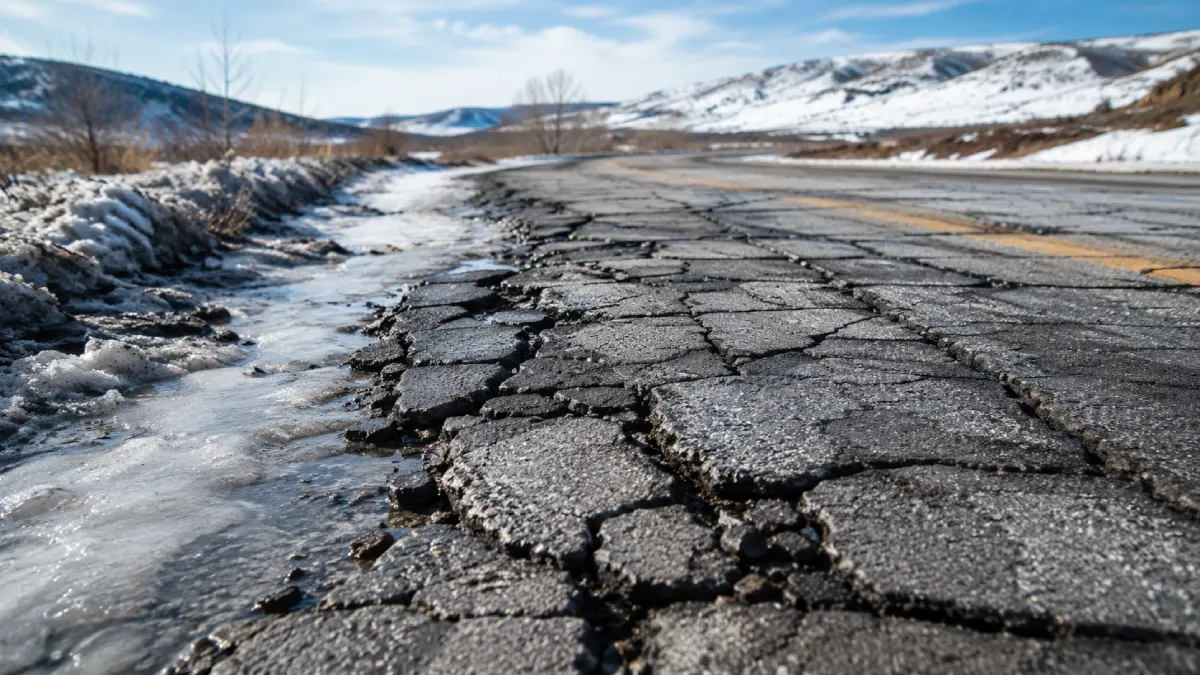
Freeze Thaw Damage on Road Surfaces Explained
Freeze thaw damage on road surfaces explained properly starts with one problem: water reaches vulnerable pavement before temperatures fall below freezing. Once moisture is inside cracks, edges or frost-sensitive ground, repeated freezing and thawing can move the pavement, weaken support and leave the surface vulnerable to traffic.
The result may appear as bumps, widening cracks, sinking areas or recurring potholes rather than one sudden failure. Preventing that progression means controlling water, checking the road foundation and deciding whether the damage is still surface-level or has reached the sub-base or subgrade. That distinction determines what should happen next.
Quick Check: Before choosing a repair method, check whether road surfacing for freeze-thaw damage includes assessment of cracks, drainage, frost-sensitive ground and structural support beneath the visible surface.
Freeze Thaw Damage On Road Surfaces Explained

Freeze-thaw road damage develops through a connected sequence involving moisture, freezing temperatures, frost-sensitive materials and traffic. The visible crack or pothole is often the final symptom of movement and weakening that has already occurred below the wearing surface.
Freeze-Thaw Road Damage Sequence
| Stage | What happens | Road-surface result |
| Moisture reaches pavement | Water enters cracks, edges or foundation | Surface remains vulnerable |
| Temperature falls | Water freezes and frost action develops | Local movement starts |
| Ice lenses form in susceptible soil | Moisture migrates toward freezing zone | Frost heave develops |
| Pavement moves unevenly | Different areas rise by different amounts | Bumps and cracking |
| Temperature rises | Ice melts within pavement foundation | Supporting layers become wetter |
| Thaw weakening develops | Saturated soil loses bearing strength | Pavement flexes more |
| Traffic returns over weak support | Repeated loading stresses the surface | Cracks widen and material loosens |
| Failure progresses | Surface loses support | Potholes and deeper damage |
Understanding the road construction layer sequence is important because freeze-thaw damage does not stop at the visible asphalt. Moisture and frost action may affect the wearing course, binder, base and the soil supporting the complete pavement.
Freeze-Thaw Road Damage Starts With Water
Freeze-thaw road damage needs moisture. Rain can enter through ageing surfaces, fine cracks, open joints and pavement edges, while groundwater can introduce moisture from below even where the asphalt initially looks reasonably intact.
Older pavement is often more vulnerable because cracking and increased porosity create additional routes for water. The road surfacing quality factors that matter here include drainage, workmanship, compaction and the condition of the underlying road layers.
A small crack may therefore be more important than its width suggests. When water repeatedly enters that defect before cold weather, each temperature cycle gets another opportunity to affect the material around the crack and the pavement beneath it.
Freeze-thaw road damage and frost heave
Frost heave develops when freezing conditions act on frost-susceptible material with enough available water. Moisture can migrate toward the freezing zone and form ice lenses within the soil, producing more movement than a simple explanation based only on the volume expansion of the original water.
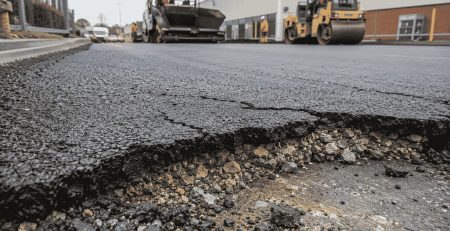
When those ice lenses grow unevenly, differential frost heave can lift one part of a road more than another. The resulting road may develop humps, rolling waves, distorted levels and cracks where the pavement bends beyond what its structure can comfortably accommodate.
The condition of the foundation matters considerably. Good road base preparation factors include adequate compaction, drainage and suitable supporting materials so moisture and frost-sensitive ground do not create avoidable movement below the finished surface.
Freeze-thaw road damage during thawing
The thawing stage can be particularly damaging because freeze-thaw road damage does not end when temperatures rise. Ice within the pavement foundation begins to melt, but water may remain trapped while deeper ground is still frozen and unable to drain normally.
This can temporarily reduce the strength of the supporting layers. A surface that survived the upward frost movement may then flex substantially when vehicles pass over a saturated, softened subgrade or sub-base.
The road base and binder layer roles become important at this stage because the asphalt surface relies on stable support underneath. When that support weakens, even a reasonably intact wearing course can begin cracking under repeated loading.
Freeze-thaw road damage under traffic
Traffic turns many frost-related weaknesses into visible failures. Freeze-thaw road damage leaves parts of the pavement less uniformly supported, and every wheel load can then bend or compress the weakened area.
Heavy vehicles put greater stress on a pavement that has already lost support. This connects directly with heavy-use road material durability, because a road expected to carry repeated commercial traffic needs sufficient structural strength beneath its surface.
Repeated bending also connects with asphalt fatigue cracking causes. Moisture and thaw weakening do not replace traffic fatigue as a cause; they can make the pavement more susceptible to damage from the loads it was already carrying.
Freeze-thaw Road Damage: why pavements fail
Some pavements experience much more freeze-thaw road damage than nearby surfaces exposed to similar temperatures. The difference often comes from moisture availability, drainage, foundation material, existing cracks, traffic loading and the structural condition before winter begins.
Freeze-thaw failure factors
| Pavement factor | Lower-risk condition | Higher-risk condition |
| Surface condition | Tight, intact surface | Open cracks and porous asphalt |
| Drainage | Water leaves quickly | Standing or trapped water |
| Subgrade | Stable, suitable material | Frost-sensitive wet soil |
| Base | Well-drained and compacted | Wet or inconsistently supported |
| Traffic | Appropriate for design | Heavy loads over weakened layers |
| Previous repairs | Stable and well bonded | Repeated sinking or cracking |
| Road edges | Supported and drained | Water entry and edge breakup |
| Winter condition | Limited saturation | Repeated wet freeze-thaw cycles |
These factors explain why freeze-thaw road damage should not be reduced to temperature alone. Two roads can experience the same cold weather while performing differently because their foundations, drainage and existing condition are different.
Freeze-thaw road damage from poor drainage
Poor drainage creates one of the clearest conditions for recurring freeze-thaw road damage. Water that remains around cracks, pavement edges or within the road foundation provides the moisture required for frost action and later thaw weakening.
Drainage should therefore be considered alongside the surface itself. The pavement erosion causes and prevention also show how uncontrolled water movement can weaken edges and supporting material even before freezing becomes part of the problem.
On suitable bound surfaces, permeability can help manage surface water when the complete construction is designed correctly. This is why permeable pavement support in Cambridgeshire can be relevant when considering how moisture moves through and away from a finished surface.
Freeze-thaw road damage on weak foundations
A road surface is only as stable as the layers supporting it when freeze-thaw road damage begins. Poorly compacted or moisture-sensitive material can experience movement, loss of strength and settlement even when the top layer originally looked smooth.
Once support varies across the pavement, cracking tends to appear where the surface repeatedly bends. Those cracks then create further routes for moisture, which can allow the next freeze-thaw cycle to affect a larger part of the road.
Where winter deterioration has already affected a tarmac surface, cold-weather pavement renewal in Hertfordshire should follow an assessment of the base rather than assuming that replacing the wearing course alone will restore structural support.
Freeze-thaw road damage and recurring potholes
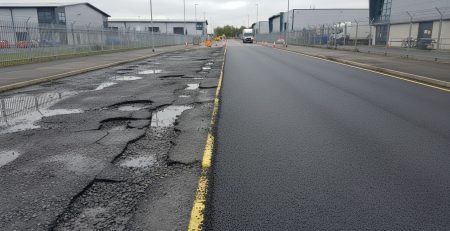
Recurring potholes are one of the clearest signs that freeze-thaw road damage may extend deeper than the missing surface material. A hole can be filled, yet surrounding or underlying pavement may still contain moisture, weak material or movement.
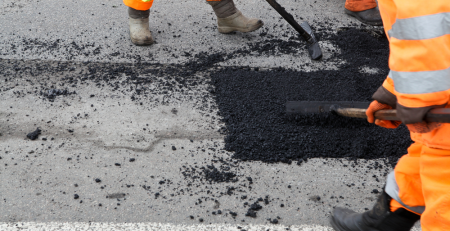
This explains why pothole repair longevity factors depend on more than the material placed into the hole. Repair depth, drainage, edge condition and the stability of the remaining pavement all affect whether the same area fails again.
Different pothole repair method differences also matter because a temporary response to an immediate defect is not equivalent to removing unstable material and rebuilding the affected pavement to a sound depth.
During cold periods, winter pothole repair conditions add another constraint. Moisture, low temperatures and the condition of the surrounding pavement can influence what type of treatment is realistic at that moment.
Freeze-thaw road damage across materials
Different pavement materials respond differently to freeze-thaw road damage, but there is no universal rule that one surface always survives winter better. Drainage, foundation strength, material specification, traffic and workmanship remain central whichever wearing material is used.
Asphalt can remain flexible, but existing cracks and weak support make it vulnerable to traffic during thaw periods. The tarmac climate durability factors include drainage and structural preparation as well as temperature exposure.
Concrete can experience a different form of freeze-thaw deterioration. Saturated concrete may suffer scaling, spalling or damage within susceptible aggregate, which is why suitable aggregates, mixture design and air entrainment are used where freeze-thaw exposure is expected.
Alternative bound surfaces also depend on correct design beneath the finish. Resin surface weather resistance should therefore be considered together with permeability, base condition and water management rather than judging the surface solely by its binder.
Freeze-Thaw Road Damage: Mitigation Steps

Limiting freeze-thaw road damage means reducing water entry, improving drainage and correcting structural weakness before repeated winter cycles enlarge the defect. The correct response changes depending on whether deterioration remains near the surface or has reached supporting layers.
Freeze-thaw road damage and crack control
Crack treatment can be useful where freeze-thaw road damage is still limited and the pavement beneath remains structurally sound. Closing suitable cracks reduces one route through which rain can reach deeper asphalt and foundation layers.
Timing matters because sealing an already unstable pavement will not rebuild its foundation. The pavement sealing timing factors help distinguish preventative treatment from a situation where cracking is already showing deeper structural movement.
For local driveway surfaces, winter surface protection in Hertfordshire should similarly begin with checking whether cracks reflect simple surface ageing or movement within the supporting construction.
Freeze-thaw road damage and drainage
Drainage control directly reduces one of the conditions required for serious freeze-thaw road damage. Surface falls, channels, edges and underlying drainage should allow water to leave rather than collect inside frost-sensitive pavement materials.
Where water remains trapped, simply placing a waterproof-looking finish over the problem can transfer rather than solve the risk. The drainage route beneath and around the surface must remain effective throughout wet winter conditions.
For driveway environments, winter water control in Essex should account for where rain leaves the surface and whether existing edges or low points feed moisture back into weakened pavement.
Freeze-thaw road damage: surface or structural?
The key repair decision is whether freeze-thaw road damage remains within the surface or has affected the foundation. Fine cracking and early permeability problems may still suit preventative treatment when the underlying pavement remains stable.
Rutting, repeated potholes, substantial frost heave and sinking repairs suggest a deeper assessment is needed. Placing another layer on top of moving pavement may hide the defect briefly without removing the reason it developed.
The tarmac resurfacing suitability factors are particularly relevant because resurfacing depends on the condition of the material beneath. A failed base cannot be strengthened merely by making the upper asphalt layer look new.
Freeze-thaw road damage and repair materials
Winter repair choices for freeze-thaw road damage depend on temperature, moisture, repair depth and how quickly the surface must return to use. A material that works as an emergency response should not automatically be treated as a permanent structural solution.
The cold and hot patch differences provide useful context when deciding how damaged pavement should be restored. Material choice should follow the condition of the hole and surrounding pavement rather than convenience alone.
Long-term performance also depends on whether the road continues receiving water after repair. If drainage and unstable support remain unchanged, even a well-compacted surface repair can be exposed to the same freeze-thaw mechanism again.
Freeze-thaw Road Damage Across Covered Areas
Freeze-thaw road damage is driven by the same core factors across Bedfordshire, Oxford, Cambridgeshire, Essex and Hertfordshire: moisture, frost-sensitive construction, drainage and pavement condition. The local surface should still be assessed individually before deciding on treatment.
Freeze-thaw resistant surfacing in Bedfordshire
Freeze-thaw road damage in Bedfordshire should be considered alongside surface permeability, base condition and drainage. Where alternative bound finishes are being assessed, winter moisture-resistant surfaces in Bedfordshire still need stable supporting layers so seasonal water and temperature changes do not expose existing movement beneath the finish.
Surface drainage for freeze-thaw in Oxford
Freeze-thaw road damage in Oxford becomes more likely where water remains around cracks or poorly drained construction. When assessing winter surface drainage in Oxford, the important question is whether the complete pavement gives rainwater a practical route away from frost-sensitive layers.
Permeable surfacing for frost damage in Cambridgeshire
Freeze-thaw road damage in Cambridgeshire should be considered together with how surface water enters, passes through or drains away from the construction. Frost-aware permeable surfaces in Cambridgeshire can only perform properly when the underlying base is suitable and drainage remains functional.
Water-resistant surfacing in Essex
Freeze-thaw road damage in Essex can exploit open cracks and ageing surfaces that admit water before colder periods. When comparing winter water-control surfaces in Essex, drainage and foundation stability should be considered alongside the water resistance of the finished surface itself.
Surface crack protection in Hertfordshire
Freeze-thaw road damage in Hertfordshire often becomes easier to control while cracking remains minor and the supporting layers are still stable. Winter crack-resistant surfaces in Hertfordshire should therefore be assessed together with drainage, base condition and signs of previous frost movement.
Freeze-thaw road damage: act before deeper failure
Recurring cracking, frost heave or winter potholes should be checked before another cosmetic repair is specified. Where the damage suggests water has reached deeper layers, road surfacing for freeze-thaw damage should begin with drainage, pavement depth and foundation condition. The aim is to correct the mechanism creating the failure rather than repeatedly cover its visible symptoms.
Freeze-thaw road damage: FAQs
Why can freeze-thaw road damage affect outside lanes?
Freeze-thaw road damage can sometimes appear more severe near outside lanes because road geometry often directs surface water towards edges, while those areas may also carry concentrated heavy vehicle traffic. The combination is site-specific rather than universal. Where moisture reaches vulnerable pavement edges and traffic repeatedly loads the weakened construction, cracking and pothole development can become more noticeable.
Can freeze-thaw road damage start below intact asphalt?
Yes. Freeze-thaw road damage can develop below a surface that initially appears intact because moisture does not have to enter only through obvious potholes. Groundwater, pavement edges, joints and fine cracks may provide water to frost-sensitive subgrade. Ice-lens formation below the asphalt can then move the foundation before a clearly visible surface fracture develops.
Does road salt worsen freeze-thaw road damage?
Road salt should not be described as the cause of all freeze-thaw road damage. Its effects depend on pavement material and exposure. Concrete is particularly relevant because deicing chemicals can contribute to surface scaling when combined with freezing and thawing. Asphalt deterioration follows different mechanisms, so broad claims that salt simply “destroys roads” should be avoided.
Does concrete prevent freeze-thaw road damage?
No material completely prevents freeze-thaw road damage under every condition. Concrete can be designed for good freeze-thaw durability through suitable aggregate, mixture design and air entrainment, yet saturated or poorly specified concrete can still scale, spall or suffer aggregate-related deterioration. Asphalt has different strengths and weaknesses, so pavement design matters more than declaring one material universally superior.
Can insulation stop freeze-thaw road damage?
Insulation can reduce freeze-thaw road damage in specialist cold-region situations by limiting frost penetration into susceptible ground, and it has been used in very cold climates. It is not a standard answer for every UK road. Drainage, suitable foundation materials and pavement design remain more broadly applicable measures, while insulation needs project-specific engineering and cost assessment.
How do you know freeze-thaw road damage is structural?
Possible signs of structural freeze-thaw road damage include recurring potholes, noticeable frost heave, sunken repairs, widespread cracking, rutting and movement that returns after the surface has been treated. One defect alone does not confirm foundation failure. The key check is whether the road remains uniformly supported or whether the sub-base or subgrade has weakened.
Why do some roads resist freeze-thaw road damage better?
Roads resist freeze-thaw road damage differently because their drainage, foundation materials, compaction, traffic loading, age and existing cracks are not identical. Two pavements exposed to the same temperatures can therefore perform very differently. A well-drained road with stable non-frost-sensitive support gives water and ice-lens growth fewer opportunities to create damaging pavement movement.