Low-Noise Road Surfacing Materials Explained UK
A road can be structurally sound yet produce intrusive cabin noise, repeated tyre impacts and serious disturbance for nearby properties. The problem is often connected to surface texture, concrete joints, open voids or inconsistent repairs, rather than traffic volume alone.
An experienced assessment separates material noise from structural, drainage and vehicle-related factors. The practical solution is to choose and install a surface that controls tyre vibration and trapped air while preserving grip, drainage, loading capacity and long-term durability.
Surfacing tip: Match texture, drainage and durability to the road conditions. Explore low-noise road surfacing materials for a suitable surface approach.
Low-Noise Road Surfacing Materials Explained UK
Low-noise road surfacing reduces the sound created where tyres meet the road. It controls tyre vibration, aggregate impact and compressed air without making the surface dangerously smooth.
At motorway speeds, tyre and road interaction can become a dominant source of traffic noise. The surface course therefore has a direct influence on noise inside vehicles and around nearby buildings.
The three material groups commonly discussed are:
- Stone mastic asphalt and SMA-type systems
- Porous asphalt or drainage asphalt
- Rubber-modified asphalt mixtures
These materials do not work in identical ways. They also cannot correct weak foundations, moving concrete slabs or unsuitable drainage without additional construction.
The wider road surface quality factors must be examined before acoustic performance is specified. Noise is only one requirement within a complete pavement design.
How Texture Optimisation Reduces Noise?

A moving tyre continually deforms as it contacts aggregate particles. An irregular or aggressive texture can increase tread vibration and transmit more sound into the vehicle.
Texture optimisation aims to balance:
- Tyre contact and grip
- Surface water removal
- Aggregate spacing
- Tyre vibration
- Air movement
- High-speed stability
- Long-term polishing resistance
The objective is not a perfectly smooth road. Excessive smoothing can reduce wet-weather grip and make water removal less reliable.
Aggregate arrangement matters as much as simple texture depth. Two surfaces with a similar measured depth may produce different noise because the spacing, direction and scale of their texture differ.
How does air absorption work?
Air becomes temporarily trapped between a rolling tyre and an impermeable surface. Rapid compression and release can generate an effect commonly described as air pumping.
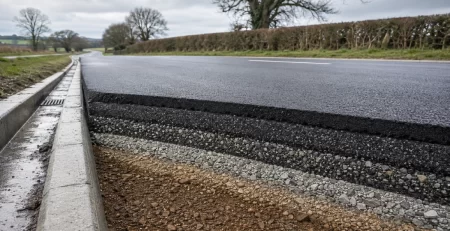
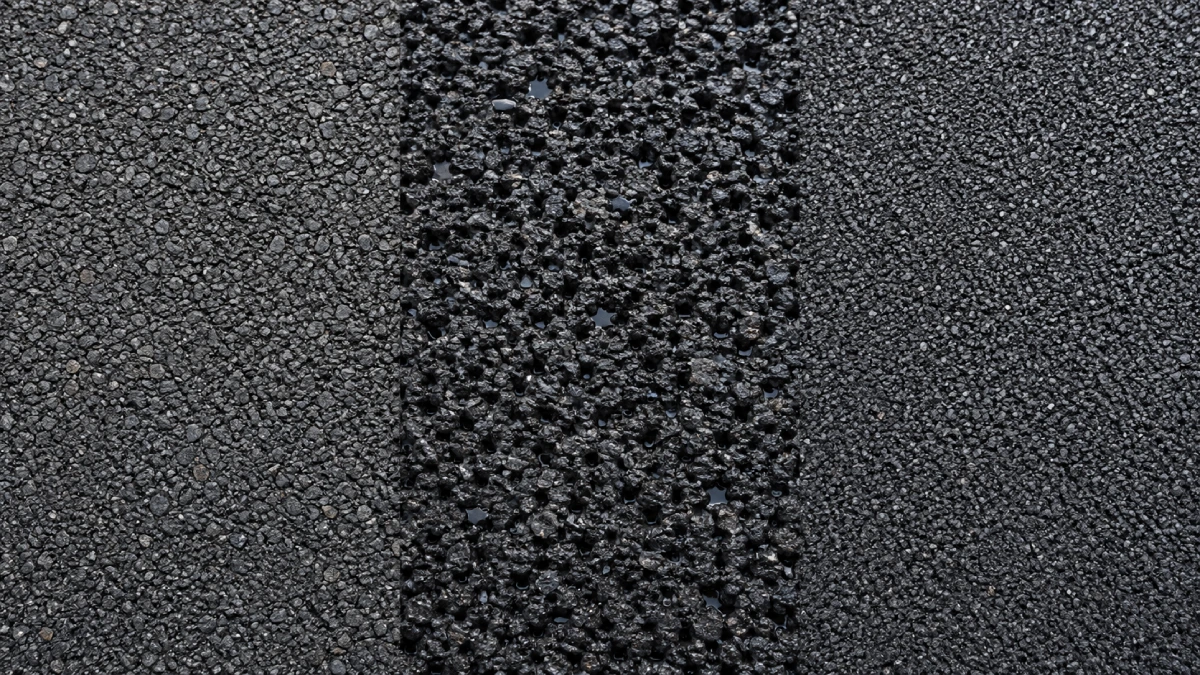
Porous asphalt contains interconnected voids. These voids allow some air movement beneath the tyre and can absorb part of the generated sound.
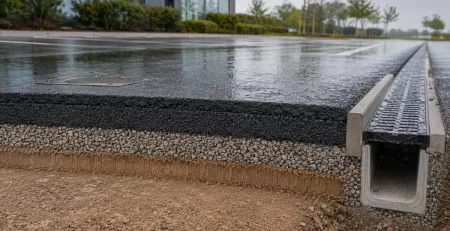
The same void network can help water move below the immediate running surface. That may reduce spray when the pavement and drainage outlets have been designed correctly.
Air absorption depends on the voids remaining connected. Dirt, rubber particles, sediment and maintenance materials can gradually obstruct them.
A porous surface should therefore be treated as an acoustic and drainage system, not merely an asphalt mixture.
How does surface texture control tyre noise?
Surface texture affects noise differently across several scales. Large irregularities can create impact and vibration, while smaller texture features influence grip and air movement.
Important texture-related noise sources include:
- Coarse or uneven exposed aggregate
- Repeated transverse grooves
- Steps across concrete joints
- Segregated asphalt
- Rough utility reinstatements
- Inconsistent patching
- Surface deformation
- Loose or missing aggregate
A sudden change between two surfaces can make drivers believe a tyre has failed. This reaction was one of the clearest recurring experiences in the supplied Reddit discussion.
Rhythmic thudding usually points toward repeated physical features. On concrete roads, these could include joints, level differences, failed seals or a deliberately formed surface texture.
Texture must be investigated alongside the supporting road construction layer functions. Movement within lower layers can eventually produce an uneven and acoustically inconsistent surface.
SMA, Porous and Rubber-Modified Asphalt
Material names are often used too loosely in articles about quieter roads. An accurate comparison must explain each material’s structure, acoustic mechanism and limitations.
| Material | Main structure | Possible acoustic action | Main limitation |
| SMA-type surfacing | Interlocking coarse aggregate with rich mortar | Controlled texture may reduce tyre vibration | Standard SMA is not automatically porous |
| Porous asphalt | Connected internal air voids | Reduces air pumping and absorbs some sound | Voids may clog and require drainage support |
| Rubber-modified asphalt | Binder or mixture containing processed tyre rubber | May alter flexibility, texture and vibration response | Rubber content alone does not prove lower noise |
| Thin surface course | Paver-laid surface under 50 mm | Can provide consistent low-noise texture | Requires a stable and compatible substrate |
Stone Mastic Asphalt
Stone mastic asphalt uses a strong aggregate skeleton filled with a binder-rich mortar. The stone-on-stone structure can provide good resistance to permanent deformation.
SMA-based thin systems may produce less tyre noise than older hot rolled asphalt references. The result depends on aggregate size, texture, workmanship and the particular system specified.
Standard SMA should not be described as porous asphalt. It may contain voids, but that does not mean those voids form a connected drainage network.
For heavily trafficked roads, acoustic selection must be coordinated with heavy-use road surfacing durability. A quiet initial surface has little value if it deforms under repeated loading.
Porous Asphalt
Porous asphalt uses a deliberately open structure with connected voids. Water and air can move through those voids when the underlying design provides a suitable discharge route.
Its possible functions include:
- Reducing tyre air-pumping noise
- Absorbing part of the generated sound
- Limiting water on the immediate surface
- Reducing spray under suitable conditions
- Changing the frequency character of tyre noise
The void structure creates maintenance demands. Clogging can reduce both acoustic absorption and water movement.
Porous asphalt is not suitable merely because a location is noisy. Structural loading, contamination, turning movements and drainage outlets must also be considered.
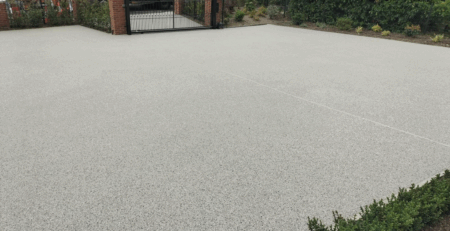
The same distinction applies to residential surfaces. The article on resin bound drainage basics explains why a permeable finish still requires compatible construction beneath it.
Rubber-Modified Asphalt
Rubber-modified asphalt incorporates processed tyre rubber into the binder or mixture. It can support recycling objectives and may influence flexibility, cracking resistance and surface behaviour.
However, claims of an 85% traffic-noise reduction should not be used without project-specific measurements. No dependable general UK evidence supports that result across ordinary applications.
A technically responsible description should state that:
- Acoustic performance depends on the whole mixture.
- Aggregate grading remains important.
- Surface texture must still be controlled.
- Skid and deformation requirements remain separate.
- UK adoption is not universal.
- Performance must be verified on the finished road.
Rubber modification is therefore a material variable, not an automatic quiet-road guarantee.
Why Quiet Surfaces Become Louder?

Initial noise performance does not necessarily continue throughout the surface’s working life. Traffic, weather, contamination and repairs gradually alter the tyre contact zone.
Common acoustic ageing mechanisms include:
- Aggregate polishing
- Surface wear
- Loss of texture consistency
- Clogged porous voids
- Binder ageing
- Local deformation
- Rough patches
- Opening joints
- Reflective cracking
A maintenance plan should record both physical condition and changing road noise. Waiting for complete structural failure may allow acoustic performance to deteriorate for years.
Cracking also requires an accurate diagnosis. The asphalt fatigue crack explanation helps separate load-related failure from superficial surface defects.
Where repeated commercial traffic is present, business park road care planning can connect acoustic inspections with drainage, patching and loading reviews.
Selecting Materials Without Reducing Safety
A quieter surface cannot be selected from its expected decibel reduction alone. It must remain safe and structurally suitable throughout its intended life.
The assessment should verify:
| Requirement | What must be checked |
| Acoustic response | Tyre-road noise at relevant speeds |
| Skid resistance | Aggregate properties and surface texture |
| Drainage | Falls, channels, outlets and internal voids |
| Loading | Vehicle numbers, axle loads and turning |
| Durability | Wear, polishing and deformation risk |
| Visibility | Marking contrast during wet and dark conditions |
| Maintenance | Cleaning, patching and access requirements |
| Structure | Foundation, base, binder and surface compatibility |
Traffic speed changes the value of acoustic surfacing. At lower speeds, engine, transmission, braking and acceleration noise may remain significant, particularly around heavy vehicles.
At higher speeds, tyre-road interaction normally becomes more important. This is where carefully controlled surface texture can produce a more noticeable result.
For roads carrying demanding loads, the surface must also connect properly with the road course structure and purpose.
Treating Noisy Existing Concrete Roads
A thin asphalt layer should not automatically be placed over every noisy concrete road. Existing slabs, joints, drainage and level differences require inspection first.
The investigation should cover:
- Identify the concrete construction type.
- Map every joint and visible crack.
- Check for stepped or moving slabs.
- Inspect joint seals and edges.
- Measure surface regularity.
- Examine drainage paths.
- Determine the required overlay depth.
- Plan treatment for reflective cracking.
- Detail transitions to adjoining surfaces.
- Confirm clearance and level constraints.
Noise may arise from joints, surface grooves, exposed aggregate or poorly matched repairs. The specific cause should be established before a treatment is selected.
Where the concrete remains structurally suitable, a designed low-noise overlay may improve texture and ride quality. Failed or unstable slabs require repair before the surface is covered.
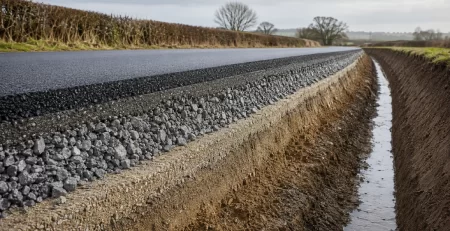
Good preparation follows the principles in the road base preparation guide. Surface material cannot compensate for uncontrolled movement beneath it.
Installation Details That Control Noise
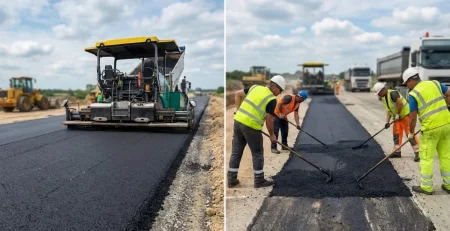
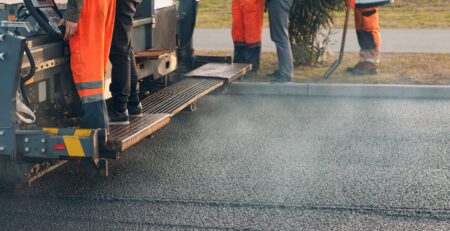
Even an appropriate material can become noisy when installation produces variable texture or abrupt level changes.
Critical workmanship controls include:
- Continuous paver movement
- Uniform material temperature
- Consistent aggregate distribution
- Correct compaction
- Smooth longitudinal joints
- Level transverse joints
- Stable edge restraint
- Clean drainage connections
- Accurate surface transitions
- Compatible repair materials
Segregated asphalt creates areas with different aggregate concentrations. Tyres crossing those areas may generate changing sound and vibration.
Poor compaction can reduce durability and create inconsistent void content. Excessive compaction may also change the intended texture of an open or thin surface system.
Industrial and commercial areas require particular attention at turning zones. The industrial yard surface structure shows why loading and manoeuvring patterns must influence the complete design.
Testing Acoustic Performance After Laying
Visual inspection cannot confirm whether a low-noise surface has achieved its intended acoustic result. Completion checks should combine construction records with surface and noise assessment.
Useful checks include:
- Surface regularity
- Macrotexture consistency
- Skid resistance
- Joint smoothness
- Void characteristics
- Drainage operation
- Ride quality
- Wet marking visibility
- Tyre-road noise where specified
- Early signs of segregation
Some noise evaluations are intentionally performed after traffic has used the surface. This allows the assessment to represent a settled condition rather than only the day of installation.
The result must be compared with an identified reference. A reduction figure has little meaning unless the reference material, vehicle speed, measurement method and surface age are known.
A 3 dB reduction represents half the sound energy, but it does not normally sound half as loud. A change of approximately 10 dB is more commonly associated with perceived doubling or halving of loudness.
Low-Noise Road Surfacing Materials Across Five UK Areas

Low-noise surfacing depends on the existing base, drainage route, expected vehicle use and installation conditions. These principles also support residential resurfacing where stable foundations and secure edges are essential.
Driveway Resurfacing in Bedfordshire
Bedfordshire driveways may contain concrete, asphalt, gravel or several repaired sections. Review driveway resurfacing in Bedfordshire before choosing an overlay or complete rebuild.
Driveway Resurfacing in Oxford
Oxford projects can involve restricted access, established boundaries and fixed drainage levels. Existing concrete should be assessed separately using the guidance on driveway resurfacing in Oxford .
Driveway Resurfacing in Cambridgeshire
Cambridgeshire ground conditions vary between individual properties. Where a permeable surface is considered, review driveway resurfacing in Cambridgeshire alongside the formation assessment.
Driveway Resurfacing in Essex
Essex driveways exposed to frequent turning need consistent base strength and reliable edge support. Owners comparing treatments can use a driveway resurfacing in Essex.
Driveway Resurfacing in Hertfordshire
Hertfordshire driveway design should account for existing levels, drainage routes and surface condition. Commercial sites can also review the Hertfordshire car park surface guide .
Frequently Asked Questions
Why does a road sound like a flat tyre?
An abrupt change in texture, concrete joints or surface regularity can create intense rumbling and vibration. If the sound continues after leaving that section, the tyres and vehicle should still be checked.
Can low-noise asphalt reduce noise inside homes?
It can reduce the tyre-road component reaching nearby properties, particularly beside higher-speed roads. Barriers, land shape, traffic composition and building insulation may still influence the final indoor result.
How long does a low-noise surface stay quiet?
There is no universal period. Traffic loading, aggregate wear, void clogging, repairs and maintenance determine how quickly acoustic performance changes.
Can a noisy road damage tyres or suspension?
Noise alone does not prove damage. Significant joint steps, potholes or surface defects can create physical impacts, so unusually severe vibration should prompt both road inspection and a vehicle check.
Why are some motorway sections louder when wet?
Water changes tyre contact and can increase spray or alter the sound produced beneath the tread. Standing water, worn texture and surface irregularities can make the difference more noticeable.