Can Ants and Weeds Actually Damage Block Paving?
Block paving is widely used for driveways, paths, courtyards and commercial areas because it provides an attractive, practical and durable surface. When properly installed and maintained, good-quality block paving can withstand regular vehicle and pedestrian traffic for many years.
However, because the surface consists of individual blocks with joints between them, those joints need to remain stable. Two surprisingly common problems are ants and weeds. Although neither is likely to cause catastrophic damage overnight, both can contribute to deterioration when they are allowed to become established.
Block paving damage from ants and weeds generally develops gradually. Ants can disturb the sand supporting and separating paving blocks, while weeds can establish themselves within joints where dirt and organic material have accumulated. Over time, these issues can contribute to loose blocks, widening joints and an increasingly untidy surface.
Understanding why these problems occur makes it much easier to prevent them from becoming expensive maintenance issues.
How Ants Can Affect Block Paving
Ants are particularly noticeable during warmer weather. A common sign of activity is a small pile of fine sand appearing around a paving joint, often accompanied by ants moving in and out of a tiny opening.
The ants are not eating the paving or directly attacking the blocks. The problem is their excavation.
When ants create nests beneath or around block paving, they move fine material to create tunnels and chambers. This can include jointing sand and, in some circumstances, material immediately beneath the paving blocks.
A small amount of displaced sand may seem insignificant. Persistent activity in the same area, however, can gradually reduce the support around individual blocks.
Why Jointing Sand Matters
The sand between paving blocks has an important structural function. It helps the individual blocks work together rather than behaving as completely separate units.
When sufficient jointing material is lost, blocks may have more opportunity to move. The joints can become increasingly open and further sand can then be washed or displaced from the surface.
This is why repeatedly sweeping away little piles of sand without investigating their cause may not be enough. If ants continually bring more material to the surface, the paving may eventually require maintenance.
The risk can be greater on paving that already has underlying installation or maintenance problems. Correct preparation is fundamental to the performance of any paved or surfaced area, which is why experienced domestic surfacing contractors consider the entire construction rather than simply the visible finished surface.
Can Ants Make Block Paving Sink?
Ant activity alone does not necessarily mean that a driveway will suddenly collapse. Nevertheless, localised settlement can potentially occur when supporting material is repeatedly disturbed.
A paving block relies on the construction beneath it to remain level and stable. If material is removed from a small area, the support can become uneven. Vehicle loading may then encourage an affected block to settle slightly lower than neighbouring blocks.
Once one part of the paving begins moving, additional problems can develop. Rainwater may collect in a depression, jointing sand may disappear more quickly, and neighbouring blocks can gradually become less stable.
If substantial sinking is present, it is important not to automatically assume that ants are the only cause. Poor ground preparation, inadequate compaction, drainage problems and deterioration beneath the surface can also produce settlement.
Visible ant activity can therefore sometimes highlight an area that was already vulnerable rather than being the sole cause of the problem.
Do Weeds Grow Through Block Paving?
One of the biggest misconceptions surrounding block paving is that every weed visible between the blocks must have grown all the way through the driveway from the soil underneath.
That is often not what has happened.
Seeds can be carried by wind, birds and general environmental activity before settling into paving joints. Dust, soil particles, leaves and other organic material also collect in these spaces over time. Once sufficient material has accumulated, the joint can provide an environment in which a seed can germinate.
The weed may therefore be growing within the material sitting in the joint rather than pushing upwards through the entire paving construction.
This distinction is important because simply assuming that weeds mean the original installation has failed can lead property owners to misunderstand the condition of their paving.
How Weeds Contribute to Block Paving Damage
A few small weeds are primarily an appearance and maintenance issue. Problems become more significant when vegetation is allowed to mature.
As weeds become established, their roots occupy space within the joints and disturb the material surrounding them. Removing larger weeds can also pull jointing material away, leaving partially empty joints behind.
Those openings can subsequently collect additional dirt and seeds, creating favourable conditions for further growth.
This creates a gradual cycle. Debris accumulates, weeds establish themselves, jointing material becomes disturbed, the joint opens further and still more material collects within the available space.
The result can be a driveway that becomes increasingly difficult to keep clean even though the paving blocks themselves remain in reasonable condition.
Why Water Can Make the Situation Worse
Water is an important factor in many external surfacing problems.
Where paving has become uneven, rainwater may begin collecting in localised depressions instead of draining away efficiently. Persistent moisture can encourage organic growth and make dirty paving joints more hospitable to weeds.
Water movement can also contribute to the loss of jointing material, particularly where joints are already depleted.
Drainage should therefore be considered as part of the overall condition of the paved area rather than as a completely separate issue. This principle applies to larger installations as well, where properly planned commercial surfacing needs to account for surface levels, usage and effective management of water.
If the same section of paving continually remains wet after surrounding areas have dried, it can be worth investigating why.
Signs That Ants or Weeds Are Becoming a Bigger Problem
Occasionally seeing ants or a small weed does not automatically mean that significant block paving damage has occurred. What matters is whether the condition of the surface is changing.
Repeated piles of excavated sand in the same location can indicate persistent ant activity beneath the paving. Similarly, joints that appear noticeably emptier than surrounding areas deserve attention.
Physical movement is more significant. Blocks that rock when walked over, paving that has developed local depressions, unusually wide joints or areas where blocks are no longer aligned can suggest that the surface needs more than routine cleaning.
Weed growth should also be monitored when it repeatedly returns in the same areas or becomes widespread across the paving.
At this stage, the aim should be to identify why the paving is deteriorating rather than repeatedly treating the visible symptom.
How Regular Maintenance Protects Block Paving
Routine maintenance is one of the simplest ways to reduce block paving damage from ants and weeds.
Keeping the surface swept limits the amount of soil, decomposing leaves and organic debris that can settle into the joints. With less growing material available, seeds have fewer opportunities to establish themselves.
Weeds are also easier to deal with while they are small. Allowing vegetation to mature gives the root system more time to develop within the joint.
Jointing material should be monitored as part of normal maintenance. If joints have become noticeably depleted, simply keeping the surface weed-free will not restore their stability. Appropriate jointing material may need to be reinstated.
Property owners should also pay attention to drainage and changes in surface levels. Early intervention is generally easier than waiting until numerous blocks require lifting and relaying.
Should You Pressure Wash Block Paving?
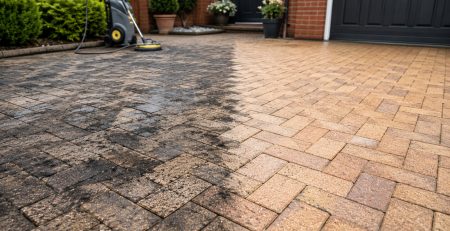
Pressure washing can improve the appearance of dirty paving, but it needs to be carried out carefully.
A powerful jet directed aggressively into the joints can remove jointing sand along with moss, dirt and weeds. The driveway may initially look considerably cleaner while actually having less material between the blocks than it had beforehand.
If pressure washing is used, the condition of the joints should therefore be checked afterwards and suitable jointing material reinstated where necessary.
Cleaning should be treated as maintenance rather than simply a cosmetic exercise. The objective is to remove unwanted contamination without unnecessarily disturbing the construction of the paving.
When Does Block Paving Need Professional Repair?
Minor weed growth or occasional ant activity can often be managed through normal property maintenance. Professional attention becomes more relevant when the paving itself starts moving.
Sunken blocks, repeated settlement, significant joint loss and unstable areas can indicate that work below the visible surface is required.
A common repair approach involves carefully lifting the affected paving blocks, inspecting the underlying area, correcting the bedding where necessary and relaying the existing blocks at the appropriate level. The exact repair will depend on what is found once the area is opened.
Where problems are widespread, it may also be necessary to investigate the original construction, drainage or loading conditions.
For property owners considering broader improvements to an ageing driveway, alternatives such as resin driveways may also be worth considering when replacement rather than localised repair becomes the more practical option.
Ants and Weeds May Be Symptoms of a Wider Issue
One of the most useful ways to think about ants and weeds is as potential indicators of changing conditions within a paved surface.
Ants are attracted to environments where they can successfully establish nests. Weeds establish themselves where seeds, moisture and suitable growing material are available. Neither automatically proves that a driveway was badly installed, but persistent problems deserve attention.
For example, repeated ant excavation accompanied by moving blocks suggests something different from a few ants crossing an otherwise solid driveway. Likewise, one weed in a dusty joint is different from widespread vegetation combined with open joints and standing water.
The condition of the whole surface provides the necessary context.
Why the Construction Beneath the Surface Matters
The visible paving blocks are only one component of a successful driveway.
The stability of any external surface depends heavily on what lies underneath it. Appropriate excavation, suitable supporting layers, effective compaction, correct levels and proper drainage all contribute to long-term performance.
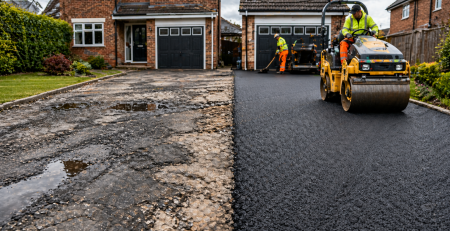
This principle applies across different types of surfacing. Professional tarmac installation and road surfacing similarly depends on preparation beneath the finished surface rather than simply the material that can be seen from above.
With block paving, a well-prepared construction provides individual blocks with consistent support. Where the underlying construction is already compromised, comparatively minor issues at surface level can develop into more noticeable movement.
That is why repairing an unstable area sometimes involves more than replacing lost jointing sand.
Protecting Block Paving Over the Long Term
The most effective approach is to address small changes before they develop into structural problems.
A block-paved driveway should be observed periodically for changes in levels, joint condition and drainage. Dirt and organic matter should not be allowed to build up indefinitely between the blocks, and weeds should be dealt with before they become deeply established.
Evidence of persistent ant excavation should also be monitored, particularly if substantial quantities of sand repeatedly appear around the same joints.
Most importantly, movement should not be ignored. A rocking or sinking block indicates that the support around or underneath it is no longer behaving as intended.
Early repairs can often remain relatively localised. Waiting until settlement spreads across a larger area can make restoration considerably more involved.
For owners and site managers who are unsure whether deterioration is superficial or related to the construction beneath the paving, an experienced surfacing contractor can assess the condition of the area and determine whether routine maintenance, local repair or more substantial resurfacing is appropriate. Further examples of professional surfacing work can be seen through Total Surfacing Solutions’ surfacing case studies.
Can Ants and Weeds Actually Ruin a Block-Paved Driveway?
Ants and weeds should not be viewed as an immediate threat to every block-paved driveway. A properly constructed and maintained surface is designed to remain stable despite normal exposure to the British climate and everyday outdoor conditions.
However, persistent ant activity can remove or disturb sand, while established weeds can disrupt joints and encourage further accumulation of organic material. Combined with water, depleted joints or existing settlement, these apparently minor problems can contribute to gradual deterioration.
The practical response is therefore prevention and early maintenance. Keep joints clean and appropriately filled, control vegetation before it becomes established, monitor persistent ant activity and investigate blocks that begin to move or sink.
A few ants or weeds may simply be a maintenance issue. Changes to the paving itself are the point at which closer attention becomes worthwhile.