What Causes Tyre Marks on New Tarmac?
Newly laid tarmac provides a smooth, clean and professional finish for driveways, access roads, car parks and commercial sites. However, shortly after installation, property owners and site managers can sometimes notice tyre marks appearing across the new surface. These marks may look concerning, particularly when the tarmac has only recently been completed.
Tyre marks on new tarmac are relatively common and do not automatically indicate that there is a problem with the installation. Fresh tarmac behaves differently from a surface that has been exposed to traffic and weather for several months. Vehicle movements, steering patterns, temperature and the weight of vehicles can all influence how a new surface responds.
Understanding why tyre marks occur makes it easier to distinguish normal early-life scuffing from signs that may require professional inspection.
Why Do Tyre Marks Appear on New Tarmac?
Tarmac is produced using aggregate bound together with bituminous material. Once it has been properly installed and compacted, it creates a strong surface capable of supporting regular vehicle traffic.
A newly installed surface, however, continues to settle and mature after the laying process has been completed. The bituminous binder can be more susceptible to movement and marking during this early period, particularly during warmer weather.
When vehicle tyres move across the surface in a straight line, they generally place relatively little sideways stress on the tarmac. Problems are more likely to occur when tyres are turned sharply, particularly while the vehicle itself is barely moving.
The resulting friction can produce visible scuffs or tyre marks.
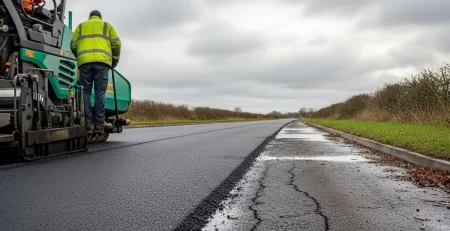
Correct tarmac installation and road surfacing is important because proper preparation, laying and compaction provide the foundation required for a durable finished surface.
Stationary Steering Is a Common Cause of Tyre Marks
One of the most frequent causes of tyre marks on new tarmac is stationary steering, sometimes referred to as dry steering.
This happens when a driver turns the steering wheel while the vehicle is stationary. Although the car is not travelling forwards or backwards, the tyres are rotating against the same area of surface.
Modern vehicles can make this particularly noticeable because power steering allows drivers to turn the wheels easily while stationary. The tyres can consequently place considerable twisting force onto a very small section of tarmac.
On an established road surface this may have little visible effect. On fresh tarmac, however, the same action can create a dark scuff, slight indentation or disturbed area.
Keeping the vehicle moving gently while turning reduces the amount of concentrated sideways force being applied to the surface.
Why Tight Turns Can Scuff Fresh Tarmac
Stationary steering is not the only cause. Tight manoeuvres can create similar effects even when the vehicle is moving.
This is particularly relevant on smaller driveways, compact commercial yards, parking areas and entrances where vehicles have limited space in which to turn.
During a tight turn, the tyres do not simply roll forwards. They also generate lateral forces as the vehicle changes direction. The tighter the steering angle, the greater the potential for the tyre to scrub against the surface.
Repeated manoeuvring in the same location can make these marks particularly noticeable.
Commercial sites can experience additional pressure where delivery vehicles regularly turn within loading areas or entrances. For these environments, appropriate commercial surfacing should take account of the expected traffic, vehicle types and day-to-day use of the site.
Warm Weather Can Make Tyre Marks More Noticeable
Temperature has an important influence on how bituminous surfaces behave.
Tarmac is designed to withstand normal variations in UK weather, but its characteristics can change as temperatures rise. On hot and sunny days, the surface can become more susceptible to scuffing from vehicle tyres.
A surface that appears completely firm during cooler conditions may therefore respond differently during prolonged warm weather.
This does not necessarily mean the tarmac has been incorrectly installed. It reflects the properties of bituminous materials and is one reason drivers should avoid unnecessary stationary steering and aggressive manoeuvres on recently surfaced areas.
The combination of a new surface, warm weather and a vehicle performing a tight stationary turn creates particularly favourable conditions for visible tyre scuffing.
Do Heavy Vehicles Cause More Marking?
Vehicle weight can also influence the appearance of tyre marks on new tarmac.
A heavier vehicle places greater pressure onto the surface through its tyres. When that pressure is combined with sharp steering or repeated turning, the stresses placed on the tarmac increase.
This is particularly relevant for commercial access roads, industrial yards, loading areas and car parks where vans, delivery vehicles or larger commercial vehicles may operate regularly.
The issue is not simply the overall weight of the vehicle. How that weight is transferred through the tyres during braking, acceleration and turning is also important.
Surfaces expected to accommodate regular commercial traffic should therefore be designed and installed for their intended use. Machine-laid tarmac can provide a consistent finish across larger areas where suitable site conditions and project requirements allow.
Are Tyre Marks on New Tarmac Permanent?
Many light tyre marks are cosmetic rather than structural.
Fresh tarmac has a particularly uniform appearance, which means even relatively minor marks can stand out. As the surface is exposed to normal weather and traffic, its appearance gradually changes and small differences can become much less noticeable.
Some light scuffing may therefore become less prominent naturally.
There is an important distinction, however, between surface marking and actual deformation.
A superficial dark mark left by a tyre is different from an area where the aggregate has moved, the surface has been torn or a noticeable indentation has developed.
Where physical deformation is occurring repeatedly, professional assessment may be appropriate to determine whether the problem is simply associated with early use or whether another factor is affecting the surface.
How Long Does New Tarmac Take to Settle?
There is no single period after which every tarmac surface suddenly becomes completely mature. Conditions vary according to the materials used, weather, surface construction, traffic and the nature of the site.
Tarmac is compacted as part of the installation process and is intended to develop a durable traffic-bearing surface. However, its characteristics continue to change after installation.
This is why sensible use during the early life of the surface can help preserve its appearance.
Property owners should pay particular attention to how vehicles enter, park and turn. Avoiding concentrated twisting forces can make a significant difference, especially where the same parking or turning manoeuvre occurs every day.
How Can You Reduce Tyre Marks on Fresh Tarmac?
The most effective approach is to reduce unnecessary sideways pressure from vehicle tyres.
Drivers should avoid turning the steering wheel while completely stationary wherever practical. Allowing the vehicle to roll slowly as the steering angle changes spreads the forces over a larger area instead of concentrating them on one point.
Very tight turns should also be minimised where sufficient space is available.
On commercial sites, traffic management can play an important role. If large vehicles repeatedly perform tight turns in one small location, that part of the surface experiences considerably different stresses from an area used primarily for straight-line traffic.
Planning vehicle routes and turning areas carefully can therefore contribute to longer-term surface performance.
For existing sites where deterioration has progressed beyond cosmetic tyre marks, professional pothole repairs and other appropriate repair methods may be required depending on the type and extent of the damage.
Does Proper Tarmac Installation Prevent Tyre Marks?
Professional installation is fundamental to creating a durable surface, but it does not mean a newly laid area can never show a tyre scuff.
A successful surfacing project depends on much more than the visible top layer. Site preparation, the condition of the underlying construction, drainage, material selection, laying methods and compaction all contribute to the finished result.
The intended use of the area must also be considered.
A residential driveway carrying a small number of cars each day has different requirements from a busy commercial access road used by delivery vehicles. Similarly, an area subject to frequent turning movements may experience different stresses from a straightforward access route.
Experienced surfacing contractors can assess these practical requirements before recommending an appropriate approach for the site.
When Should Tyre Marks Be Investigated?
Light surface scuffs shortly after installation are generally very different from ongoing physical deterioration.
If marks are accompanied by significant indentations, displaced material, cracking or obvious movement of the surface, the affected area may benefit from inspection.
The pattern of the damage can provide useful information. A mark that appears exactly where vehicles routinely perform tight turns may indicate tyre scrubbing, while widespread deformation could suggest that further investigation is required.
Site managers should also monitor whether the issue is stabilising or becoming progressively worse. A few cosmetic marks that become less noticeable with time present a different situation from areas that continue to deform under ordinary vehicle movements.
Where there is uncertainty, obtaining advice from an experienced surfacing contractor can help determine whether any remedial action is necessary.
Tyre Marks on Commercial Tarmac Surfaces
Commercial sites can be particularly susceptible to tyre scuffing because their traffic patterns are often repetitive.
Delivery vans may enter through the same gate, turn in the same loading area and leave along the same route several times each day. Larger vehicles may also need to manoeuvre at sharper angles because of restricted space.
These repeated movements concentrate wear in specific locations.
This is why commercial surfacing should be considered in relation to how a site actually operates rather than simply the size of the area being surfaced. Vehicle weights, turning movements, parking arrangements and drainage requirements all affect long-term performance.
A well-planned surface should provide safe and practical access while being suitable for the level and type of traffic expected.
The Difference Between Cosmetic Scuffing and Surface Damage
The appearance of tyre marks on new tarmac can sometimes make a minor issue look more serious than it is.
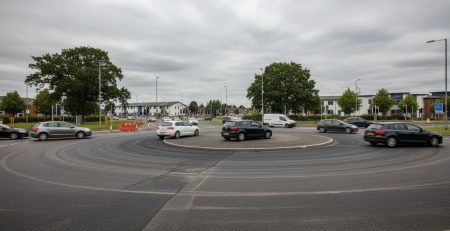
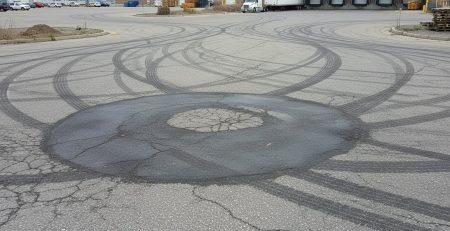
Cosmetic scuffing generally affects the appearance of the surface without significantly changing its shape or structural performance. It may appear as darker patches, curved tyre patterns or light abrasions corresponding with steering movements.
Surface damage is more significant. This may involve visible displacement, depressions, tearing or progressive deterioration.
Recognising the difference prevents unnecessary concern while also ensuring genuine problems are not ignored.
If the surface remains level, intact and stable, minor tyre marks are often primarily an appearance issue. If the tarmac is physically moving or deforming during normal vehicle use, further assessment is sensible.
Protecting the Long-Term Appearance of New Tarmac
New tarmac is designed to provide a durable surface, but the way it is used still influences its long-term condition.
Avoiding stationary steering, reducing unnecessarily tight turns and managing heavy vehicle movements can all help limit early scuffing. These habits are particularly useful during warmer weather and during the early life of a newly surfaced area.
Regular observation is also worthwhile. Small changes in appearance are not necessarily cause for concern, but monitoring the surface makes it easier to identify genuine deterioration before it develops into a larger repair requirement.
For property owners and commercial site managers considering a new surface, appropriate preparation and professional installation remain central to long-term performance. Examples of completed surfacing work can also be viewed through road surfacing case studies, providing an indication of how different sites and surfacing requirements can be approached.
Tyre marks on new tarmac are therefore often a normal consequence of the interaction between fresh bituminous material, vehicle tyres, steering forces and temperature. Sensible vehicle movements and appropriate surface design can minimise their appearance while helping the tarmac deliver reliable performance over the longer term.