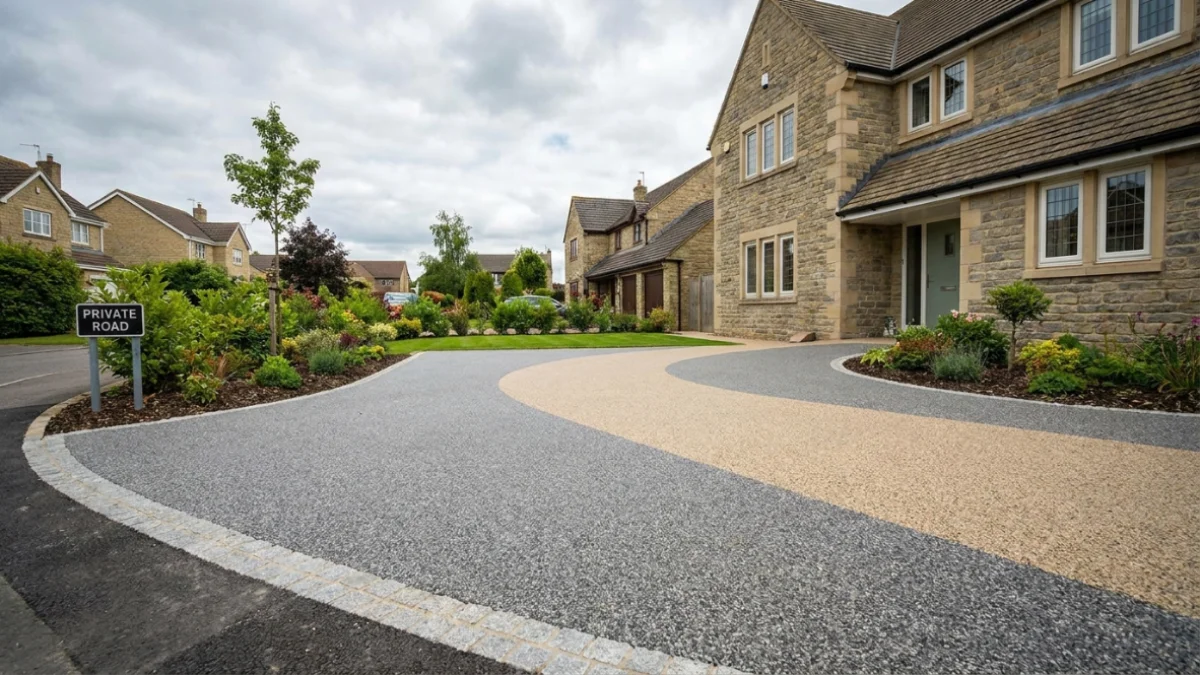
Modern Resin Driveway Designs for UK Homes
Modern driveways need more than a clean-looking surface. A poor base, wrong resin system, weak drainage plan, or low-grade installation can lead to cracking, sinking, staining, or planning issues within a few years. The serious step is to check Legal Requirements & SuDS Compliance, inspect the base, compare proper materials, and understand real cost drivers before choosing the design. The experienced solution is a resin-bound driveway built around drainage, durability, colour balance, and correct groundwork.
Quick clue: the best modern resin driveway is permeable, UV-stable, properly based, and designed around the house style.
Modern Resin Driveway Designs for UK Homes
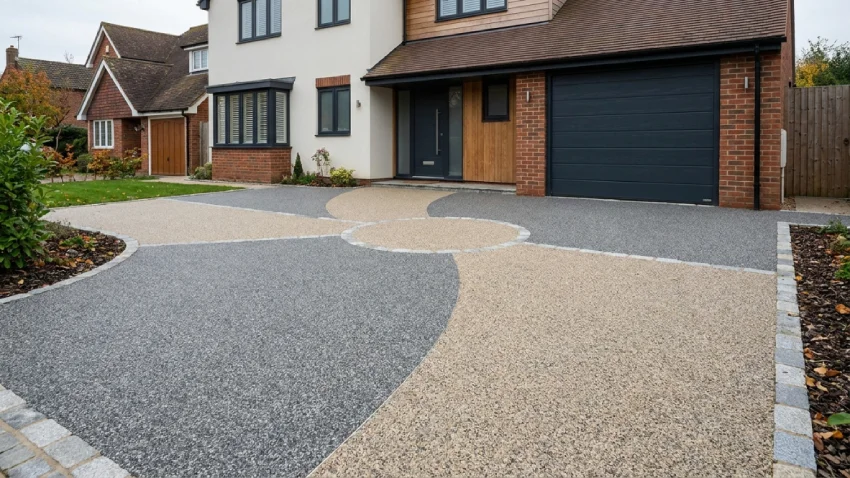
Modern Resin Driveway Designs for UK Homes should balance kerb appeal with drainage, strength, and daily use. A good design starts with the ground, then builds the look around the property.
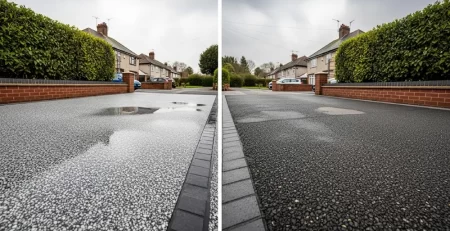
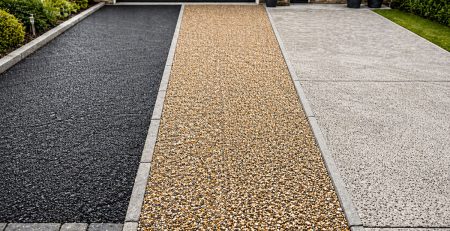
A modern resin driveway can create a smooth, seamless entrance that suits brick, render, glass, black frames, garage doors, and landscaped front gardens. It also works well for clean driveway lines, curved borders, contrast edging, and low-maintenance surfaces.
The mistake many homeowners make is choosing a colour sample first. The better order is to check the existing base, drainage route, traffic load, slope, and planning position before deciding on the stone blend or border detail.
A complete design should consider:
- Resin-bound or resin-bonded system
- Existing driveway condition
- Drainage and SuDS compliance
- Sub-base strength
- DPC and threshold levels
- Vehicle weight and turning
- Colour and aggregate size
- Edging and access covers
- Maintenance access
A specialist such as Total Surfacing Solutions can help assess whether the existing driveway is suitable for overlay or whether a full installation is needed.
For homeowners comparing resin driveways with block paving, tarmac, gravel, or concrete, the key advantage is the combination of smooth finish, modern styling, and permeability when built correctly.
| Design Factor | Why It Matters | Best Check |
| Base condition | Prevents cracks and sinking | Survey before quote |
| Drainage | Avoids planning issues | SuDS route |
| Resin type | Controls durability | Bound vs bonded |
| Colour | Affects kerb appeal | Match property |
| Traffic load | Affects depth and finish | Cars, vans, SUVs |
The strongest design looks simple because the technical details underneath have already been solved.
Legal Requirements & SuDS Compliance: Avoid Delays
Legal Requirements & SuDS Compliance affect many UK front driveways, especially where homeowners replace lawns, extend parking, or use impermeable surfaces. A modern resin design should manage water before colour is chosen.
In the UK, front garden paving rules focus heavily on surface water runoff. If a driveway uses a permeable surface or drains into a lawn, border, soakaway, or other permeable area, planning permission is often avoided.
The risk starts when an impermeable surface covers more than 5m² and sends water toward drains, the road, or neighbouring land. That can create planning issues and drainage problems.
Resin-bound systems are usually preferred for modern driveways because the aggregate and resin are mixed together, creating a smooth and permeable finish when installed over a suitable base.
A correct resin bound surfacing specification should include the surface layer, base layer, drainage route, edging, and site preparation. Permeability depends on the full build-up, not only the top resin layer.
Check these legal and practical points:
- Is the surface permeable?
- Where does rainwater drain?
- Is the driveway over 5m²?
- Is a dropped kerb required?
- Are you in a conservation area?
- Are there estate or covenant rules?
- Will the finished level protect the DPC?
| Situation | Likely Concern | Better Action |
| Permeable resin system | Usually lower planning risk | Confirm full build-up |
| Resin-bonded surface | May be non-permeable | Check drainage |
| New driveway access | Dropped kerb needed | Apply to the council |
| Water runs to the road | Planning issue | Add drainage route |
| Conservation area | Extra restrictions | Check local rules |
Legal checks are not paperwork for the sake of it. They protect your driveway investment from later disputes, drainage failures, and unnecessary rework.
The Groundwork: Why the Sub-Base Matters: Build Right
The Groundwork: Why the Sub-Base Matters is the most important technical decision in a resin driveway project. Resin is a finish layer, not a structural foundation.
The resin surface can only perform as well as the layers beneath it. If the base moves, holds water, cracks, or sinks, the resin surface can mirror those problems. This is why many failed resin driveways trace back to poor preparation.
A strong build-up may include:
| Layer | Typical Role | Why It Matters |
| Resin-bound surface | Smooth wearing course | Final finish |
| Open-graded tarmac | Stable binder course | Permeable support |
| Type 3 sub-base | Structural drainage layer | Water movement |
| Geotextile membrane | Separation layer | Reduces soil mixing |
| Compacted subgrade | Ground foundation | Load support |
You should not lay resin directly onto loose gravel, soil, unstable block paving, or cracked concrete. Block paving can move at the joints and cause reflective cracking through the resin surface.
Existing tarmac or concrete may be suitable only when it is stable, clean, crack-free, and structurally sound. If it is damaged, the surface may need repair or full removal before resin is installed.
This matters when comparing Resin Driveways for new builds or older homes. New build driveways often hide service trenches and settlement risks, while older drives may hide cracks, drainage defects, or weak repair patches.
| Base Problem | Common Failure |
| Loose gravel base | Rutting and movement |
| Thin sub-base | Sinking and cracks |
| Dense base with poor drainage | Water trapping |
| Cracked concrete | Reflective cracking |
| No edge restraint | Frayed borders |
A proper quote should explain the base. If the quote only talks about colour and square metres, it is missing the most important part.
Bound vs Bonded Resin: Choose Correctly
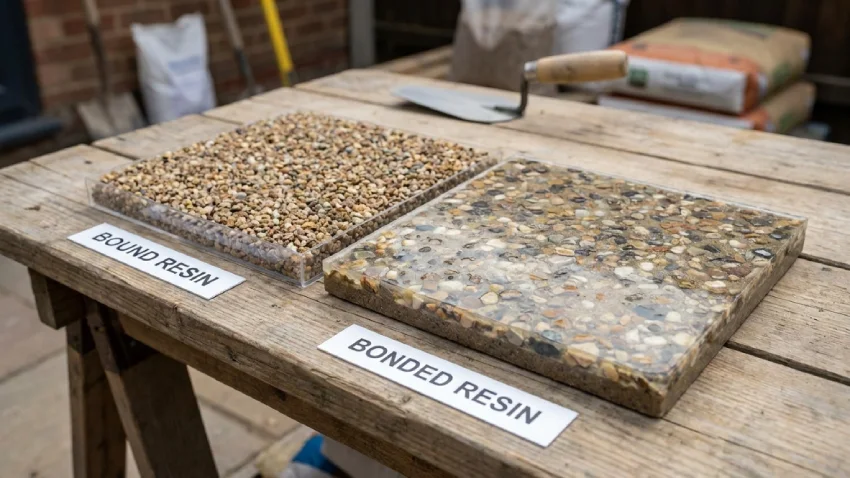
Bound vs Bonded Resin is one of the biggest design decisions because the two systems look similar in name but perform very differently. A modern UK home usually needs the bound system.
A resin-bound surface is created by mixing aggregate and resin before trowelling it onto the base. This creates a smooth, seamless, permeable surface when installed correctly.
A resin-bonded surface is different. Resin is spread over a base, then aggregate is scattered over the top. It can look like loose gravel, but it is usually less permeable and can shed stones faster.
A quick comparison:
| Feature | Resin Bound | Resin Bonded |
| Installation | Mixed before laying | Stone scattered onto resin |
| Finish | Smooth and seamless | Textured gravel-like |
| Permeability | Usually permeable | Often not permeable |
| Maintenance | Easier to clean | More loose stones |
| Modern driveway use | Usually preferred | More limited |
For most modern front driveways, resin-bound is the stronger choice because it gives a clean finish, better drainage potential, and a more premium look.
Terms such as resin-coated driveways can create confusion because people use them casually for different systems. The safer approach is to confirm whether the installer means resin-bound or resin-bonded before agreeing to the quote.
For area-specific examples, homeowners can review resin coated driveways in Bedfordshire or resin bound surfaces in Cambridgeshire to understand how local service pages position the correct system.
The wording matters because the wrong system can affect drainage, planning, long-term durability, and appearance.
Cost Breakdown for UK Homes: Price Clarity
Cost Breakdown for UK Homes should focus on scope, not only a headline square-metre price. Resin driveway prices change sharply depending on whether the work is an overlay or a full construction.
An overlay is usually cheaper because the installer uses an existing tarmac or concrete base. This only works when the base is clean, strong, stable, crack-free, and suitable.
A full excavation costs more because it includes digging out the old surface, preparing the sub-base, installing edging, laying binder, managing drainage, and then applying resin.
Typical UK cost factors include:
- Driveway size
- Overlay or full excavation
- Base condition
- Edging choice
- Drainage work
- Aggregate quality
- UV-stable resin
- Access covers
- Waste removal
- Labour and location
A useful guide:
| Project Type | Typical Price Direction | Notes |
| Overlay only | Lower cost | Needs a perfect base |
| Partial repair and overlay | Mid-range | Depends on cracks |
| Full excavation | Higher cost | Best for weak ground |
| Premium design | Higher cost | Borders and details |
| Complex drainage | Higher cost | Extra groundwork |
Homeowners researching driveway cost should ask what is included. A cheap price may leave out base depth, drainage, proper edging, UV resin, or access cover upgrades.
For detached and semi-detached homes, Best Resin Driveways can help compare driveway shape, parking load, borders, and property style.
The best quote is not always the lowest. It is the one that explains the base, resin type, drainage route, and finish detail clearly.
Colour and Finish Choices: Kerb Appeal
Colour and Finish Choices should suit the house, not only the sample board. The best resin driveway colour works with brick, render, doors, windows, roofline, borders, and landscape planting.
Grey, silver, and granite-style blends suit many modern UK homes with black windows, white render, or anthracite garage doors. Warm gold, bronze, and natural stone blends suit red brick, buff brick, and softer traditional frontages.
Avoid choosing ultra-light aggregate only because it looks clean on a sample. Short driveways with tight turning circles can show black tyre marks faster, especially where cars turn while stationary.
Use UV-stable resin for visible front driveways. Non-UV resin can yellow or discolour, which can change the appearance of pale grey, cream, and light stone blends.
For colour planning, Best Resin Driveway Colours can help match aggregate blends with house materials.
| House Style | Resin Colour Direction |
| White render | Silver, soft grey, mixed stone |
| Red brick | Bronze, golden, warm natural |
| Grey brick | Graphite, granite, cool grey |
| Black frames | Dark border, mid-grey centre |
| Traditional frontage | Natural buff or mixed gravel tone |
Finish details also matter. Clean borders, recessed covers, curved edges, and neat transitions can make the surface look designed rather than simply installed.
Area Coverage for Modern Resin Driveway Designs
Modern Resin Driveway Designs for UK Homes need local planning awareness, ground checks, and finish decisions. Bedfordshire, Cambridgeshire, Essex, Hertfordshire, and Oxford homes each need area-sensitive driveway planning.
Resin Bound Surfaces In Bedfordshire
Bedfordshire homes often include a mix of new estates, semi-detached houses, detached homes, and compact front parking layouts. Resin works well here when the design balances kerb appeal with practical access and drainage.
For resin bound driveways bedfordshire, the first check should be the current base. Older tarmac, cracked concrete, or thin developer surfacing may not be suitable for overlay. A proper survey should check edges, falls, service covers, DPC height, and parking load.
Bedfordshire homeowners should also think about colour harmony. Grey resin blends suit modern brick and black-framed homes, while warmer tones suit red brick properties. A clean border can make a small frontage look more intentional.
Resin Bound Surfaces In Cambridgeshire
Cambridgeshire driveways often need careful drainage thinking because many plots are flat or close to garden boundaries. A resin-bound surface can work well when the sub-base and water route are designed properly.
For resin bound driveways cambridgeshire, the base should be checked before the design is finalised. If the existing surface is dense, cracked, or uneven, a full build-up may be safer than a thin overlay.
Cambridgeshire homeowners should also ask about SuDS compatibility, edging, and access cover treatment. A modern driveway should look clean, but it also needs to move water away from the house and stay stable under daily vehicle use.
Resin Bound Surfaces In Essex
Essex homes often place strong value on frontage appearance, parking space, and property presentation. Resin can provide a clean, premium look, but the design must handle turning marks, delivery vehicles, and daily use.
For resin bound driveways essex, vehicle movement should be discussed early. Short driveways, SUVs, and tight turning areas may need stronger edging and darker or mixed aggregate blends to reduce visible tyre marking.
Essex homeowners looking for resin bound driveways installers should focus on technical answers, not just photos. Ask about UV resin, sub-base depth, drainage route, and how the installer handles manhole covers.
Resin Bound Surfaces In Hertfordshire
Hertfordshire homes often suit modern grey, silver, and granite-style resin finishes, especially where properties have black windows, rendered elevations, or contemporary landscaping. The design should still begin with the base.
A grey resin bound surface can look sharp, but it needs UV-stable resin to protect the colour over time. Pale grey surfaces can also show tyre marks if vehicles turn tightly in the same spot.
If the current drive or access route is damaged, pothole repairs in hertfordshire may be needed before any final surfacing plan. A resin layer should not be used to hide structural defects.
Resin Bound Surfaces In Oxford
Oxford homes often need sensitive design choices because kerb appeal, materials, and planning context can matter more. Resin can suit modern and traditional homes when colour, edging, and drainage are handled carefully.
For Oxford homeowners comparing resin coated driveways, the wording should be clarified before work starts. A proper resin-bound system is different from a resin-bonded surface, and that difference affects drainage, texture, and maintenance.
Oxford driveways should use neat edging, discreet access covers, and colours that match the house rather than overpower it. Soft grey, natural stone, and warm buff blends often work well depending on brick, render, and landscaping.
Maintenance and Longevity: Protect the Surface
Maintenance and Longevity depend on the base, resin quality, UV stability, drainage, and cleaning routine. A good resin driveway can last well, but poor care or weak installation can shorten its life.
Regular sweeping removes leaves, grit, seeds, and organic debris. Washing helps reduce stains, algae, and tyre marks. Oil spills should be handled quickly because they can mark the surface if left too long.
For cleaning advice, clean driveway guidance is useful. Use sensible pressure-washing methods and avoid aggressive blasting that could loosen the surface.
Modern homeowners should also think about seasonal use. Rock salt can usually be used carefully, but metal snow shovels can scratch or damage the surface. Plastic tools are safer for winter clearing.
A contractor such as Total Surfacing Solutions can help with installation planning and long-term surface expectations. The goal is a driveway that looks good after years of use, not only on the handover day.
| Maintenance Task | Why It Helps |
| Sweep leaves | Reduces organic staining |
| Wash tyre marks early | Keeps colour cleaner |
| Clear drainage areas | Prevents pooling |
| Remove oil quickly | Reduces staining |
| Avoid metal shovels | Protects surface |
| Check edges | Finds early movement |
A strong installation and simple maintenance routine protect the finish, improve kerb appeal, and reduce avoidable repair costs.
Frequently Asked Questions: Modern Resin Driveways
1. Are modern resin driveways worth it?
Yes, when installed correctly. Resin-bound driveways offer a smooth, modern finish, good kerb appeal, permeability, and low maintenance. The value depends heavily on the base, drainage, resin type, and installer quality.
2. Do resin driveways need planning permission in the UK?
A permeable resin-bound driveway usually avoids planning permission when water drains naturally. Impermeable surfacing over 5m² may need permission if water is not directed to a permeable area.
3. What is the best base for a resin driveway?
A stable, clean, load-bearing base is essential. Open-graded tarmac or suitable concrete can work. Loose gravel, soil, unstable block paving, cracked bases, and weak sub-bases should be avoided.
4. Is resin-bound better than resin-bonded?
For most modern UK driveways, resin-bound is the better choice because it is smoother, more premium-looking, and usually permeable. Resin-bonded surfaces are more textured and can shed stones faster.
5. How much does a resin driveway cost in 2026?
Costs vary by size and groundwork. Overlay work may sit in a lower range, while full excavation with sub-base, edging, and drainage can cost much more. Always compare the full specification, not only the m² price.