Health & Safety Line Marking Requirements for Warehouses
Warehouse safety fails when workers, forklifts, pallets, loading bays, and restricted zones share space without clear visual control. The serious action is to mark safe walkways, forklift lanes, hazard zones, storage areas, and emergency access points before confusion leads to accidents. The experienced solution is a practical marking system that supports Forklift Lanes, a clear Color Coding System, and regular Layout Updates as warehouse operations change.
Quick clue: warehouse line marking should show where people walk, where vehicles move, where danger begins, and where access must stay clear.
Health & Safety Line Marking Requirements
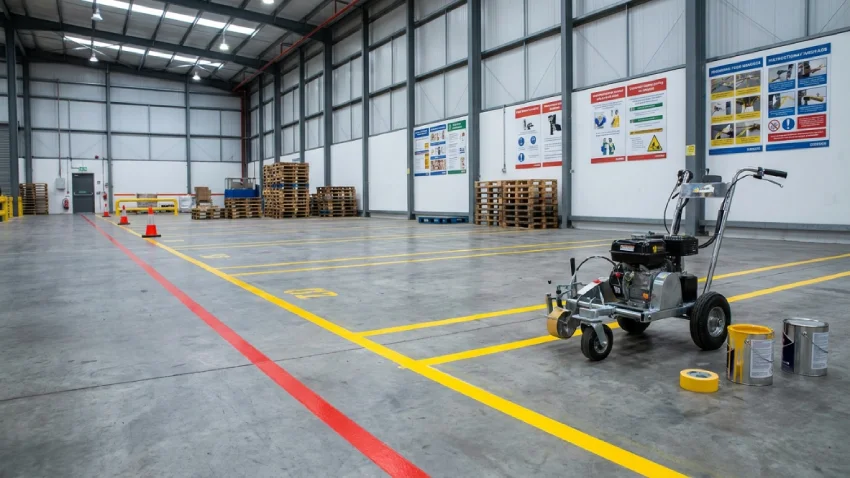
Health & Safety Line Marking Requirements for Warehouses begin with clear movement control. This section explains the core marking areas every warehouse should review before daily operations become harder to manage.
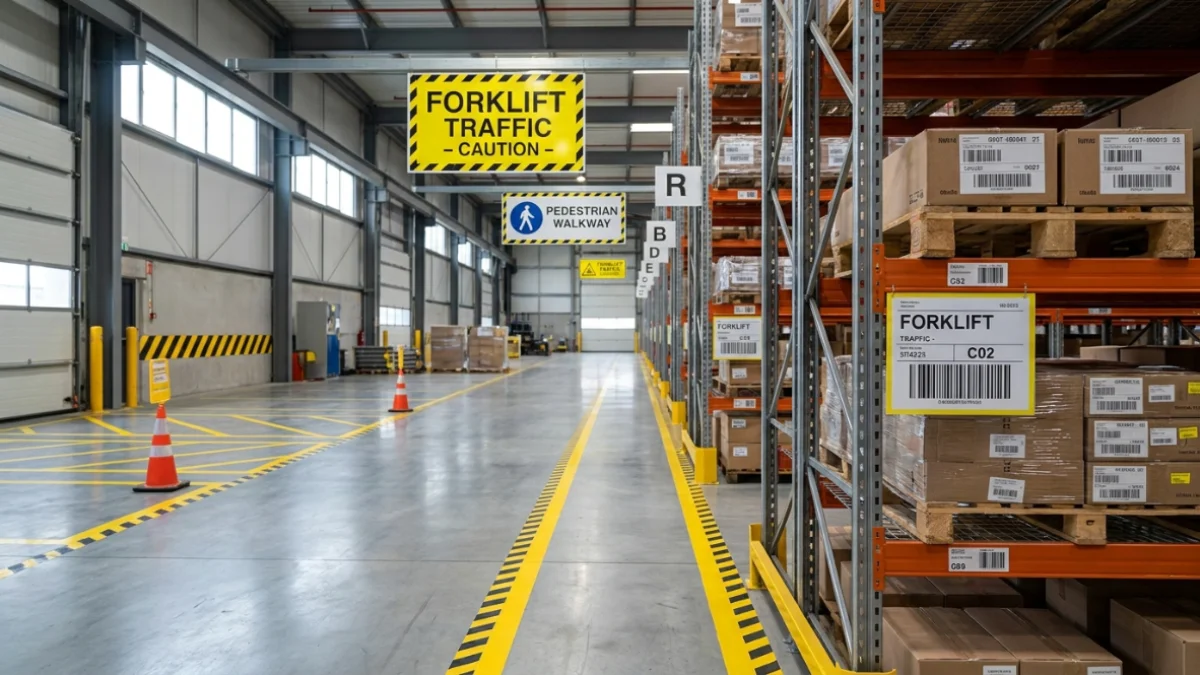
Warehouses need markings because people make faster decisions when the floor gives clear instructions. A busy worker should not need to guess where to walk, where forklifts turn, or where pallets can be stored. The markings should match the real movement of staff, vehicles, stock, and visitors.
A strong warehouse marketing plan should include:
- Pedestrian walkways
- Forklift lanes
- Loading bay boundaries
- Hazard zones
- Restricted access areas
- Fire exit keep-clear zones
- Pallet storage bays
- Crossing points
- No-parking zones
- Emergency access routes
A professional contractor, such as Total Surfacing Solutions can help plan markings around the actual layout, not just the empty floor. Good line marking should support the way workers and vehicles move during real shifts.
| Warehouse Area | Marking Requirement | Safety Purpose |
| Walkways | Clear pedestrian lines | Safer movement |
| Forklift routes | Vehicle lanes | Collision control |
| Loading bays | Exclusion zones | Crush risk reduction |
| Fire exits | Keep-clear boxes | Emergency access |
| Storage zones | Defined bays | Less obstruction |
The aim is simple. A visitor, new starter, forklift driver, or warehouse operative should understand the safe route quickly by looking at the floor.
Forklift Lanes: Safer Vehicle Routes
Forklift Lanes are one of the most important marking requirements in active warehouses. This section explains how marked lanes control powered vehicle movement and reduce serious collision risk.
Forklifts, pallet trucks, and warehouse vehicles create risk because they move near people and stock. When routes are unclear, drivers may take shortcuts, reverse more often, or pass too close to pedestrian areas. Clear forklift lanes make vehicle movement predictable.
Effective forklift lane marking may include:
- Dedicated travel lanes
- Directional arrows
- Stop lines
- Give-way points
- Crossing areas
- Reversing exclusion zones
- Loading bay approach lines
- Speed-control zones
- Parking bays
Clear forklift lane markings help drivers understand where vehicles should move and where pedestrians may cross. They also help supervisors spot unsafe movement faster.
Forklift lane planning should consider blind corners, doorways, racking aisles, loading bays, and high-traffic junctions. These are the points where near misses often happen.
| Forklift Area | Marking Needed | Risk Controlled |
| Main aisle | Lane lines | Route confusion |
| Junction | Stop or give-way marking | Side impact |
| Loading bay | Exclusion boundary | Crush injury |
| Reversing area | Keep-out box | Pedestrian contact |
| Parking area | Forklift bay | Obstruction |
Forklift markings should not work alone. They should be supported by signs, mirrors, lighting, training, barriers where suitable, and regular layout review.
Colour Coding System: Faster Decisions
A colour-coding system helps warehouse workers read the floor quickly. This section explains how colour consistency improves safety decisions, route control, and day-to-day compliance.
Colour coding works because it is immediate. Workers can recognise a danger zone, walkway, storage area, or restricted space faster than reading written instructions every time. This is useful in noisy warehouses where speed and attention matter.
A warehouse colour system should stay simple. Too many colours can create confusion. The best system uses a limited set of colours and applies them consistently across every zone.
Common uses may include:
- Yellow: walkways, traffic routes, caution areas
- Red: restricted or danger zones
- Green: safe routes, first aid, emergency access
- Blue: equipment or information zones
- White: storage boundaries or general markings
- Black/yellow: high-risk edges or hazard warnings
Clear industrial floor marking can help warehouses define colour use, line styles, warning areas, and traffic routes in one system.
A practical colour table:
| Colour | Warehouse Use | Worker Message |
| Yellow | Walkways and caution | Move carefully |
| Red | Restricted zones | Do not enter |
| Green | Emergency or safety | Safe access |
| White | Storage and boundaries | Keep organised |
| Black/yellow | High-risk hazard | Stay alert |
The colour system should be explained in staff training. If yellow means pedestrian walkway in one area, it should not mean pallet storage somewhere else. Consistency keeps the system easy to follow.
Layout Updates: Keep Markings Relevant
Layout Updates keep warehouse markings aligned with real operations. This section explains why safety markings must change when routes, racking, storage, machinery, or traffic patterns change.
Warehouse layouts do not stay fixed. New racking is installed, dispatch routes change, picking areas expand, and loading points become busier. If the markings stay the same while the work changes, people begin to ignore them.
Line marking should be reviewed after:
- New racking installation
- Changed forklift routes
- New loading or dispatch process
- Increased stock levels
- Machine relocation
- Repeated near misses
- Fire route changes
- Storage zone changes
- Floor resurfacing
- Site expansion
A layout update should start with real movement. Watch where people walk, where forklifts turn, where pallets block aisles, and where drivers pause. Then adjust the markings to guide safer behaviour.
| Change in Warehouse | Marking Update Needed |
| New racking | Update aisle and storage lines |
| New forklift route | Add lane and direction arrows |
| More dispatch traffic | Redesign loading bay markings |
| Blocked walkways | Adjust storage boundaries |
| Near miss at junction | Add stop or warning zone |
Strong health & safety line marking should never be treated as a one-time job. It should be reviewed whenever the warehouse changes.
A contractor such as Total Surfacing Solutions can help refresh markings when the site layout or traffic pattern needs improvement.
Hazard Zones: Control High-Risk Areas
Hazard zones must be clearly marked so workers can recognise danger before stepping into it. This section explains how warehouse markings support restricted access and high-risk area control.
Some hazards are obvious, such as loading bays or moving forklifts. Others are less obvious, such as battery charging areas, chemical storage, machine access points, blind corners, or falling-object zones. Line marking makes those areas visible before an accident happens.
Important hazard zones include:
- Loading bay edges
- Machine operating zones
- Battery charging areas
- Chemical storage areas
- Restricted maintenance zones
- Fire equipment access
- Emergency exit routes
- Waste collection areas
- Pallet stacking limits
- Forklift reversing areas
Clear hazard zone markings in industrial facilities help workers understand where risk increases. They also help supervisors enforce site rules.
| Hazard Zone | Marking Purpose | Safety Result |
| Loading bay | Shows exclusion boundary | Reduces crush risk |
| Machine area | Keeps workers clear | Reduces contact risk |
| Fire equipment | Keeps access open | Faster response |
| Chemical zone | Controls entry | Reduces exposure |
| Blind corner | Warns traffic | Reduces collision risk |
Hazard markings should be visible, clean, and easy to understand. If a hazard line fades or becomes covered by stock, the warning is weakened.
Pedestrian Routes: Separate People and Vehicles
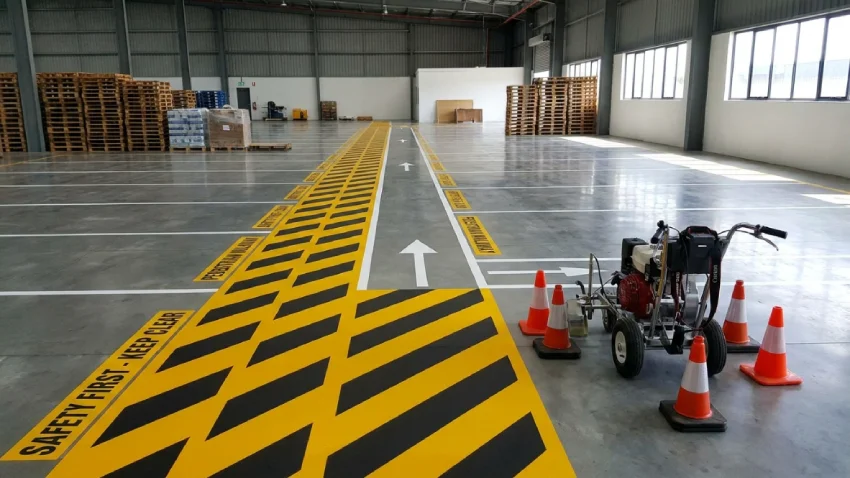
Pedestrian routes should be separated from vehicle routes wherever possible. This section explains how warehouse line marking reduces conflict between people, forklifts, and moving goods.
The safest warehouse traffic plans reduce the number of places where people and vehicles meet. Where complete separation is not possible, marked crossings, stop lines, barriers, signs, and warning zones become important.
Pedestrian markings may include:
- Dedicated walkways
- Crossing points
- Doorway warning boxes
- Visitor routes
- Staff entrance routes
- Keep-clear access lanes
- No-walk vehicle zones
- High-visibility boundary lines
Clear line marking can help prevent warehouse accidents by making pedestrian and vehicle expectations visible. Workers should know where to walk without cutting through forklift lanes.
| Pedestrian Risk | Marking Solution |
| Walking through vehicle lanes | Marked pedestrian path |
| Crossing near blind corners | Controlled crossing point |
| Door opening into traffic | Warning box |
| Visitor confusion | Guided route |
| Blocked walkway | Keep-clear marking |
Pedestrian routes should follow natural movement where possible. If the marked route is too long or inconvenient, workers may take shortcuts. Practical layouts are safer because people are more likely to follow them.
Surface Condition: Keep Markings Effective
Surface condition affects how well line markings perform. This section explains why damaged, uneven, oily, or poorly prepared surfaces reduce safety visibility and marking durability.
Warehouse markings need a clean, stable surface. If the floor is dusty, oily, cracked, or damaged, markings may peel, fade, or become hard to read. External yards and loading routes also need safe surfacing where vehicles operate.
Poor surfaces can create:
- Trip risks
- Forklift instability
- Poor line adhesion
- Water pooling
- Faded markings
- Unsafe loading movement
- Confusing traffic routes
Where access roads, loading yards, or external warehouse routes need a stronger surface, tarmac installation services may support safer vehicle movement. For larger areas, machine lay tarmac services can create a durable base for high-use routes.
Damaged areas should be repaired before they become daily hazards. pothole repair services are useful where yard defects affect forklifts, delivery vehicles, or pedestrians.
Local sites may also need area-specific repair support. Businesses can use machine lay tarmac and pothole repairs in essex for Essex operations, while machine lay tarmac in hertfordshire and pothole repairs in hertfordshire support Hertfordshire sites.
| Surface Problem | Safety Issue | Action |
| Potholes | Vehicle instability | Repair surface |
| Dusty floor | Poor line bonding | Clean first |
| Oil contamination | Slippery surface | Degrease |
| Faded markings | Confusion | Refresh lines |
| Cracked floor | Broken markings | Repair before marking |
Good line marking depends on good surface preparation. A clean, level, well-maintained surface keeps safety instructions visible for longer.
Inspection Plan: Maintain Warehouse Safety
An inspection plan keeps warehouse markings visible, current, and useful. This section explains how routine checks prevent faded lines, blocked routes, and outdated layouts from becoming safety issues.
Line markings should be treated as part of the safety system. They need inspection, cleaning, refreshing, and improvement when operations change. A faded line is not only a cosmetic issue. It can weaken route control.
Inspect these areas regularly:
- Forklift lanes
- Pedestrian walkways
- Loading bay markings
- Hazard zones
- Fire exit keep-clear areas
- Storage bay lines
- Crossing points
- Restricted zones
- Outdoor yard routes
- Damaged surfacing
A practical inspection schedule:
| Frequency | What to Check |
| Weekly | Blocked walkways and exits |
| Monthly | Faded or dirty markings |
| Quarterly | Traffic flow and near misses |
| After layout changes | Route and zone updates |
| After resurfacing | Full remarking plan |
Regular inspections support Total Surfacing Solutions style maintenance planning by linking surface condition, marking visibility, and warehouse safety.
A well-maintained marking system helps supervisors act faster. If pallets are outside marked bays, if walkways are blocked, or if lanes are fading, the issue is easy to spot and correct.
The final rule is simple. Warehouse markings should stay clear enough that a new worker, delivery driver, or contractor can understand the safest route within seconds.
Frequently Asked Questions: Warehouse Line Marking
1. What line markings are required in a warehouse?
Warehouses should mark pedestrian routes, forklift lanes, loading bays, storage zones, hazard areas, fire exits, emergency access routes, and restricted zones. Requirements depend on site layout, traffic risks, and daily operations.
2. Are forklift lanes required in warehouses?
Forklift lanes are strongly recommended where powered vehicles operate near people, stock, or loading areas. Marked lanes help control vehicle movement, reduce confusion, and support safer pedestrian separation.
3. What colours should warehouse line markings use?
Colours should be consistent across the site. Yellow is often used for walkways or caution routes, red for restricted areas, green for safety access, and black-yellow patterns for high-risk hazard zones.
4. How often should warehouse markings be updated?
Warehouse markings should be updated when lines fade, layouts change, traffic routes shift, racking moves, loading areas expand, or near misses reveal a weak point in the current layout.
5. Why do layout updates matter for safety markings?
Layout updates matter because old markings can guide workers into routes that no longer fit the operation. Updated markings keep walkways, forklift lanes, hazard zones, and storage areas aligned with real workflow.