Why Do Some Newly Resurfaced Roads Develop Puddles?
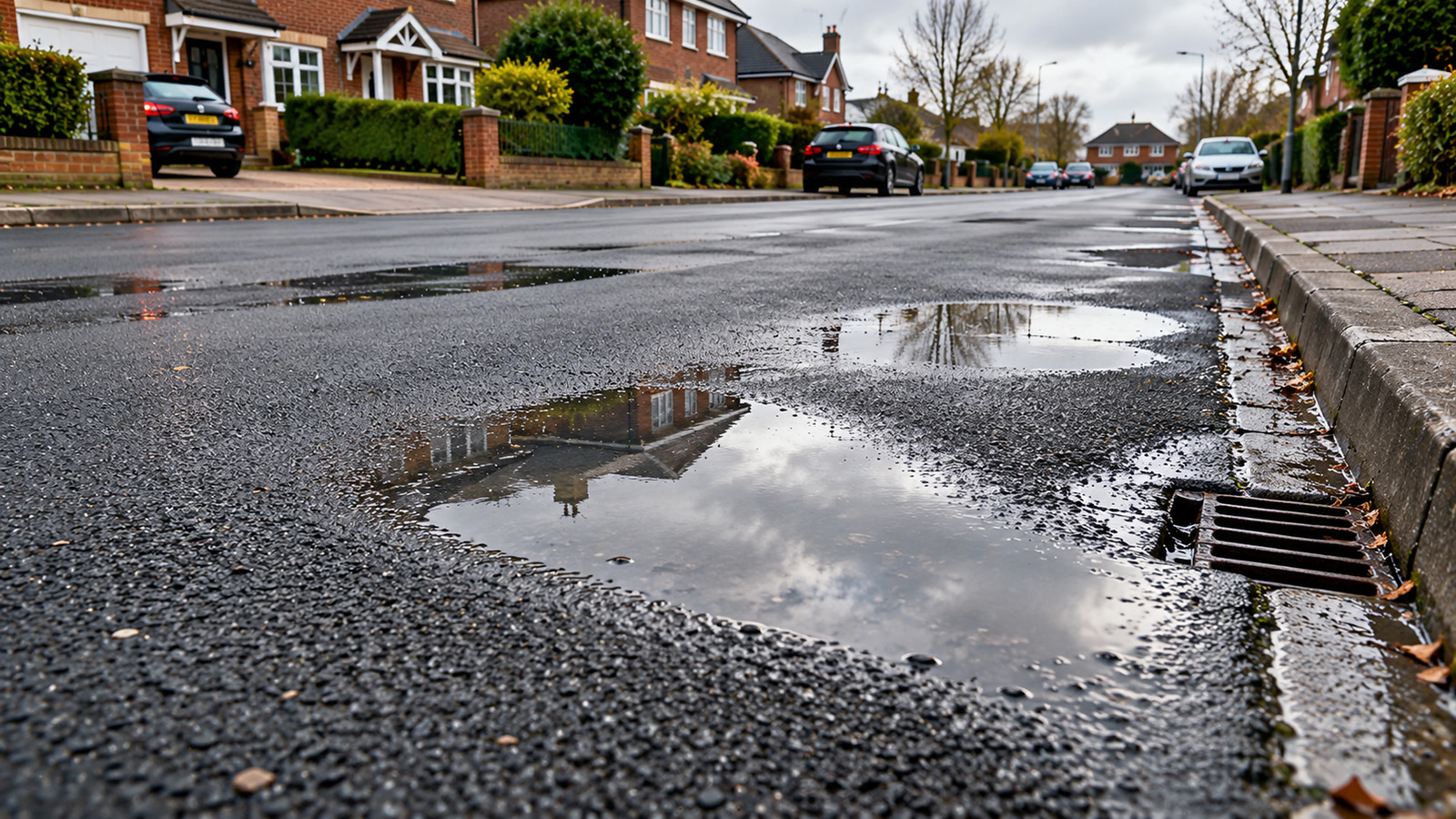
A newly resurfaced road should provide a smooth, durable and properly drained surface. However, some property owners and commercial site managers notice puddles forming shortly after resurfacing work has been completed. This can be frustrating, particularly when the purpose of the project was to improve the condition and performance of an existing road.
Water collecting on newly laid tarmac or asphalt does not automatically mean that the resurfacing work has failed. Small amounts of temporary surface water can occur during heavy rainfall, especially where drainage systems are already under pressure. However, persistent puddles in the same locations may indicate problems with surface levels, drainage design, installation or the underlying structure.
Understanding why newly resurfaced roads develop puddles is important because standing water can affect road safety, accelerate surface deterioration and increase long-term maintenance requirements.
For private roads, commercial access routes, industrial yards and car parks, identifying the cause early can prevent relatively minor drainage concerns from developing into more expensive problems.
Why Proper Drainage Matters in Road Surfacing
Drainage is one of the most important considerations in any road surfacing project. Although tarmac and asphalt provide durable surfaces capable of supporting regular vehicle movements, they must be installed with appropriate gradients to direct rainwater towards suitable drainage points.
Most conventional asphalt road surfaces are designed to shed water rather than allow it to pass directly through the material. This means the finished surface must have sufficient fall to move rainwater away from traffic areas.
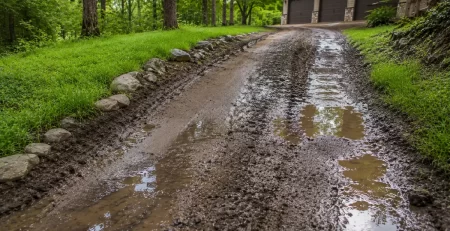
Where water cannot flow freely, it collects in localised depressions or low points.
Professional tarmac installation and road surfacing services should consider existing site levels, surface gradients, drainage outlets and the intended use of the road before installation begins.
These factors are particularly important on commercial premises, where frequent vehicle movements and heavy loads can place additional stress on the finished surface.
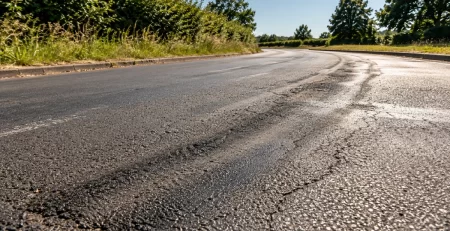
A road may look visually smooth immediately after resurfacing but still contain subtle variations in level that become apparent during rainfall.
Common Reasons Newly Resurfaced Roads Develop Puddles
Incorrect Surface Gradients
One of the most common causes of standing water on newly resurfaced roads is an insufficient or incorrectly formed surface gradient.
Road surfaces generally require a controlled slope to direct rainwater towards drainage channels, gullies or suitable surrounding areas.
This gradient may run across the width of the road, along its length or through a combination of both.
If the surface is installed too flat, water may struggle to reach the intended drainage point.
Even relatively small variations in height can create shallow depressions where rainwater collects.
This is particularly noticeable on large car parks, industrial yards and wide commercial access roads, where water must travel across substantial surface areas.
The appropriate gradient depends on the road layout, surfacing specification and drainage arrangement. It should therefore be established during the planning stage rather than left to visual judgement during installation.
Existing Low Spots Beneath the New Surface
Not every resurfacing project involves removing and reconstructing the entire road.
In many cases, a new asphalt layer is installed over an existing surface that remains structurally suitable.
Although this approach can be practical and cost-effective, existing depressions may remain if the underlying levels are not properly corrected.
For example, an older road may contain shallow areas created by years of traffic loading, settlement or previous repairs.
If a new layer is laid without sufficient levelling work, these irregularities can influence the finished surface.
The result may be a newly resurfaced road that looks significantly improved but continues to collect water in familiar locations.
A proper site assessment should identify these areas before resurfacing begins.
Where necessary, localised regulating layers or more extensive preparation may be required to achieve suitable finished levels.
Poor Drainage Design
Sometimes the road surface itself is not the main problem.
Standing water can develop because the surrounding drainage system does not adequately manage rainfall.
Road gullies may be positioned incorrectly, drainage channels may lack sufficient capacity, or existing outlets may not be located at the lowest points of the finished surface.
In other situations, resurfacing work may alter the relationship between the road level and existing drainage features.
For example, raising the road surface without adjusting drainage arrangements can change how water moves across the site.
Commercial premises often have complicated drainage requirements because roads connect with loading bays, parking areas, pedestrian routes and building entrances.
These interconnected areas must be considered together.
Effective drainage planning should account for how water enters the site, where it travels and how it eventually leaves the surfaced area.
Inadequate Surface Preparation
Surface preparation has a direct influence on the quality and performance of newly laid asphalt.
Before resurfacing begins, contractors should assess the existing surface for structural weaknesses, settlement, contamination and drainage problems.
Where preparation is insufficient, the new surface may inherit problems from the layers beneath it.
Weak areas can gradually deform under traffic loading, creating depressions that collect water.
This is particularly relevant for industrial roads and commercial yards used by heavy goods vehicles, delivery lorries and machinery.
These vehicles generate substantial loads, especially where they brake, turn or remain stationary.
A surface that performs adequately under light vehicle traffic may deteriorate more quickly if the underlying construction is unsuitable for heavier use.
Appropriate preparation helps reduce this risk and supports the long-term performance of the resurfaced area.
Uneven Asphalt Laying and Compaction
The way asphalt is laid and compacted can also influence surface drainage.
During installation, contractors must control material thickness, temperature, levels and compaction to produce a consistent finished surface.
Uneven laying can create subtle variations in height that interfere with water movement.
Similarly, inconsistent compaction may contribute to localised changes in surface levels.
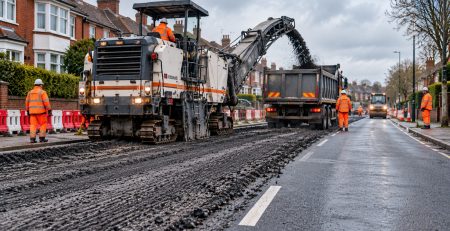
For larger roads and commercial areas, machine-laid tarmac can help achieve consistent material distribution and controlled installation.
However, machinery alone does not guarantee correct drainage.
Accurate level setting, appropriate preparation, skilled operation and quality checks remain essential.
Where the surface contains irregularities, water may collect even when the asphalt itself is otherwise sound.
Can Puddles on New Tarmac Be Normal?
Not every puddle indicates defective workmanship.
During heavy rainfall, temporary surface water may form faster than the drainage system can remove it.
This can happen on both new and established roads.
Small, shallow areas of standing water may also be visible immediately after rainfall before gradually draining away.
The important distinction is whether the water clears within a reasonable period and whether it repeatedly collects in the same location.
Persistent puddles deserve closer investigation, particularly where they remain long after surrounding areas have dried.
The depth, size and location of the puddle are also relevant.
Water collecting near pedestrian crossings, entrances, loading areas or vehicle turning points can create practical and safety concerns even when the affected area is relatively small.
There is no single acceptable puddle depth or drainage time that applies to every resurfacing project. The relevant contract specification, intended use and site conditions should guide the assessment.
How Standing Water Can Damage Newly Resurfaced Roads
Water Penetration and Surface Deterioration
Although asphalt is designed to resist normal weather exposure, prolonged standing water can contribute to deterioration, particularly where joints, cracks or other weaknesses are present.
Water may gradually enter vulnerable areas and affect the layers beneath the surface.
Repeated traffic loading can then worsen existing weaknesses.
Over time, this may contribute to cracking, deformation and localised surface failure.
The risk becomes greater when standing water is combined with frequent heavy vehicle movements.
Freeze-Thaw Damage During Winter
British winter conditions can make persistent puddles particularly problematic.
When water enters cracks or voids and subsequently freezes, expansion can place additional stress on the surrounding material.
Repeated freezing and thawing may contribute to the development of cracks and surface defects.
Water that remains on the surface can also freeze, creating slippery conditions for vehicles and pedestrians.
For commercial sites, this can affect access, deliveries and general site safety.
Preventing persistent water accumulation is therefore an important part of maintaining reliable year-round access.
Increased Risk of Potholes
Standing water does not automatically cause potholes, but it can accelerate deterioration where the road structure is already vulnerable.
Once cracks or localised defects allow water to enter the pavement, traffic loading can progressively weaken the affected area.
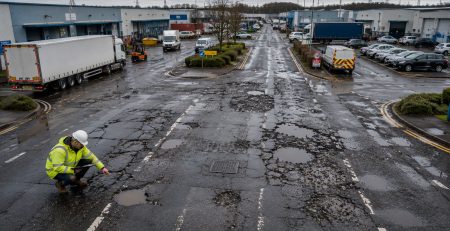
As material begins to break down, the surface may develop into a pothole.
Early investigation and appropriate pothole repairs can help prevent localised damage from spreading across larger sections of the road.
However, repairing individual potholes without addressing an underlying drainage problem may only provide a temporary improvement.
Why Commercial Roads and Car Parks Are Particularly Vulnerable
Commercial surfacing projects often involve more complicated requirements than small residential access roads.
Industrial estates, logistics centres, retail premises and business parks typically contain extensive paved areas with multiple drainage points.
These surfaces must accommodate regular traffic movements while directing rainfall away from buildings, entrances and operational areas.
Heavy vehicles can also create concentrated loading at specific locations.
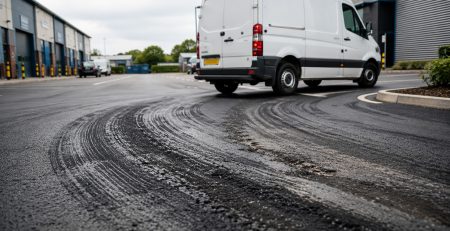
Loading bays, turning circles and delivery entrances are particularly susceptible to deformation if the pavement construction is inadequate.
When these areas develop depressions, standing water can become a recurring problem.
Professional commercial surfacing contractors should assess both the structural requirements and drainage characteristics of a site before recommending resurfacing work.
This helps ensure that the finished surface is appropriate for the vehicles using it and the conditions it will experience.
For site managers, drainage performance should form part of the overall assessment of a resurfacing project rather than being treated as a separate issue.
How Contractors Prevent Puddles During Road Resurfacing
Carrying Out a Detailed Site Assessment
Preventing drainage problems begins before the first layer of asphalt is installed.
A site assessment should examine existing surface levels, visible depressions, drainage features and areas of previous deterioration.
Contractors should also consider how rainfall moves across adjoining surfaces.
For example, water from nearby buildings, higher ground or neighbouring paved areas may flow onto the road.
If this additional runoff is overlooked, the drainage system may struggle even when the resurfaced road has suitable gradients.
Understanding these conditions allows the resurfacing work to be planned around the actual requirements of the site.
Establishing Suitable Finished Levels
Accurate level setting is essential for effective drainage.
Contractors may use surveying equipment and level controls to establish the required surface falls.
The objective is to provide a smooth and usable road while ensuring water can reach appropriate drainage points.
On complicated sites, several gradients may need to work together.
This is particularly important where a road connects with existing buildings, kerbs, drainage channels and other paved surfaces.
Finished levels must also avoid directing water towards vulnerable areas such as doorways or building entrances.
Correcting Existing Surface Defects
Where the existing road contains depressions, these should be assessed before new asphalt is applied.
Depending on their cause and severity, corrective work may involve localised levelling, removal of damaged material or reconstruction of weakened areas.
Simply covering a depression with a uniform new layer may not provide the required improvement.
The chosen preparation method should reflect the condition of the existing pavement and the intended service life of the resurfaced road.
Checking Drainage Before Completion
Drainage should be considered during installation and final inspection.
Contractors can check finished levels against the project specification and examine whether surface water has a suitable route towards drainage outlets.
Where practical, rainfall observations or controlled water testing may help identify localised ponding.
Any concerns should be assessed before the project is considered complete.
These checks are particularly valuable on commercial sites where future access restrictions could make remedial work more disruptive.
What Should You Do If Your Newly Resurfaced Road Has Puddles?
If puddles appear shortly after resurfacing, the first step is to observe when and where they develop.
Water collecting during exceptionally heavy rainfall may have a different cause from a puddle that appears after every light shower.
It is useful to note whether the water clears quickly, whether it remains in the same location and whether nearby drainage outlets appear blocked.
Photographs taken after rainfall can help document the issue.
The next step is to contact the contractor responsible for the resurfacing work and request an inspection.
A professional assessment can determine whether the problem relates to finished surface levels, drainage capacity, underlying settlement or another factor.
The appropriate solution depends on the findings.
Minor localised depressions may be suitable for targeted corrective work, while more extensive gradient problems could require a larger area to be reprofiled or resurfaced.
Where the drainage system is inadequate, improvements to gullies, channels or outlets may be necessary.
It is important to establish the cause before carrying out repairs. Adding asphalt to a low area without considering surrounding levels can sometimes move the problem elsewhere.
Can Drainage Problems Be Fixed Without Resurfacing the Entire Road?
In many cases, drainage problems can be corrected without replacing the whole road surface.
The feasibility depends on the extent of the affected area, the existing pavement condition and the required finished levels.
For isolated depressions, localised removal and replacement of asphalt may provide a suitable solution.
Where drainage outlets are blocked or poorly positioned, cleaning or modifying the drainage system may improve water removal.
Some sites may require additional surface drainage channels or adjustments to existing kerb arrangements.
However, if the road has widespread level inconsistencies, substantial settlement or inadequate structural support, more extensive reconstruction may be necessary.
The most effective approach is to investigate the underlying cause rather than choosing a repair method based solely on the visible puddle.
A targeted repair may cost less initially, but it should also provide a reliable long-term result.
The Importance of Long-Term Road Surface Maintenance
Even when a newly resurfaced road has been installed correctly, ongoing maintenance remains important.
Drainage gullies and channels can become obstructed by leaves, silt and other debris.
Over time, this can reduce drainage capacity and allow water to collect on otherwise properly graded surfaces.
Regular inspections can also identify early signs of settlement, cracking and surface deformation.
For commercial premises, maintenance should take account of traffic patterns and the areas exposed to the greatest loading.
Heavy vehicle turning areas, loading bays and frequently used access routes may require more frequent attention.
Maintaining drainage infrastructure alongside the road surface helps protect the investment made in resurfacing.
It also reduces the likelihood of small defects developing into larger problems that require disruptive repairs.
When Should a Professional Road Surfacing Inspection Be Arranged?
An inspection is advisable when puddles repeatedly form in the same locations, remain for prolonged periods or begin to affect safe access.
Professional assessment is also appropriate if standing water appears alongside cracking, deformation or other visible surface defects.
On newly completed projects, concerns should be raised promptly so that the contractor can review the finished work against the agreed specification.
For established commercial roads, an inspection can help determine whether the issue is caused by blocked drainage, gradual settlement or deterioration of the pavement structure.
The aim should be to identify the source of the problem and recommend corrective work proportionate to its severity.
Where resurfacing or drainage improvements are required, property owners and site managers can contact Total Surfacing Solutions to discuss the condition of their road or commercial access area.
Maintaining Effective Drainage After Resurfacing
Newly resurfaced roads can develop puddles for several reasons, including insufficient gradients, existing low spots, inadequate drainage arrangements and uneven installation.
While temporary surface water during heavy rainfall is not necessarily a concern, recurring or persistent ponding should be investigated.
The long-term performance of a road depends on more than the appearance of the finished asphalt. Suitable preparation, accurate surface levels, effective drainage and appropriate pavement construction all contribute to durability.
For property owners and commercial site managers, the practical priority is to establish whether water is draining as intended and to address persistent problems before they contribute to further deterioration.
Early assessment, proportionate corrective work and regular drainage maintenance can help preserve the condition, safety and usability of a resurfaced road.