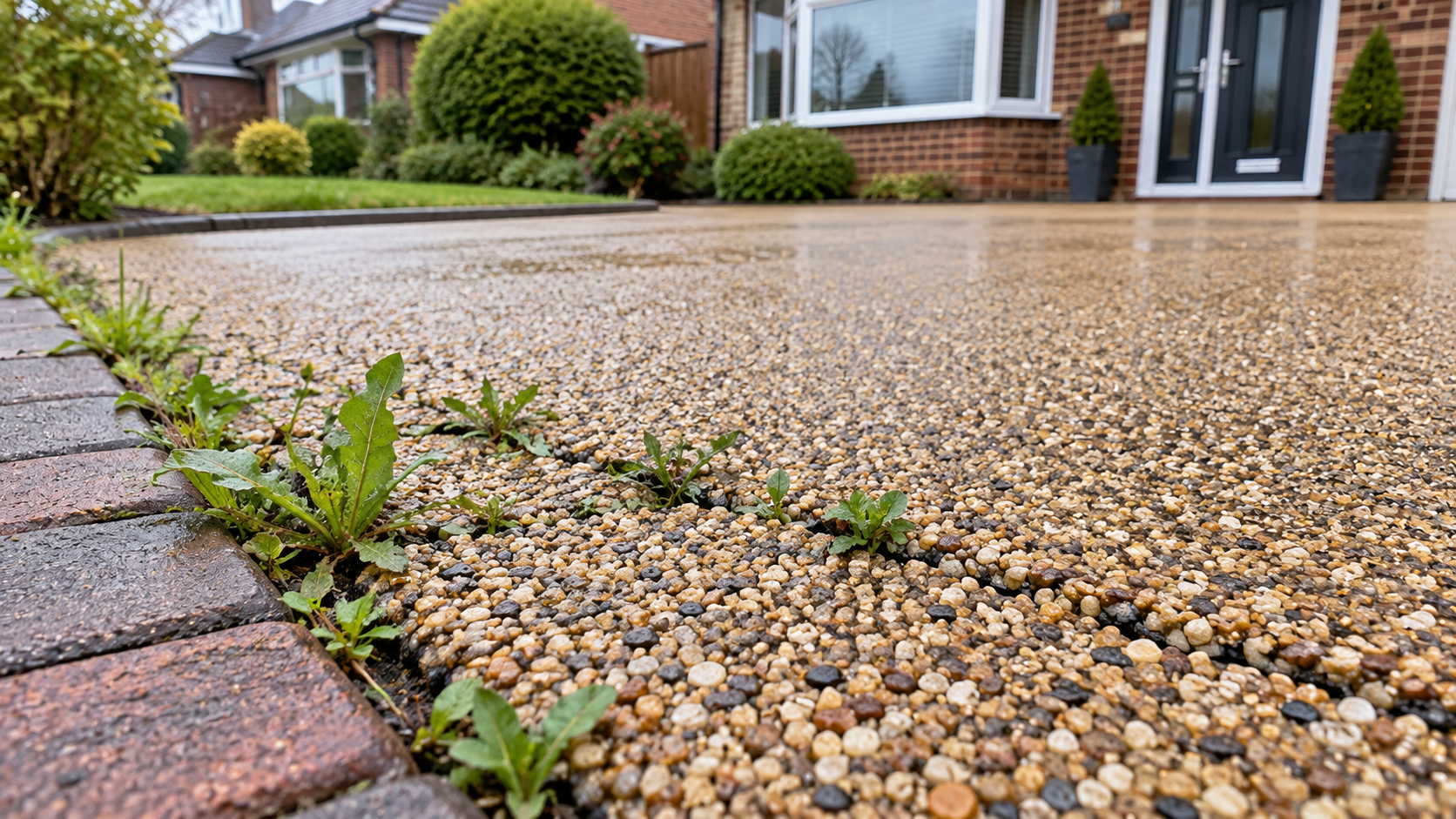
What Causes Weeds to Grow Through a Resin Driveway?
Resin driveways are increasingly popular across the UK because of their attractive appearance, durability and relatively low maintenance requirements. A properly installed resin-bound surface creates a smooth, seamless finish that can withstand everyday vehicle use while allowing rainwater to drain through its structure.
However, some homeowners notice weeds appearing on their resin driveway after installation. This can be frustrating, particularly when the surface was chosen partly because it was expected to require less maintenance than traditional paving.
The appearance of weeds does not automatically mean that the entire driveway has failed. In many cases, the growth originates from organic material accumulating on the surface, surrounding vegetation or defects in the underlying construction.
Understanding what causes weeds to grow through a resin driveway is important because the appropriate solution depends on where the plants are actually growing.
Can Weeds Really Grow Through a Resin Driveway?
A correctly installed resin-bound driveway should provide a relatively resistant surface against weed growth.
Unlike traditional block paving, resin-bound surfacing does not normally contain regular joints filled with sand where seeds can easily settle and germinate.
The aggregate is bonded together using a specialist resin, creating a continuous surface with small interconnected voids that allow water to pass through.
However, resin-bound surfacing is not completely weedproof.
Seeds can settle on the surface, particularly where dust, soil and decomposing leaves accumulate. Once enough organic material is present, weeds may establish themselves without growing directly through the resin layer.
In other situations, vegetation may emerge from cracks, damaged sections or poorly constructed edges.
This distinction matters because surface weed growth is usually a maintenance issue, whereas plants emerging through structural defects may indicate a problem requiring further investigation.
Professional resin driveway installation should consider the existing ground conditions, base construction, drainage and surrounding landscape to minimise these risks.
Poor Ground Preparation Before Installation
One potential cause of weeds appearing through a resin driveway is inadequate preparation of the ground beneath the finished surface.
A resin-bound system relies on a stable, suitable base. Simply spreading resin-bound aggregate over soil or an unstable surface is not an appropriate method of constructing a durable driveway.
Existing Vegetation Beneath the Driveway
If the installation area contains established weeds, roots or other vegetation, these should be properly addressed during preparation.
Persistent plants can exploit weaknesses in a driveway construction, particularly where existing cracks, gaps or poorly supported edges are present.
Some aggressive species have extensive underground root systems that may remain active if they are not managed correctly.
However, it is important to understand that ordinary weeds do not generally push directly through an intact, correctly installed resin-bound surface.
Growth emerging from beneath the driveway is more likely to follow an existing weakness or opening.
An Unsuitable Base
The underlying construction must provide sufficient stability for the intended traffic.
If the base moves, settles or deteriorates, cracks may develop in the finished resin surface.
These openings can create opportunities for vegetation to establish itself.
The risk is particularly relevant where resin surfacing has been installed over an existing driveway without adequately assessing the condition of the original construction.
A sound surface begins with appropriate preparation, not simply an attractive finished layer.
Airborne Seeds Settling on the Resin Surface
One of the most common explanations for weeds appearing on resin driveways is airborne seed germination.
Wind, birds and nearby vegetation can deposit seeds onto virtually any outdoor surface.
Although resin-bound aggregate forms a continuous finish, its textured appearance and small surface voids can trap fine debris.
Over time, dust, soil particles, pollen and decomposing organic matter may accumulate.
When seeds land in this material and receive sufficient moisture, they can begin growing.
Why This Happens More Often Near Gardens
Driveways surrounded by lawns, flower beds, hedges and mature trees are naturally exposed to greater quantities of seeds and organic debris.
Fallen leaves can gradually decompose, creating small pockets of material suitable for plant growth.
Similarly, soil washed from nearby planting areas can settle along driveway edges or in areas where water regularly collects.
The resulting weeds may appear to be growing through the resin, even though their roots are primarily established within debris above the surface.
This is an important difference because removing surface debris and young plants may resolve the problem without any structural repair.
Cracks and Damage in the Resin Surface
Cracks provide another potential route for weed growth.
Although resin-bound driveways are designed to withstand normal use, their performance depends on correct installation, appropriate thickness, suitable materials and the stability of the supporting base.
Movement beneath the driveway can cause cracks to develop.
Once an opening exists, soil and organic material may collect inside it. Seeds can then germinate, while existing vegetation may exploit the damaged area.
What Causes Resin Driveways to Crack?
Cracking can result from several factors, including inadequate base preparation, settlement, unsuitable installation conditions or excessive movement within the underlying construction.
Heavy vehicle loading may also contribute where the driveway has not been designed for the loads it experiences.
Resin-bound surfacing is not intended to compensate for a structurally unsound base.
If the supporting layers are already moving or deteriorating, the finished surface may eventually reflect those problems.
Where cracking is extensive, simply removing weeds will not address the underlying cause.
A professional assessment may be necessary to establish whether a local repair is suitable or whether a more substantial reconstruction is required.
Weeds Growing Around Driveway Edges
Driveway edges are particularly vulnerable to unwanted vegetation.
The transition between resin surfacing and surrounding soil, grass, paving or garden borders can provide opportunities for plants to establish themselves.
Where edging is poorly constructed or gaps develop, roots and shoots may spread into the adjoining surface.
Why Proper Edging Matters
A well-designed driveway should have suitable edge restraints that support the surfacing and provide a defined boundary.
Without adequate edge support, the surrounding material may move or become disturbed.
This can create gaps where soil accumulates and vegetation takes hold.
Grass can also spread laterally from adjoining lawns, giving the appearance that plants are emerging through the resin itself.
Maintaining clear boundaries between the driveway and nearby planting areas can help reduce this problem.
Homeowners should pay particular attention to areas where grass meets the driveway, as these locations can require more frequent maintenance than the central surface.
Poor Drainage and Persistent Moisture
Drainage conditions can influence the likelihood of weed growth.
Resin-bound driveways are commonly selected because their permeable structure can allow rainwater to pass through the surface.
However, permeability alone does not guarantee effective drainage.
The underlying construction must also be capable of managing the water passing through the resin layer.
If water cannot drain away adequately, persistent moisture may contribute to deterioration and create favourable conditions for vegetation.
Blocked Surface Voids
Over time, fine sediment and organic material can accumulate within the surface texture.
If this material is not removed, it may reduce the effectiveness of surface drainage and provide a growing medium for seeds.
This is particularly relevant beneath trees, near garden borders and in areas receiving soil-laden runoff.
Regular cleaning helps prevent debris from building up and supports the intended drainage performance of the surface.
Where standing water becomes a recurring problem, the underlying drainage arrangement should also be investigated rather than assuming surface cleaning alone will resolve it.
Is There a Difference Between Resin-Bound and Resin-Bonded Driveways?
Yes, and the distinction is relevant when considering maintenance and weed growth.
Resin-bound and resin-bonded systems use different installation methods and produce different surface characteristics.
Resin-Bound Surfacing
With resin-bound surfacing, decorative aggregates are mixed with resin before being laid and finished.
This creates a relatively smooth, continuous surface with interconnected voids that can allow water to drain through.
When correctly installed over a suitable construction, resin-bound surfacing offers a durable, low-maintenance driveway finish.
Resin-Bonded Surfacing
Resin-bonded surfacing is created by applying resin to a prepared substrate and broadcasting aggregate onto the resin.
This produces a more textured, generally impermeable finish.
The rougher texture can retain surface debris, which may provide opportunities for seeds to germinate if maintenance is neglected.
Neither system should be described as completely weedproof.
The likelihood of unwanted growth depends on installation quality, surrounding conditions, surface cleanliness and the condition of the supporting construction.
How to Remove Weeds From a Resin Driveway
The appropriate removal method depends on whether weeds are growing in surface debris, around the edges or through an existing defect.
For small weeds growing in accumulated material, careful manual removal is often sufficient.
Young plants should be removed before they develop extensive roots or produce additional seeds.
After removal, the affected area can be cleaned to eliminate the organic material that allowed the weeds to establish themselves.
Cleaning the Surface Safely
A stiff but non-damaging brush can help remove loose leaves, soil and other debris.
The driveway may also be washed using methods suitable for the particular resin system.
If pressure washing is permitted by the manufacturer or installer, it should be carried out carefully using an appropriate pressure and nozzle arrangement.
Excessively aggressive cleaning can damage some resin surfaces or dislodge aggregate.
Strong chemical treatments should not be applied without checking their compatibility with the resin system and the product’s approved use.
Where weeds are emerging through cracks, removing the plants is only part of the solution.
The damaged area should be assessed to determine whether a suitable repair is needed.
How to Prevent Weeds From Returning
Preventing weed growth is generally easier than dealing with established vegetation.
A sensible maintenance approach focuses on keeping the driveway clear of material that supports germination while monitoring the surface for developing defects.
Regular Sweeping and Cleaning
Sweeping removes the leaves, dust and soil that can accumulate within the textured surface.
This is particularly useful during autumn when falling leaves can collect quickly.
Driveways beneath mature trees may require more frequent attention than those in open locations.
Keeping the surface clean also makes it easier to identify cracks, loose aggregate or other changes before they become more serious.
Maintaining Surrounding Garden Areas
Vegetation beside the driveway should be managed to reduce encroachment.
Grass edges can be trimmed, and excessive soil accumulation near the driveway boundary should be avoided.
Where garden beds sit directly beside resin surfacing, suitable edging can help maintain separation between planting material and the finished surface.
Addressing Small Defects Early
Small cracks and damaged edges should not be ignored.
Although not every minor defect indicates structural failure, openings can allow debris and moisture to enter and may eventually support vegetation growth.
Timely assessment can establish whether a local repair is appropriate.
The same principle applies to other external surfaces, including tarmac driveways and road surfacing, where early attention to cracking can help prevent further deterioration.
Does Weed Growth Mean a Resin Driveway Was Installed Incorrectly?
Not always.
A small number of weeds growing in accumulated surface debris does not necessarily indicate defective workmanship.
Seeds can germinate on many outdoor materials when sufficient moisture and organic matter are available.
However, repeated vegetation growth through cracks, widespread surface movement or significant deterioration around the edges may justify a closer examination of the installation.
The age of the driveway, condition of the base, traffic loading and local ground conditions all need to be considered.
A recently installed driveway showing extensive cracking or vegetation emerging through structural openings may warrant inspection by the original installer.
An older driveway may simply require routine maintenance or localised repairs, depending on its condition.
The key is to distinguish normal environmental growth from defects affecting the construction.
How Long Should a Properly Installed Resin Driveway Remain Weed-Resistant?
There is no fixed period during which a resin driveway can be guaranteed to remain completely free from weeds.
Its resistance to vegetation depends on the quality of the installation, the stability of the base and the maintenance carried out throughout its service life.
A correctly constructed resin-bound surface should substantially reduce opportunities for weeds to establish themselves through the main driveway area.
However, airborne seeds and surrounding vegetation remain ongoing environmental factors.
Even a relatively new driveway can develop small weeds if organic debris is allowed to accumulate.
Equally, an older driveway that remains structurally sound and is cleaned regularly may continue to experience very little unwanted growth.
For homeowners considering a new installation, discussing ground preparation, base suitability, drainage and edge construction with an experienced contractor is more useful than relying on claims that a particular surface will never develop weeds.
When Should You Seek Professional Advice?
Occasional weeds appearing in surface debris can usually be managed through straightforward maintenance.
Professional advice becomes more important when vegetation repeatedly emerges from the same cracks, when the resin begins separating from the base or when significant movement appears around the driveway edges.
Persistent standing water, loose aggregate and widespread cracking may also indicate that the problem extends beyond surface cleanliness.
An assessment should consider the underlying cause before deciding on a repair.
Homeowners planning a new driveway or investigating problems with an existing installation can explore suitable resin driveway solutions and the preparation requirements associated with different ground conditions.
The most appropriate treatment will depend on whether the issue is environmental, maintenance-related or structural.
Understanding the Real Cause of Weeds in Resin Driveways
Weeds appearing on a resin driveway are not necessarily growing directly through the finished material.
In many cases, they originate from seeds that have settled in accumulated soil and organic debris. Other growth may emerge from poorly maintained edges, existing cracks or weaknesses in the supporting construction.
Identifying the source of the vegetation is essential before choosing a solution.
Routine cleaning and careful management of surrounding garden areas can reduce surface germination. Where cracks or structural movement are involved, the underlying defect should be investigated rather than repeatedly removing the visible weeds.
A resin-bound driveway is best understood as a low-maintenance surface, not a maintenance-free one. Its long-term resistance to weed growth depends on sound construction, suitable drainage and ongoing care.