The Hidden Reasons a Smooth-Looking Road Feels Bumpy
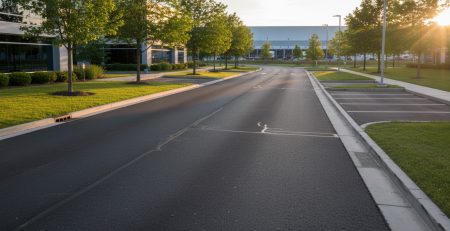
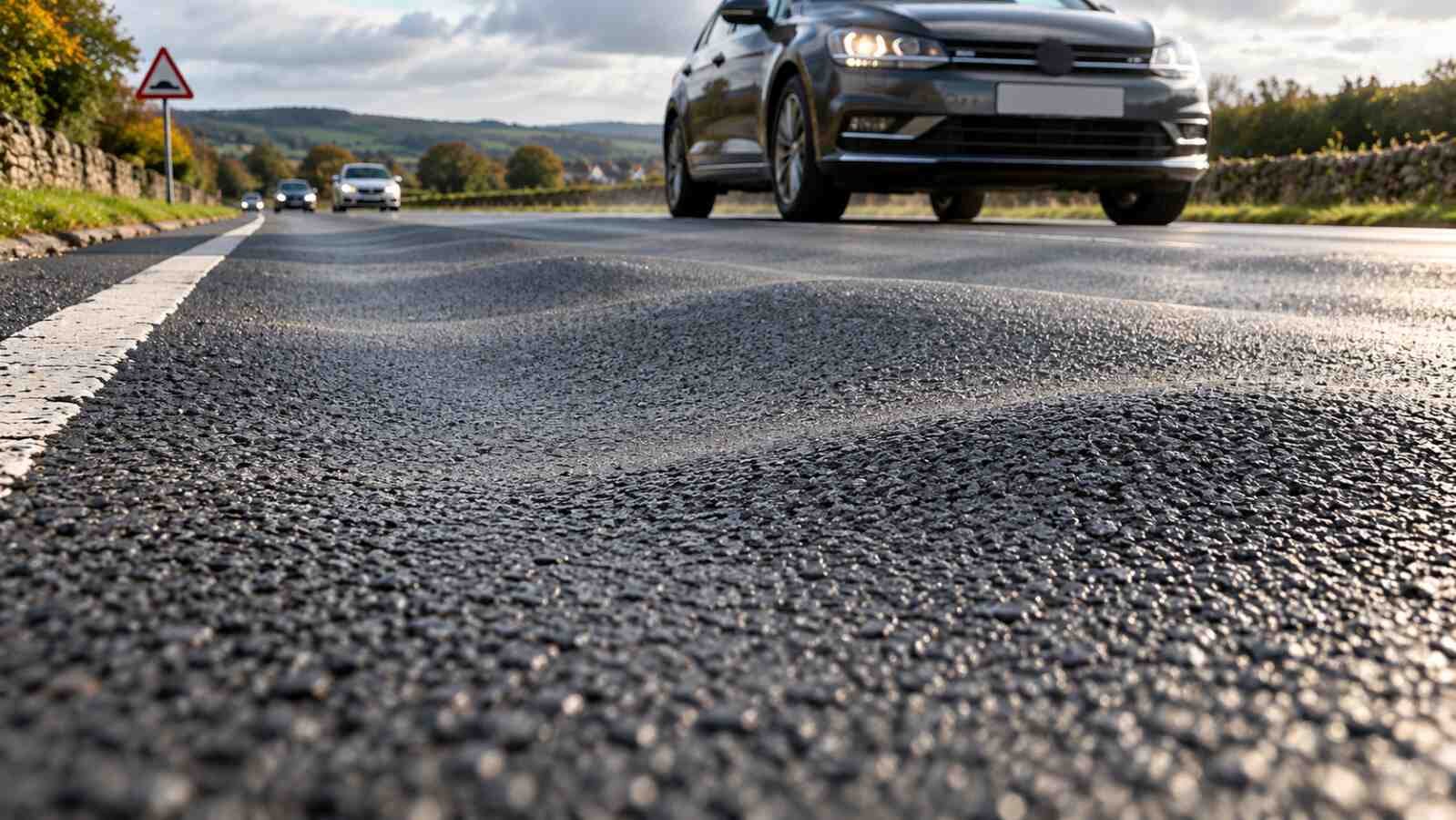
A newly surfaced road can appear almost perfect when viewed from the pavement or the edge of a site. The colour may be consistent, there may be no visible potholes or cracks, and the surface texture may look uniform. Yet the experience can be very different once a vehicle travels over it. Small vibrations, repeated bumps or subtle changes in level can make an apparently smooth road feel surprisingly uneven.
Road surface unevenness in the UK is not always caused by an obvious defect in the visible wearing course. A road is a layered construction, and its performance depends on everything beneath the surface as well as the quality of the final material. Sub-base preparation, compaction, drainage, laying technique and the condition of the existing ground can all influence how smoothly vehicles travel across it.
Understanding these hidden factors is particularly important for commercial property owners, estate managers and anyone responsible for private roads, access routes or car parks. A visually attractive finish is important, but the real measure of a road surface is how consistently it performs under traffic.
Surface Appearance Does Not Tell the Whole Story
The upper layer of a road is only the part that users can see. Beneath it may be several layers designed to distribute vehicle loads and provide a stable platform for the finished surface.
If these underlying layers are inconsistent, the top can initially look smooth while still reproducing subtle changes in level. These variations may be difficult to identify by eye because they can occur gradually across several metres rather than forming an obvious dip or raised section.
Professional tarmac installation and road surfacing therefore involves considerably more than applying a new black surface. Preparation and construction beneath the visible layer have a major influence on ride quality, drainage and long-term durability.
A person walking across a road may not notice these variations at all. A vehicle, however, transfers movement through its tyres and suspension, making small differences much easier to detect.
Inconsistent Foundations Can Create Hidden Unevenness
One of the most important factors behind a bumpy road is the condition of the foundation.
The layers beneath a surfaced road must provide consistent support. Where one area is significantly stronger or more compacted than another, the surface may react differently as vehicles pass over it. Over time, weaker sections can settle slightly while stronger areas remain at their original level.
Uneven Sub-Base Compaction
Compaction is essential because loose construction material contains spaces that can close under pressure. If those spaces remain when surfacing takes place, traffic can effectively continue the compaction process afterwards.
This can result in gradual settlement.
The difference may only be a few millimetres, but repeated changes across a road can produce a noticeable vibration inside a vehicle. Heavy goods vehicles can make the effect particularly obvious because their weight places greater pressure on the pavement structure.
This is one reason appropriate site preparation is so important for commercial surfacing, where roads, yards and access routes may regularly experience heavier loading than a domestic driveway.
Variations in Existing Ground Conditions
The natural ground beneath a road is not necessarily uniform.
One section may contain firm material while another contains softer ground or previously disturbed soil. Utility trenches are another potential source of variation because excavated sections may behave differently from surrounding undisturbed ground if reinstatement has not been carried out correctly.
When a new road surface is installed over inconsistent support, these differences can eventually become noticeable at surface level.
The Laying Process Affects Ride Quality
Even with a well-prepared foundation, the way asphalt or tarmac is laid has a direct effect on smoothness.
Road surfacing materials need to be placed at a controlled thickness and compacted correctly. Maintaining consistency across a substantial area requires suitable machinery, experienced operators and careful control of the installation process.
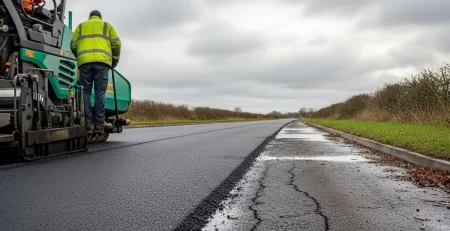
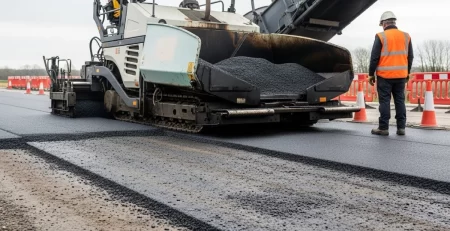
Machine-laid tarmac is particularly useful where larger areas need a consistent finish. Proper paving equipment helps control the distribution and level of the material as it is placed.
However, machinery alone does not guarantee a perfectly smooth road. The paving operation needs to progress correctly, and factors such as material supply, paving speed and site geometry can influence the finished result.
Small Changes in Surface Level Can Feel Larger in a Vehicle
One reason road surface unevenness can be confusing is that what a driver feels does not necessarily correspond with what they can see.
Vehicle suspension reacts to changes in height over relatively short distances. When the wheels repeatedly rise and fall, the movement can be transmitted into the vehicle body.
A broad, gradual change in road level may be almost invisible when looking along the road. At driving speed, however, the same variation can produce noticeable vertical movement.
Vehicle type also affects perception. A rigid commercial vehicle may respond differently from a passenger car, while wheelbase, tyre pressure and suspension design can alter how strongly a particular irregularity is felt.
This means a road should not automatically be considered defective simply because one vehicle feels more movement than another. The pattern, location and severity of the unevenness need to be considered.
Joints and Transitions Can Cause Repeated Bumps
Roads cannot always be surfaced as one completely uninterrupted area.
There may be joints between different phases of work, transitions into existing surfaces, drainage channels, utility covers or connections with surrounding roads. Each transition creates an area where levels need to be carefully controlled.
A joint that is only slightly higher or lower than the neighbouring surface can create a noticeable bump. If several joints occur along an access road, the result may feel like repeated unevenness even though the areas between them are smooth.
Transitions are particularly important where new surfacing meets old pavement. The existing surface may have a different profile, thickness or structural condition, so careful preparation is needed to produce a comfortable connection.
On public and heavily trafficked routes, professional highway surfacing must take these changes in level into account alongside durability, safety and drainage requirements.
Drainage Can Influence Surface Levels
Water management is closely connected with road construction.
A road generally should not be completely flat. It needs appropriate falls so that rainfall moves towards drainage points rather than remaining on the surface. These designed gradients can sometimes be mistaken for unevenness, particularly around gullies, channels and changes in direction.
The important distinction is between intentional drainage geometry and uncontrolled deformation.
Poor Drainage Can Cause Problems Below the Surface
Water that enters the pavement structure can contribute to deterioration over time. If moisture reaches vulnerable underlying material, the ability of that material to provide stable support may be reduced.
Repeated wet conditions can therefore contribute to local movement and settlement.
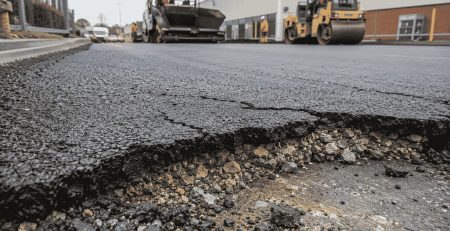
During colder periods, water-related deterioration can become more significant where temperature changes place additional stress on already weakened areas. The result may eventually appear as cracking, depressions or potholes.
Early attention to damaged sections is valuable because targeted pothole repairs can address localised failures before deterioration spreads into surrounding pavement.
Heavy Traffic Can Reveal Weaknesses That Were Initially Invisible
A newly completed road may feel acceptable immediately after construction but begin to feel different after months or years of use.
Traffic repeatedly applies loads to the pavement. Where construction is consistent, these loads should be distributed effectively through the road structure. Where there is a local weakness, repeated loading can gradually reveal it.
Commercial sites are particularly demanding environments. Delivery vehicles, refuse lorries, articulated vehicles and other heavy traffic can place substantial loads on turning areas, entrances and loading zones.
Slow-moving heavy vehicles can also impose significant stresses where they brake, accelerate or turn sharply. These movements are very different from a car travelling steadily along a straight residential road.
Consequently, road construction needs to reflect expected usage rather than simply the desired appearance.
Previous Repairs Can Affect How a Road Feels
Older roads frequently contain a history of repairs that may not be immediately obvious.
A section might have been excavated for utilities, patched following deterioration or resurfaced at a different time from the surrounding pavement. Even when repairs have been neatly finished, differences in materials and underlying construction can affect ride quality.
A road containing numerous historical repairs may therefore look reasonably smooth while producing a series of small movements under a vehicle.
Where isolated deterioration is responsible, repairing individual sections may be appropriate. Where variations are widespread, a more comprehensive resurfacing approach may provide a better long-term result.
Property owners considering the condition of an existing surface can look at examples of completed surfacing projects to understand how different road and access environments can be addressed.
Why Simply Adding Another Surface Layer May Not Solve the Problem
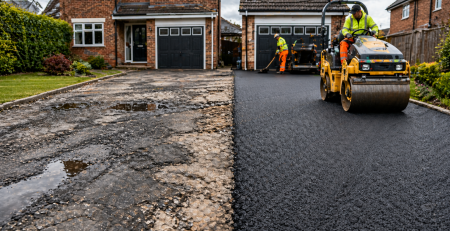
When a road feels bumpy, resurfacing can seem like the obvious solution. In some circumstances it is appropriate, but placing new material over an existing road does not automatically correct problems underneath.
If significant depressions, unstable foundations or poorly reinstated trenches remain below the new surface, the underlying profile can eventually influence the finished pavement.
This is sometimes described as the existing condition being reflected through the new work.
Before resurfacing, the existing road therefore needs to be assessed. Areas requiring deeper repair may need to be corrected before the final surface is installed.
The aim is not merely to conceal visible imperfections. It is to create a stable and appropriately prepared platform capable of supporting the new surface.
Temperature and Material Consistency Matter During Installation
Road surfacing materials need to be handled and compacted under suitable conditions.
As asphalt material cools, its ability to be compacted effectively changes. If different areas are placed or compacted under significantly different conditions, achieving completely consistent density can become more difficult.
Material delivery and paving operations therefore need to be coordinated.
Interruptions can also create challenges. If paving stops and restarts, a joint or transition may be created. Experienced surfacing teams manage these areas carefully because a poorly formed transition can be felt by vehicles even when it does not immediately look severe.
UK weather adds another practical consideration. Rain, low temperatures and changing site conditions can influence when particular surfacing operations should take place.
Tree Roots and Ground Movement Can Change a Road Over Time
Not every bump originates during the original construction.
Nearby vegetation can affect surfaces as roots develop beneath or alongside paved areas. Local ground conditions may also change with time, particularly where soils respond to changes in moisture.
These movements can create gradual lifting or settlement.
A raised area caused by underlying movement may initially be subtle. Because the surface itself can remain intact, there may be no crack or obvious failure to attract attention. Drivers may notice the change well before it becomes visually prominent.
Investigating the cause is important before deciding on a repair because replacing only the upper layer may provide limited benefit if movement underneath continues.
How to Assess a Road That Looks Smooth but Feels Bumpy
A useful assessment should consider the road as a complete structure rather than focusing exclusively on the appearance of its surface.
The location of the movement can provide clues. A bump occurring at a visible joint suggests a different issue from a long wave running through an otherwise uninterrupted section. Repeated depressions along a wheel path may indicate another pattern entirely.
Drainage behaviour is also worth observing. Standing water can reveal low areas that are difficult to identify in dry conditions. Cracking around a depression may indicate that movement has been occurring for some time.
Traffic patterns provide additional context. Areas used by heavy vehicles, turning traffic or frequent deliveries should be assessed with those loads in mind.
For property owners or facilities managers who are uncertain whether a surface requires local repair or more extensive work, a professional road surfacing assessment can help establish what is happening beneath the visible surface.
Smoothness Should Be Considered Alongside Structural Performance
A road that looks good but feels bumpy demonstrates why appearance alone is not a reliable measure of surfacing quality.
Road surface unevenness in the UK can originate from inconsistent foundations, settlement, construction joints, drainage geometry, previous repairs, heavy traffic or gradual ground movement. In many cases, the visible wearing course is only part of the explanation.
The most effective approach is to identify whether the movement is superficial or structural before choosing a remedy. Minor localised irregularities may require relatively limited intervention, while widespread settlement or foundation problems may justify more extensive reconstruction or resurfacing.
A well-constructed road should provide more than a clean visual finish. Its underlying layers, drainage, material placement and compaction should work together to create a stable surface that performs consistently under the traffic it is expected to carry. That combination of preparation and controlled installation is what ultimately determines whether a road merely looks smooth or genuinely provides a smooth, durable journey.