Why Water Sometimes Seeps Up Through a Road
When water appears on a road, car park or access route without obvious rainfall collecting on the surface, it can seem as though the water is coming directly through the tarmac or asphalt. In many cases, that is effectively what is happening. Water has entered the layers beneath the finished surface and is finding a route back upwards through joints, cracks, weak areas or other openings.
This is an important warning sign for property owners and commercial site managers because the visible water is often only part of the problem. Moisture beneath a road can affect the supporting layers that give the surface its strength. If the underlying cause is not addressed, the road may gradually develop cracking, movement, potholes or localised depressions.
Effective road surfacing drainage UK projects therefore need to consider much more than simply moving rainwater away from the visible surface. A professionally constructed road must manage both surface water and moisture that could reach the layers underneath.
Understanding where the water is coming from is the first step towards deciding whether drainage improvements, local repairs or more extensive tarmac installation and road surfacing work may be required.
How Water Gets Beneath a Road
Road surfaces are designed to withstand regular exposure to British weather, but they are not completely isolated from the surrounding ground. Water can reach the construction layers beneath a road through several different routes.
Rainwater may penetrate existing cracks or damaged joints. Water can also enter from the edges of a road where surrounding ground is saturated, particularly when verges, landscaped areas or neighbouring surfaces sit at an unsuitable level.
In other situations, the source may be groundwater rather than rainfall directly entering through the road. Following prolonged periods of wet weather, the ground surrounding and beneath a road can become heavily saturated. As groundwater levels increase, moisture can move through permeable underlying materials and reach areas beneath the finished surface.
Drainage defects can create similar symptoms. A damaged underground pipe, blocked drainage system or poorly positioned drainage feature may allow significant quantities of water to collect beneath an otherwise sound-looking road.
This is why simply sealing the point where water appears is not necessarily a permanent solution. The source and movement of the water need to be understood first.
The Role of the Road’s Sub-Base
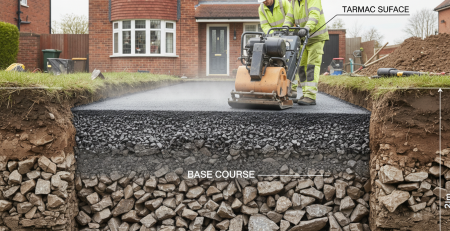
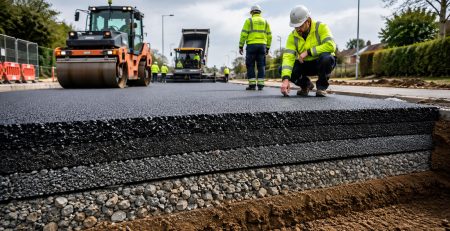
The visible tarmac or asphalt is only one part of a road construction. Beneath it are supporting materials that distribute vehicle loads and provide a stable foundation.
A properly prepared sub-base is extremely important because the finished road relies on the strength and stability of the layers below it. When those materials remain suitably compacted and drained, they can provide reliable support for the surface above.
Problems can develop when excessive water reaches these layers.
Some supporting materials can lose stability when they become heavily saturated. Water may also move fine particles within the construction, gradually creating weaker areas or small voids. Repeated vehicle loading can then place additional stress on the surface because the support beneath it is no longer consistent.
This explains why drainage should be considered during the preparation stage rather than treated as an afterthought. Professional road surfacing depends on both the quality of the visible finish and the condition of the construction underneath it.
Why Water Sometimes Moves Upwards
Water does not always travel in the direction that appears most obvious from the road surface. Pressure, groundwater levels and differences between construction materials can influence its movement.
After prolonged rainfall, the ground beneath and alongside a road may become saturated. If water cannot escape through suitable drainage channels, pressure can build within the underlying materials. The water will then look for the easiest available route.
A crack, joint, damaged patch or porous section of the road may provide that route.
Traffic can also contribute to the visible effect. Vehicle loads repeatedly apply pressure to the road structure. Where water is trapped beneath a weakened surface, that loading can encourage moisture and fine material to move through cracks or openings. In some cases, this produces a pumping effect in which water appears at the surface as vehicles pass over the affected area.
The important point is that the location where water becomes visible is not always the location where the problem began.
Surface Drainage and Subsurface Drainage Are Different
Good road surfacing drainage UK design considers how water behaves both above and below the road.
Surface drainage deals with rainwater landing directly on the carriageway, access road, yard or car park. The finished surface should normally have suitable falls so that water moves towards the intended drainage points rather than remaining in depressions.
Subsurface drainage deals with water within the ground and road construction. This moisture may originate from groundwater, neighbouring land, damaged drainage infrastructure or water that has penetrated the road over time.
A surface can therefore appear to have adequate falls while still experiencing serious moisture problems underneath.
For commercial sites, this distinction is particularly important because extensive areas of hard surfacing can produce substantial quantities of runoff. Loading yards, car parks and access roads need drainage arrangements suited to their size, layout and use. Experienced commercial surfacing contractors should therefore consider drainage conditions alongside traffic requirements and surface construction.
Why Standing Water Should Not Be Ignored
Standing water is different from water being forced upwards through a road, although the two problems can sometimes be connected.
Puddles that repeatedly form in the same location can indicate inadequate falls, settlement or a drainage system that is not removing water effectively. If the water remains for extended periods, existing surface defects provide opportunities for moisture to penetrate.
Once water enters a crack, deterioration can gradually become more severe. Traffic places stress around the damaged area, the crack can widen and additional water can enter. Over time, the supporting material beneath the surface may also become affected.
A small drainage or cracking problem can consequently develop into a larger structural repair if it remains unresolved.
Early investigation is particularly valuable because local defects may sometimes be addressed before extensive resurfacing becomes necessary.
How Poor Drainage Contributes to Potholes
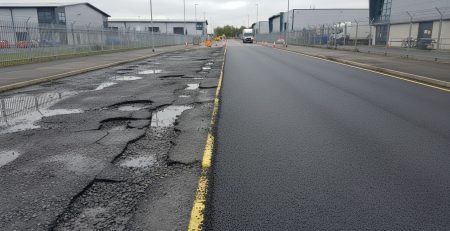
Potholes rarely appear without an underlying process of deterioration. Water is frequently an important part of that process.
When moisture reaches beneath a damaged surface, the supporting material can become weakened or displaced. Repeated vehicle movements then place loads on a surface that no longer has uniform support.
The road begins to flex and break around the weakened location. Loose material is gradually removed by tyres and weather, turning a relatively small defect into a recognisable pothole.
Professional pothole repairs should therefore consider why the defect formed rather than viewing the hole in isolation. Where drainage is contributing to repeated failure, repairing the visible surface without dealing with the water problem can result in further deterioration.
This is especially relevant on commercial access roads where HGVs, delivery vehicles and frequent traffic can accelerate damage once the supporting structure has weakened.
Cracks Can Become Routes for Water
Cracking is another important sign to monitor.
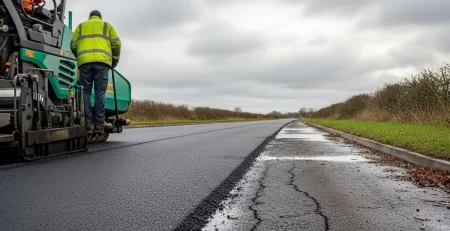
Not every minor surface crack means that water is already causing structural damage. However, cracks provide an opportunity for moisture to enter the road construction, particularly when they widen or extend across heavily trafficked areas.
Once water penetrates beneath the surface, the combination of moisture and traffic loading can accelerate deterioration.
Cracking can also be a symptom rather than the original cause. If saturated or unstable material beneath the road has already started moving, the surface may crack because it is losing consistent support.
For this reason, an assessment should consider both the condition of the surface and what may be happening underneath it.
Road Edges Are Particularly Important
The edges of roads and access routes can be vulnerable to water ingress, especially where the road meets soil, grass, gravel or landscaped areas.
If neighbouring ground is higher than the road, rainwater can move towards the road rather than away from it. Saturated verges can also introduce moisture laterally into the road construction.
Edge deterioration can then create additional openings through which water enters.
The condition of channels, kerbs and adjoining surfaces should therefore form part of any drainage assessment. A road cannot be considered completely independently from the land around it because water will naturally follow available gradients and permeable materials.
For domestic access roads and larger private properties, experienced domestic surfacing contractors can assess how the existing surface interacts with surrounding ground and drainage arrangements before resurfacing work begins.
Why Correct Levels and Falls Matter
One of the most effective ways to manage surface water is to establish suitable levels during construction.
A road that appears visually flat may actually need a carefully controlled gradient to move rainwater towards drainage channels, gullies or other collection points. These gradients are often subtle, but they are fundamental to the performance of the finished surface.
If levels are incorrect, water may repeatedly collect in low spots. This is sometimes caused by poor initial construction, although settlement or previous repair work can also alter the original drainage pattern.
Correcting the problem may therefore require more than filling the depression. The surrounding levels need to be considered so that water has somewhere suitable to travel.
Machine installation can be particularly useful on appropriate larger projects because machine-laid tarmac allows material to be placed consistently across substantial areas while working to the required profile.
Why Drainage Problems Can Become More Noticeable After Heavy Rain
A road may perform normally during relatively dry periods and then begin showing unusual water movement after several days of persistent rainfall.
This can happen because the surrounding ground takes time to become saturated. During initial rainfall, the soil and underlying construction may absorb or disperse some moisture. As rainfall continues, however, the available capacity decreases.
Groundwater levels can then rise and drainage systems may have to handle greater volumes of water.
Existing weaknesses that were previously difficult to detect can become much more obvious. Water may begin appearing through cracks, along road edges or around repaired sections.
The fact that the problem disappears during dry weather does not necessarily mean it has resolved. It may simply mean that the conditions required to produce visible seepage are no longer present.
Investigating Water Seepage Before Resurfacing
Resurfacing a road without considering an existing water problem can lead to avoidable failure.
If moisture is reaching the surface from below, installing a new layer over the affected area may conceal the symptoms temporarily without removing the cause. Water may continue moving beneath the new construction until another weak point develops.
Before resurfacing, the condition of the existing surface, sub-base, drainage and surrounding ground should therefore be assessed.
The appropriate response will depend on the cause. Some situations may require local drainage improvements and repairs, while others may involve removing failed material and reconstructing part of the road. Where widespread deterioration exists, more extensive resurfacing may provide a better long-term solution.
Examples of completed surfacing work can also help property owners understand how different site conditions are approached, particularly where access, drainage and surface construction must be considered together. Relevant examples can be viewed within our surfacing case studies.
Drainage Planning for Commercial Roads and Yards
Commercial environments place particular demands on road construction.
Large hard-surfaced areas can collect significant amounts of rainwater, while heavy vehicles place greater loads on the supporting structure. If water becomes trapped beneath an area regularly used by HGVs or plant, deterioration can progress quickly once the sub-base begins losing stability.
Drainage planning should therefore form part of the overall surfacing specification.
The intended traffic, site levels, existing drainage infrastructure, surrounding land and condition of the sub-base all influence how a surface should be constructed. This is especially important around loading areas, turning points, entrances and other locations where repeated heavy vehicle movements concentrate stress.
The same principles apply to highway surfacing, where reliable drainage and a properly prepared supporting structure are fundamental to long-term road performance.
When Water Coming Through a Road Needs Attention
Occasional surface water immediately after rainfall is not automatically evidence of a serious structural problem. Roads are exposed to weather and temporary wet conditions are normal.
Repeated seepage from the same crack or location deserves closer attention, particularly if it is accompanied by surface movement, depressions, cracking, loose aggregate or potholes.
Changes over time are particularly useful indicators. A wet area that becomes larger, a crack that continues widening or a repair that repeatedly fails can suggest that the underlying cause has not been addressed.
Investigating the problem at this stage can help determine whether the issue is primarily related to surface drainage, groundwater, damaged drainage infrastructure or deterioration within the road construction.
Protecting the Road for the Longer Term
The most durable road surfaces are built as complete systems rather than simply as layers of black material placed over the ground.
Preparation provides the foundation. Suitable materials create structural strength. Correct compaction improves stability. Appropriate levels control surface runoff, while effective drainage prevents excessive moisture from remaining within or beneath the construction.
Maintenance then helps preserve those conditions throughout the life of the road.
Where water is already seeping through a road, the priority should be to understand its source and the condition of the affected construction. Repairing the visible symptom alone may not prevent the problem returning.
A properly assessed road surfacing drainage UK solution considers the surface, supporting layers, surrounding ground and route that water is taking through the site. Addressing these elements together provides a much stronger basis for protecting access roads, commercial yards, private roads and other surfaced areas from recurring water-related deterioration.