Raised Ridge Down the Middle of a Tarmac Road
A raised ridge down the middle of a tarmac road can be an obvious concern for property owners, estate managers and commercial site operators. Instead of having a consistently smooth profile, the road may have a noticeable raised line running along its centre or following the point where two sections of surfacing meet.
In many situations, this feature is associated with the longitudinal joint created during the installation process. A road is not always surfaced in one continuous strip across its entire width. Depending on the dimensions of the road, the equipment being used and access to the site, the surface may be constructed using adjoining passes of tarmac.
Where those passes meet, careful preparation, material placement and compaction are required to produce a consistent finished level. Professional tarmac installation and road surfacing therefore involves much more than simply placing hot material onto an existing road.
A small visible joint does not necessarily mean that the road has failed. However, when the joint develops into a significant raised ridge, particularly one that affects vehicles, drainage or the overall road profile, further investigation may be appropriate.
Understanding the Centre Joint in a Tarmac Road
The centre of a surfaced road is often where two paving passes meet. This meeting point is generally referred to as a longitudinal joint.
Creating a good longitudinal joint requires the adjoining sections of material to be installed at compatible levels and compacted correctly. The objective is to create a dense, stable surface where the transition between the two sections is as consistent as possible.
Modern machine-laid tarmac can help achieve an accurate and uniform finish across larger roads, commercial areas and access routes. However, the quality of the final surface still depends on correct preparation, experienced operation of the equipment and suitable compaction.
If additional material remains around the joint or the two paving passes finish at slightly different heights, the centreline can become higher than the surrounding carriageway.
Why the Joint Can Become Raised
A raised ridge in a tarmac road may originate during construction or become more noticeable as the road ages.
During installation, the amount and position of material have to be carefully controlled. Tarmac is laid before being compacted to its required finished level. If there is too much material around the joint, or if adjoining sections are not compacted evenly, a raised section can remain.
The temperature of the material can also influence how effectively it is compacted. Tarmac needs to be handled and compacted under appropriate conditions so that the aggregate and binder form a dense, stable layer.
Differences between the first and second paving passes can therefore influence the appearance and performance of the joint.
Is a Raised Centre Normal on a Tarmac Road?
It is important to distinguish between a deliberate road profile and an unwanted ridge.
Road surfaces are rarely designed to be completely flat from one side to the other. A controlled crossfall or camber may be incorporated into the design to direct rainwater towards drainage points, channels or the edges of the carriageway.
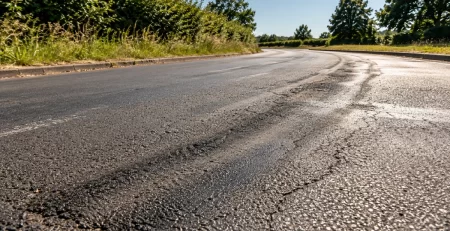
A properly designed camber creates a gradual change in level. It should not normally resemble a narrow, abrupt ridge.
This distinction matters because a slightly higher centre may simply be part of the intended drainage design. A sharp or irregular raised line, on the other hand, can indicate an issue with the joint, compaction, deformation or previous surfacing work.
The surrounding road profile should therefore be considered before deciding whether remedial work is required.
Can Traffic Create a Ridge in Tarmac?
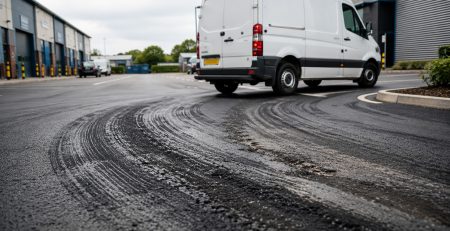
Traffic loading can contribute to changes in a tarmac surface over time. This is particularly relevant on commercial access roads, industrial sites and other areas regularly used by heavy vehicles.
Tarmac and asphalt surfaces are designed to withstand traffic, but their long-term performance depends on the complete pavement construction beneath the visible surface. The sub-base, base layers, drainage and surface course all contribute to the road’s ability to carry loads.
Where the construction is unsuitable for the traffic using the road, deformation can develop. The wheel paths may gradually become lower while surrounding material appears higher. In some circumstances, this can make the centre of the road look increasingly raised even if the centre itself has not moved significantly.
For sites exposed to frequent HGV movements, deliveries or other demanding traffic, appropriately specified commercial surfacing is important because the road construction needs to reflect its expected use.
Why Proper Compaction Matters
Compaction is one of the most important stages of constructing a durable tarmac road.
Once material has been laid, suitable compaction equipment is used to achieve the required density and finished profile. Effective compaction reduces excessive voids within the material and helps create a stable surface capable of resisting normal traffic and weather exposure.
The joint between adjoining paving passes requires particular attention. If one side is compacted differently from the other, the finished levels may not align correctly.
An uneven joint can initially appear to be primarily a visual issue. Over time, however, differences in density or level may become more noticeable as the surface is exposed to traffic and changing weather conditions.
Drainage and Raised Tarmac Ridges
Water management should always be considered when assessing an unusual road profile.
A road surface needs to direct rainwater towards an appropriate drainage route. Depending on the site, this might involve gullies, channels, drainage systems or controlled falls towards the road edge.
A raised centre can actually form part of this design when it creates a gradual camber. The problem occurs when an unintended ridge disrupts the planned surface levels.
Water may begin collecting alongside the ridge or in depressions elsewhere in the road. Persistent standing water can indicate that the road profile or drainage arrangement is no longer performing as intended.
Water itself can also contribute to deterioration when defects allow it to penetrate into the pavement structure. Cracks, failed joints and potholes can provide routes for moisture to reach lower layers.
When Does a Raised Ridge Become a Problem?
The severity of a raised ridge depends on its height, shape, location and effect on the road.
A minor centreline that does not affect vehicles or drainage may require little more than monitoring. A pronounced ridge is different, particularly when drivers noticeably cross it when changing position on the road or when water begins collecting alongside it.
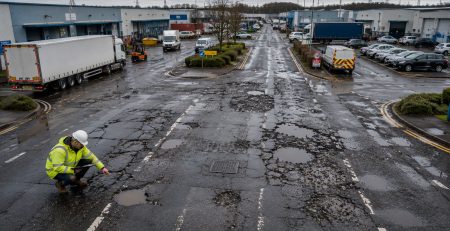
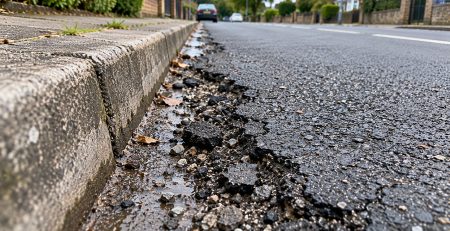
The condition of the surrounding surface is equally important. Cracking along the centreline, loose material, depressions, potholes or deformation in the wheel tracks can suggest that the problem extends beyond a simple high spot.
For private roads and commercial premises, surface condition can also affect the overall usability and appearance of the site. A professional inspection can establish whether the ridge is an isolated defect or part of wider deterioration.
Could the Ridge Indicate Poor Surfacing Work?
A raised centreline can sometimes result from installation problems, but its appearance alone is not enough to establish the cause.
The original design needs to be considered first. What appears to be a raised centre could be intentional camber. The age of the road also matters because traffic loading and deterioration may have altered its original profile.
Where a relatively new surface has an abrupt ridge exactly along a paving joint, installation quality may reasonably need to be examined. The finished levels, joint construction and compaction can all be assessed.
Experienced highway surfacing contractors consider levels, drainage, material placement and compaction as connected parts of the overall installation rather than treating the surface course in isolation.
Repairing a Raised Ridge in a Tarmac Road
The appropriate repair depends on what has caused the ridge.
Simply removing the highest point is not always sufficient. If the underlying problem involves deformation, weak construction or drainage, treating only the visible ridge may leave the actual cause unresolved.
For a localised surface defect, it may be possible to remove the affected material and reinstate the area to the correct profile. Where deterioration is more extensive, a larger section may need to be resurfaced.
If surrounding wheel tracks have sunk or deformed, the correct solution may involve addressing those areas rather than concentrating exclusively on the centreline.
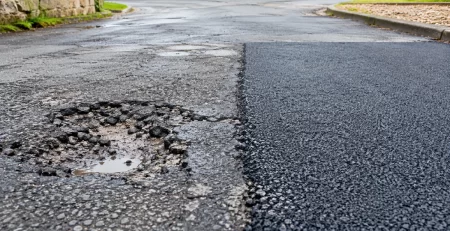
Where potholes or associated local failures have developed, professional pothole repairs can restore damaged sections, although the condition of the wider pavement should still be considered.
Why the Underlying Cause Should Be Identified First
A road surface is part of a layered construction. The visible tarmac is therefore only one element of the system.
If a ridge is caused by the way the surface course was laid, a surface-level repair may be appropriate. If the surrounding road has moved because of inadequate support underneath it, deeper reconstruction may be necessary.
This is why diagnosis should come before repair.
Removing material without understanding the road profile could also interfere with drainage. A centre section that initially appears unnecessarily high might be contributing to the designed crossfall, meaning an inappropriate repair could create standing-water problems.
Preventing Centreline Problems During Installation
Good prevention begins before the tarmac reaches the site.
The existing ground and pavement need to be assessed, suitable levels established and drainage requirements considered. The road construction should also be appropriate for the type and frequency of traffic expected to use it.
During surfacing, consistent material placement helps establish the correct profile. Particular care is required where paving passes meet because this is where differences in material thickness and compaction can become visible.
Machine laying is particularly useful for larger areas because controlled equipment can distribute material consistently. This needs to be supported by correct rolling and attention to joints, edges and finished levels.
Professional road construction therefore depends on preparation and workmanship throughout the project rather than relying on the final surface layer to compensate for problems underneath.
Should an Existing Raised Ridge Be Repaired?
Not every visible centreline requires immediate removal. The decision should be based on the condition and performance of the road rather than appearance alone.
If the centre is smoothly raised as part of a consistent camber and water drains correctly, the profile may be intentional. If the ridge is narrow, irregular or becoming increasingly pronounced, it is sensible to investigate why it has formed.
Signs such as cracking, standing water, rutting, loose material or potholes provide additional information about the condition of the pavement.
For commercial sites, private estates and access roads, early assessment can also make it easier to determine whether a localised repair remains practical or whether broader resurfacing should be considered.
A specialist surfacing contractor can inspect the existing levels, identify the likely reason for the raised section and determine how much of the pavement needs attention. Examples of completed surfacing work can also be viewed through relevant road surfacing case studies before planning a project.
Maintaining a Smooth and Durable Tarmac Road
A well-constructed tarmac road should provide a consistent driving surface while managing water effectively and coping with the traffic for which it was designed.
A raised ridge down the middle of a tarmac road should therefore be assessed in context. A gradual central rise may simply be the intended camber, while a pronounced longitudinal ridge can result from differences in laying levels, joint construction, compaction or subsequent deformation.
The most appropriate response depends on identifying that cause rather than treating the visible symptom alone. Where the ridge is affecting drainage, vehicle movement or the surrounding surface, professional assessment can establish whether local repair, resurfacing or more extensive reconstruction is appropriate.
For advice on an existing road surface or a planned surfacing project, property owners and site managers can contact Total Surfacing Solutions to discuss the condition and requirements of the site.