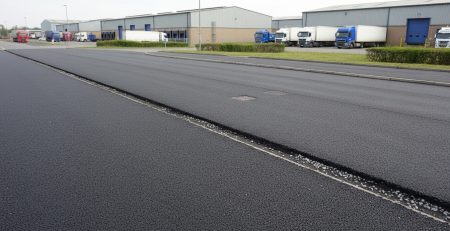
Why Loading Bays Need More Than Just Thicker Tarmac
Loading bays are among the hardest-working areas on any commercial or industrial site. Unlike an ordinary access road, where vehicles generally continue moving across the surface, a loading bay has to cope with heavy goods vehicles slowing, turning, reversing, standing and repeatedly applying concentrated loads in the same locations.
For this reason, simply specifying a thicker layer of tarmac does not necessarily create a durable loading area. The performance of loading bay surfacing depends on the complete construction beneath and around the visible surface, including the subgrade, sub-base, drainage, material selection, installation quality and expected vehicle movements.
For property owners, facilities managers and commercial site managers, understanding these factors can help prevent premature deformation, cracking, standing water and disruptive repairs.
Loading Bays Experience Different Loads to Ordinary Roads
The demands placed on a loading bay are significantly different from those experienced by many standard roads and car parks. An access road primarily carries vehicles travelling over the surface, distributing traffic across a relatively large area. A loading bay concentrates activity into a much smaller space.
Heavy vehicles frequently follow almost identical routes when approaching a loading point. Their wheels turn in the same areas, trailers are positioned in similar places and vehicles may remain stationary while loading or unloading takes place.
This creates repeated stress within particular sections of the pavement construction. Areas close to loading doors, turning points and manoeuvring zones can therefore deteriorate much faster than surrounding sections if the surface has not been designed for its actual use.
Professional commercial surfacing contractors should therefore consider how the site operates rather than treating a loading bay as simply another section of tarmac.
Why Thicker Tarmac Alone Does Not Solve the Problem
It is easy to assume that a loading bay carrying heavier vehicles simply requires more surfacing material. Thickness certainly forms part of pavement design, but increasing the depth of the upper layers cannot compensate for weaknesses elsewhere in the construction.
A road surface works as a complete system. Loads applied at the surface have to be transferred through the different pavement layers and ultimately into the ground beneath them. If one of those layers lacks sufficient strength or stability, adding more material at the top may only delay the appearance of the underlying problem.
For example, a loading bay constructed over poorly compacted ground can still settle under repeated HGV traffic even when the tarmac itself is relatively substantial. Similarly, inadequate drainage can allow water to weaken lower layers, eventually affecting the integrity of the surface above.
Effective loading bay surfacing UK projects therefore need to consider the pavement from the ground upwards.
The Foundation Carries the Load
One of the most important parts of a loading bay is also the part that cannot be seen once construction has been completed. The foundation provides the support required to carry repeated commercial vehicle movements.
Subgrade Conditions Matter
The subgrade is the natural or prepared ground beneath the pavement construction. Its condition has a direct influence on how the completed loading bay performs.
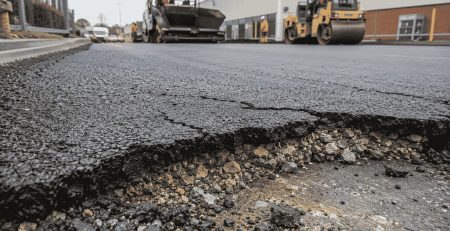
Ground that is soft, inconsistent or poorly prepared may move when subjected to repeated loads. Once movement occurs below the finished surface, cracking, depressions and deformation can begin to appear above it.
Site preparation therefore needs to reflect existing ground conditions and the intended use of the area. This is particularly important when an existing yard or lightly trafficked area is being converted into a loading bay. A construction that previously performed adequately for cars and vans may not be suitable for regular articulated lorries.
A Strong Sub-Base Is Essential
Above the subgrade, the sub-base helps distribute vehicle loads across a wider area. Correct material selection, appropriate depth and thorough compaction all contribute to its performance.
If the sub-base is inconsistent or insufficiently compacted, heavy vehicles can expose those weaknesses surprisingly quickly. Localised settlement may develop where wheels repeatedly pass or where trailers remain positioned for extended periods.
The visible tarmac surface cannot perform properly without dependable support beneath it. This is why professional tarmac installation and road surfacing should consider the entire pavement construction rather than concentrating solely on the final layer.
Turning HGVs Create Additional Surface Stress
Vehicle weight is only part of the challenge in loading bays. Vehicle movement also matters.
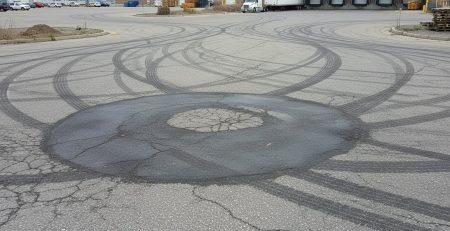
When an HGV travels in a relatively straight line, its tyres mainly apply vertical loads to the pavement. During tight turns and low-speed manoeuvres, additional forces are transferred horizontally through the surface.
These forces can be particularly severe where drivers regularly turn their steering wheels while the vehicle is moving very slowly or almost stationary. The tyres effectively scrub against the surface, creating stresses that ordinary straight-running traffic does not generate to the same extent.
Over time, unsuitable surfacing can begin to distort in these high-stress areas. Surface material may move, wheel paths can become visible and depressions can develop.
This is one reason why loading bay design should be based on anticipated vehicle movements rather than vehicle weight alone.
Drainage Is Part of the Structural Design
Water is a major consideration in almost every road surfacing project, but loading areas present additional challenges because relatively small surface depressions can interfere with everyday operations.
Standing water around a loading bay can affect pedestrian movements, create spray from passing vehicles and contribute to deterioration of the pavement. During colder conditions, retained water can also increase the effects of freeze-thaw cycles.
More importantly, water that penetrates through cracks or damaged areas can affect the layers beneath the finished surface. Once lower layers become weakened, repeated HGV loads can accelerate deterioration.
Effective drainage therefore needs to be incorporated into the overall design. Surface levels should direct water towards appropriate drainage points rather than allowing it to collect in wheel tracks or immediately outside loading doors.
Drainage channels and other features also need to be positioned and constructed with vehicle loading in mind. A drainage detail that performs well hydraulically but cannot tolerate repeated heavy wheel loads can become a maintenance problem itself.
Material Selection Needs to Match Site Use
Not every tarmac or asphalt specification performs identically. Different materials and layer combinations are used depending on the type of traffic, construction requirements and expected stresses.
For a loading bay, material selection should account for repeated heavy loading, slow-moving vehicles, turning movements and the operational characteristics of the site.
The objective is not simply to create the thickest possible surface. It is to develop a pavement construction in which the different layers work together effectively.
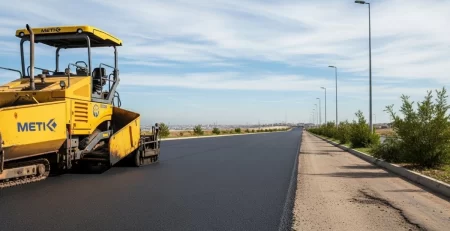
This is also where machine-laid tarmac can be particularly relevant on suitable commercial projects. Controlled laying and compaction help produce a consistent finished construction across larger areas, reducing variations that could otherwise become weak points under demanding traffic.
Compaction Has a Major Effect on Durability
Even a suitable material specification can underperform if it is not installed correctly. Compaction is a particularly important part of the surfacing process.
Correct compaction helps the material achieve the density required to resist traffic loading and water penetration. Poorly compacted sections can behave differently from the surrounding pavement and may deteriorate prematurely.
Loading bays make consistency particularly important because heavy vehicles repeatedly expose the same sections of pavement to substantial forces. A weak section that might survive for longer in a lightly trafficked car park can become apparent much sooner in an HGV manoeuvring area.
Experienced surfacing teams therefore need to control laying and compaction throughout the work rather than relying on the appearance of the finished surface as the only measure of quality.
Existing Loading Bays Need Proper Assessment Before Resurfacing
When an older loading bay begins to deteriorate, resurfacing the visible area may appear to be the simplest solution. In some circumstances that may be appropriate, but only when the underlying construction remains sound.
Cracks, depressions, rutting and recurring potholes can sometimes indicate deeper structural problems. Covering those defects without addressing their cause may result in the new surface developing similar problems.
The condition of the existing pavement should therefore be assessed before deciding on the repair approach. Localised pothole repairs can be suitable where deterioration is confined to particular areas, while widespread movement or structural weakness may require more extensive reconstruction.
This distinction is particularly important on operational commercial sites, where repeated repairs can create ongoing disruption for deliveries, staff and customers.
Loading Bay Layout Influences Surface Performance
Good surfacing design should also consider how vehicles actually use the space.
A theoretically strong loading bay can still experience concentrated wear if its layout forces HGVs into unusually tight manoeuvres. Repeated steering in one small area increases surface stress, while poorly positioned loading points can cause wheels to continually cross drainage channels, joints or pavement edges.
Where possible, vehicle routes, turning areas and loading positions should be considered alongside the pavement construction.
For existing sites, evidence of previous wear can provide useful information. Rutting, polished areas, deformation and recurring repairs often reveal where the greatest stresses occur. These locations may require particular attention during resurfacing or reconstruction.
Planned Maintenance Still Matters
Heavy-duty construction does not make a loading bay maintenance-free. Regular observation and timely repairs remain important.
Small cracks and localised defects can allow water into the pavement. If these issues are addressed early, it may be possible to prevent more substantial deterioration below the surface.
Site managers should pay particular attention to heavily trafficked wheel paths, turning areas, drainage points and locations where vehicles regularly stand. Changes in surface level can also be important because depressions may indicate movement beneath the visible layer.
A planned approach to maintenance is generally more practical for a busy commercial site than waiting until deterioration interferes with loading operations.
Loading Bay Surfacing Should Be Designed as a Complete System
The durability of a loading bay cannot be judged by tarmac thickness alone. A successful pavement depends on suitable ground preparation, a stable sub-base, appropriate materials, effective drainage, correct installation and an understanding of how commercial vehicles will use the area.
This whole-system approach is particularly important where HGVs repeatedly turn, reverse and stand in the same positions. These movements place concentrated stresses on the pavement and can quickly expose weaknesses that would remain unnoticed on a lightly trafficked surface.
For property owners and site managers planning loading bay works, the most useful starting point is therefore not simply asking how thick the tarmac should be. The more important question is whether the complete pavement construction is appropriate for the loads, movements, drainage conditions and operational demands of the site.
A properly considered commercial surfacing specification addresses those factors together. That provides a stronger basis for long-term performance and reduces the likelihood that a newly surfaced loading area will require avoidable repairs after being exposed to regular commercial traffic.