How to Build a Driveway on a Slope?
A sloped driveway can fail quickly if water, traction, sub-base strength, and vehicle movement are not planned correctly. The serious step is to handle Planning and Preparation, select the right surface, install Essential Drainage Solutions, and follow proper Construction Steps before the final finish is laid. The experienced solution is to build the slope as an engineered system, not a simple paved path, so the driveway stays safe, stable, and usable in wet UK weather.
Tip: A sloped driveway requires proper drainage, a stable foundation, and the right surface material for long-term performance. Get A Free Quote for expert advice.
How to Build a Driveway on a Slope?
A sloped driveway needs more planning than a flat driveway because water, vehicle weight, braking, and traction all work against the surface. This section explains the core build logic.
How to build a driveway on a slope? Start by measuring the gradient, checking access rules, planning drainage, choosing a grippy surface, stabilising the sub-base, and building the driveway in compacted layers.
A slope adds pressure to every part of the driveway. Water runs faster, loose gravel moves downhill, vehicles brake harder, and weak edges can erode after heavy rain.
A safe sloped driveway should include:
- Accurate slope measurement
- Strong sub-base preparation
- Drainage at the top and bottom
- Surface grip
- Edge restraint
- Smooth entrance geometry
- Correct material choice
- Planning or access checks
- Erosion control
- Long-term maintenance plan
A professional installer, such as Total Surfacing Solutions can assess whether resin-bound, asphalt, pavers, or another surface is suitable for the slope, drainage, and vehicle use.
| Slope Factor | Why It Matters |
| Gradient | Controls safety and material choice |
| Drainage | Prevents washout and flooding |
| Sub-base | Stops movement and sinking |
| Surface texture | Improves tyre grip |
| Edge restraint | Holds the driveway in place |
| Transitions | Prevents bumper scraping |
A sloped driveway should be designed around water and tyres first. The final appearance comes after those two are controlled.
Planning and Preparation: Measure First
Planning and preparation set the technical direction before excavation begins. This section covers slope grade, permits, property lines, soil condition, vehicle access, and material limits.
Planning and preparation begin with measuring the driveway gradient. A mild slope may only need good drainage and grip, while a steeper slope may need retaining edges, stronger base layers, and specialist surface design.
Many local authorities or private estates may control access, front-garden drainage, dropped kerb changes, and surfacing rules. If the driveway connects to a public pavement or road, permission checks should happen before work begins.
Before construction, check:
- Slope percentage
- Driveway width
- Vehicle type
- Turning space
- Surface material limits
- Public access rules
- Drainage direction
- Soil stability
- Boundary lines
- Retaining wall need
People planning access changes should read widen driveway permission UK before altering the entrance. A slope project can involve drainage, frontage, and highway considerations.
| Planning Check | Best Outcome |
| Measure gradient | Avoids unsafe design |
| Check soil | Reduces settlement risk |
| Review permissions | Prevents legal issues |
| Confirm drainage | Stops water damage |
| Check vehicle use | Supports correct depth |
| Mark boundaries | Avoids encroachment |
A driveway on a slope should never be planned by eye. Small level errors can create standing water, wheel spin, scraping, or erosion.
Essential Drainage Solutions: Stop Washout
Essential Drainage Solutions protect the driveway from water damage. This section explains trench drains, channel drains, crowns, cross-falls, French drains, and erosion control.
Essential Drainage Solutions are the most important part of a sloped driveway. Water running downhill can destroy the surface, wash out the base, and carry loose material into the road.
A sloped driveway should not send water straight toward the house, garage, pavement, or neighbouring property. It should direct rainwater into a safe drainage route, permeable area, soakaway, or channel system.
Common drainage options include:
- Channel drains
- Trench drains
- French drains
- Soakaways
- Permeable surfacing
- Crowned driveway profile
- Cross-fall to the side
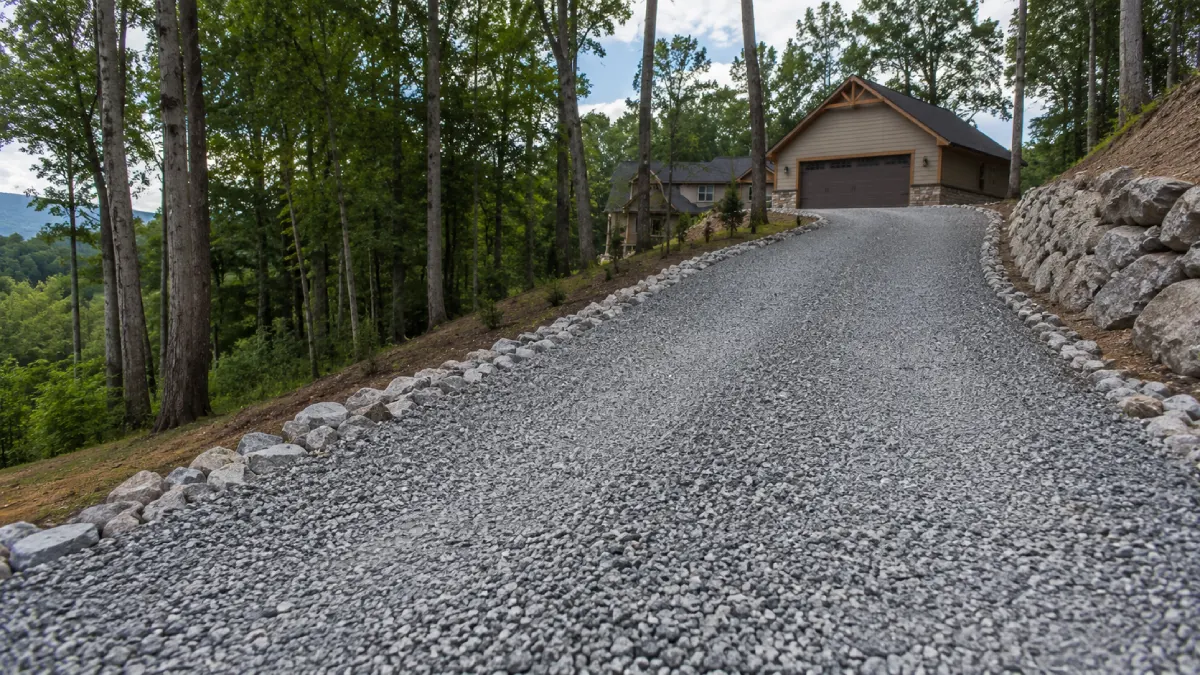
- Riprap stone edging
- Drainage channels near the garage
- Stable planted banks
A crown means the centre sits slightly higher, so water moves toward the sides. A cross-fall directs water across the driveway toward a drainage edge.
For water crossing issues, driveway culvert is useful. Some sloped driveways need culverts where a ditch or watercourse crosses the entrance.
| Drainage Feature | Best Use |
| Channel drain | Bottom of slope or garage entry |
| French drain | Side drainage on slopes |
| Permeable resin | Surface water control |
| Crown profile | Pushes water outward |
| Riprap stone | Stops edge erosion |
| Soakaway | Stores runoff underground |
Poor drainage usually causes sloped driveway failure before the surface wears out. Water must be controlled before any finish is installed.
Construction Steps: Build Strong
Construction Steps should follow a strict order to stop sliding, cracking, rutting, and base collapse. This section explains excavation, stabilisation, base layers, drainage, and finishing.
Construction Steps start with excavation. The ground should be cut to the correct levels, with enough depth for the sub-base, bedding layers, drainage components, and final surface.
The native soil must be compacted before new materials are installed. Weak soil should be removed or stabilised, especially where water has softened the slope.
A strong build sequence includes:
- Excavate to formation level
- Shape the slope and transitions
- Compact the subgrade
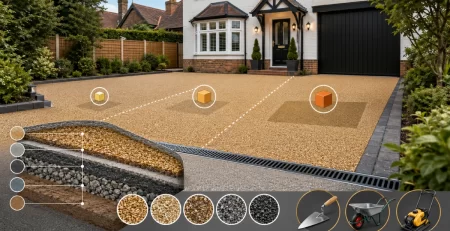
- Install geotextile membrane
- Lay angular crushed stone base
- Compact in thin layers
- Install drainage channels
- Add bedding or binder layer
- Install final surface
- Finish edges and transitions
Angular crushed stone is better than rounded stone because it locks together under compaction. Rounded material can move more easily on a slope.
For base material planning, driveway gravel size can help explain why aggregate shape and grading matter under vehicle pressure.
| Build Stage | Failure It Prevents |
| Excavation | Uneven levels |
| Compaction | Settlement |
| Geotextile | Soil mixing |
| Crushed stone base | Rutting and sliding |
| Drainage install | Washout |
| Edge restraint | Side movement |
A sloped driveway is only as good as the base below it. The surface is the visible part, but the strength sits underneath.
Surface Material Choice: Grip Matters
Surface Material Choice affects traction, maintenance, drainage, and lifespan. This section compares resin bound, asphalt, concrete, pavers, and gravel for sloped driveways.
Choosing the right surface matters more on a slope than on a flat driveway. Tyres need grip while braking, turning, and starting uphill.
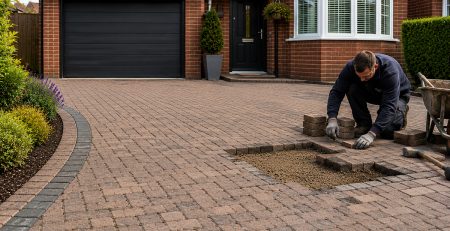
Concrete can work when textured properly, but it can crack if the base moves. Asphalt offers grip and flexibility, but it needs maintenance. Interlocking pavers look attractive but need strong edge restraints.
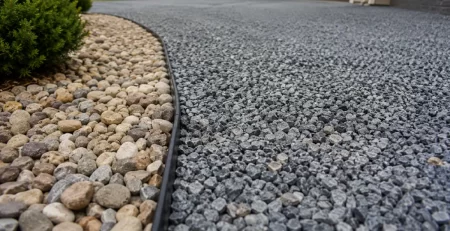
Gravel is usually the weakest choice for steeper slopes because it can wash downhill, rut, and scatter under tyres. Resin-bound surfacing can be suitable on some slopes when the base, texture, and drainage are correctly designed.
Surface comparison:
| Material | Slope Suitability | Main Watch Point |
| Resin bound | Good with correct base | Grip and drainage design |
| Asphalt | Good practical option | Resealing and heat wear |
| Textured concrete | Strong and durable | Cracking risk |
| Pavers | Attractive and grippy | Edge restraint |
| Gravel | Better on mild slopes | Washout risk |
For resin surface decisions, resin driveway pros cons can help homeowners compare appearance, drainage, maintenance, and long-term performance.
For winter grip, resin driveways slippery is also useful. Surface texture, drainage, algae control, and cleaning all affect safety on a slope.
The best surface is the one that balances grip, drainage, cost, maintenance, and local weather.
Slope Transitions: Avoid Scraping
Slope Transitions control how vehicles move onto and off the driveway. This section explains top crests, bottom sags, aprons, turning room, and retaining edges.
A sloped driveway can be technically strong but still frustrating if the transition angles are wrong. Vehicles may scrape at the top, bottom, or road entrance if the slope changes too sharply.
A gradual crest at the top and a smooth sag at the bottom help vehicles move without bumper scraping. This is especially important for low cars, long-wheelbase vans, and family vehicles with heavy loads.
Transition details include:
- Smooth top crest
- Gentle bottom sag
- Correct apron angle
- Stable kerb connection
- Safe road entry
- Turning space
- Side retaining edges
- Drainage at low points
- Clear visibility
- Strong surface grip
For entrance design, driveway apron meaning explains how the driveway connects to the road, pavement, or access edge.
For layout planning, the driveway width guide is also important. A sloped driveway needs enough width for turning without damaging edges.
| Transition Issue | Possible Result |
| Sharp top crest | Bumper scraping |
| Poor bottom sag | Water pooling |
| Narrow entrance | Edge damage |
| No retaining edge | Soil movement |
| Poor apron angle | Difficult access |
| Low-point drainage gap | Flooding |
A slope is not just a straight ramp. The top, bottom, and entrance geometry decide how comfortable it feels every day.
Area Coverage for Sloped Driveways
Sloped driveway construction depends on ground level, local drainage, surface choice, vehicle use, and council access rules. These area sections explain how Bedfordshire, Cambridgeshire, Essex, Hertfordshire, and Oxford homeowners should approach slope planning.
Resin Driveway Installation In Bedfordshire
For resin bound driveways in Bedfordshire, sloped driveway planning should start with base stability and drainage direction. Many homes need a driveway that handles daily vehicle use without rutting, slipping, or washing out in wet weather.
A resin-bound surface can work well when the slope is suitable and the sub-base is designed correctly. The driveway still needs grip texture, edge support, and a controlled water route.
Bedfordshire homeowners should avoid choosing surface colour before slope design. The correct build-up, drainage, and compaction will decide how long the driveway lasts.
Resin Driveway Installation In Cambridgeshire
For resin bound driveways in Cambridgeshire, drainage planning is critical because some frontages can hold water or move runoff slowly. Even a gentle slope can cause damage if the driveway sends water toward the house or pavement.
A sloped resin-bound driveway should be designed with a permeable build-up where suitable. Channel drains, side falls, or soakaway systems may also be needed, depending on ground conditions.
Cambridgeshire homeowners should check water movement before installation. A driveway that drains well in light rain may still need stronger protection during heavy downpours.
Resin Driveway Installation In Essex
For resin bound driveways in Essex, sloped driveway work often needs both practical grip and strong kerb appeal. A driveway that looks neat from the road still needs the right surface texture for wet conditions.
A resin-bound finish can create a clean frontage, but the slope should be tested for safe vehicle movement. If the incline is too steep, surface choice, drainage, and traction need expert review.
Homeowners considering long-term value can also review driveway increase home value. A safe, attractive, well-drained sloped driveway can support kerb appeal better than a cracked or slippery entrance.
Resin Bound Driveway Repair In Hertfordshire
For resin bound driveways in Hertfordshire, steeper sites may need more engineering. Retaining edges, drainage channels, textured surfaces, and gradual transitions can all become important.
If the slope is above a comfortable gradient, vehicles may struggle with grip or scrape at the entrance. Water can also run quickly down the surface and erode the edges.
Hertfordshire homeowners should treat the driveway as a controlled access route, not just a finished surface. The base, gradient, drainage, and edge restraint should be designed together.
Smooth Resin Driveways In Oxford
For resin bound driveways in Oxford, sloped driveway design may need careful attention to frontage character, older kerbs, pavement access, and local drainage requirements.
If the driveway connects to a public footway or road, approval may be needed for access changes. The surface should also manage rainwater within the property where required.
Oxford homeowners should check permissions before excavation begins. A resin-bound sloped driveway can look elegant, but rules, drainage, and slope safety must come first.
Final Sloped Driveway Checklist: Build Safely
A sloped driveway needs accurate levels, strong support, drainage, grip, and safe transitions. This checklist helps avoid the most common design and construction failures.
Before building a driveway on a slope, check:
- What is the slope percentage?
- Is the surface suitable for the gradient?
- Will vehicles scrape at the top or bottom?
- Where will rainwater drain?
- Is a channel drain needed?
- Is the sub-base deep enough?
- Will the edges be restrained?
- Is planning permission needed?
- Will the driveway stay grippy in winter?
- Can the surface be maintained easily?
A contractor such as Total Surfacing Solutions can inspect the site, check driveway gradient, and recommend a suitable surface and drainage structure.
| Checklist Item | Safer Result |
| Slope measured | Correct design |
| Drainage planned | Less washout |
| Base compacted | Less settlement |
| Surface textured | Better grip |
| Transitions shaped | Less scraping |
| Edges restrained | Less movement |
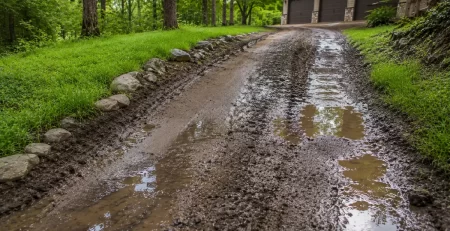
For unstable or water-damaged entrances, driveway erosion fix and muddy driveway fix can help before final surfacing begins.
A sloped driveway should be built for rain, tyres, gravity, and long-term movement. When those are controlled, the finish has a far better chance of lasting.
Frequently Asked Questions
1. What is the best surface for a sloped driveway?
Resin bound, asphalt, textured concrete, and interlocking pavers can all work depending on slope, drainage, base strength, and grip. Gravel is usually less suitable for steeper slopes because it can wash down.
2. How steep can a driveway be?
Many driveway designs become more difficult above moderate gradients, and local rules may set limits. Steeper slopes need expert review for traction, drainage, visibility, and safe entry.
3. How do you stop water from running down a sloped driveway?
Use channel drains, French drains, cross-falls, crowns, permeable surfacing, soakaways, and stable edge protection. The aim is to move water safely away before it erodes the driveway.
4. Can resin-bound be used on a sloped driveway?
Yes, resin-bound may be suitable on some slopes when the base, texture, edge restraint, and drainage are properly designed. Very steep or poorly drained slopes need professional assessment first.
5. Do I need planning permission for a sloped driveway?
You may need permission if the work affects drainage, front-garden surfacing, dropped kerbs, public access, or impermeable runoff. Permeable surfacing or draining water within the property can reduce planning risk.